Behind Every Map, There is a Person
31 Août 2015
Magazine C&
2 min de lecture
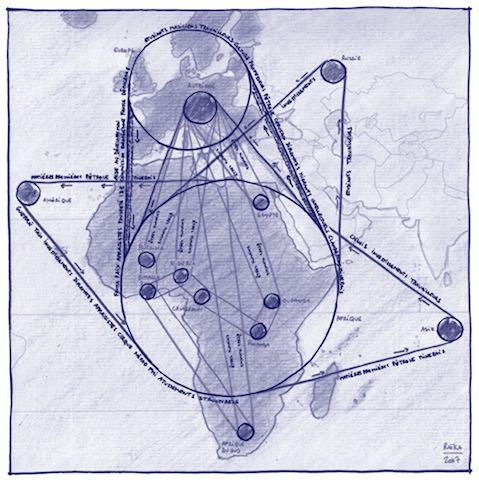
These maps by Philippe Rekacewicz show how the phenomenon of migration relates to the issue of political borders. They are not “finalized” maps, but rather rough drafts whose the provisional character attests to the nature of the border itself: ambivalent and paradoxical (it divides as much as it unites). Borders are difficult to map out: first …
These maps by Philippe Rekacewicz show how the phenomenon of migration relates to the issue of political borders. They are not "finalized" maps, but rather rough drafts whose the provisional character attests to the nature of the border itself: ambivalent and paradoxical (it divides as much as it unites). Borders are difficult to map out: first the maps respond to the question of "where" and then they permit us to understand "what", to understand how human communities organize and produce their territory to the detriment of their neighbors.
Behind every map, there is an intention. A map is born of an idea; it is an intellectual construction before being formalized into the sketched draft, the sign of that first cartographic intent. Once they are printed, the political maps of the world “ those depicting the complex networks of lines that symbolize borders - create the illusion of a world that is perfectly carved up into units of life, into regions and countries. They have an air of harmony about them, and they give the borders a sense of permanence. However, borders are inscribed into the landscape in a myriad of ways: they can tower up as thick, insurmountable barriers, or they can be practically nonexistent. Between these extremes, there is an infinite number of variations. And these virtual lines shift in time and space whenever history unsettles the world.
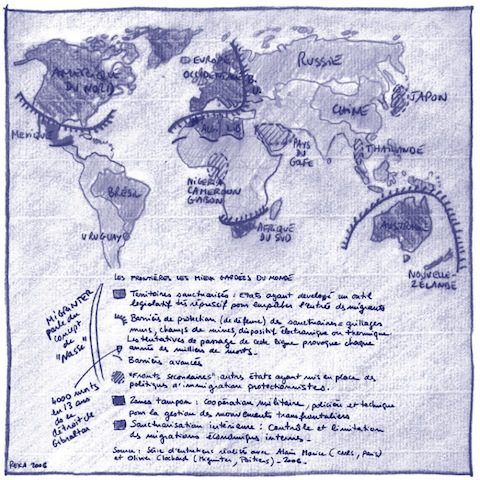
This collection of maps were produced for the exhibition "WAYPOINTS LIKE SHARON S STONE", Kunsthalle Exnergasse, 2007, and first appeared in print inChimurenga, Vol. 14, “Everyone Has Their Indian.”
A Cohort of Artists Reconfiguring AI’s Memories
Situating AI: Conversations on African Ecosystems
The Artist Residency Centre (ARC) in Botswana
Seed Archives: Thabo Weaves a Cocoon for Listening
Naafia Naahemaa: What Appears Solid Is Already In Motion