Zainab Aliyu: A litany for past suns
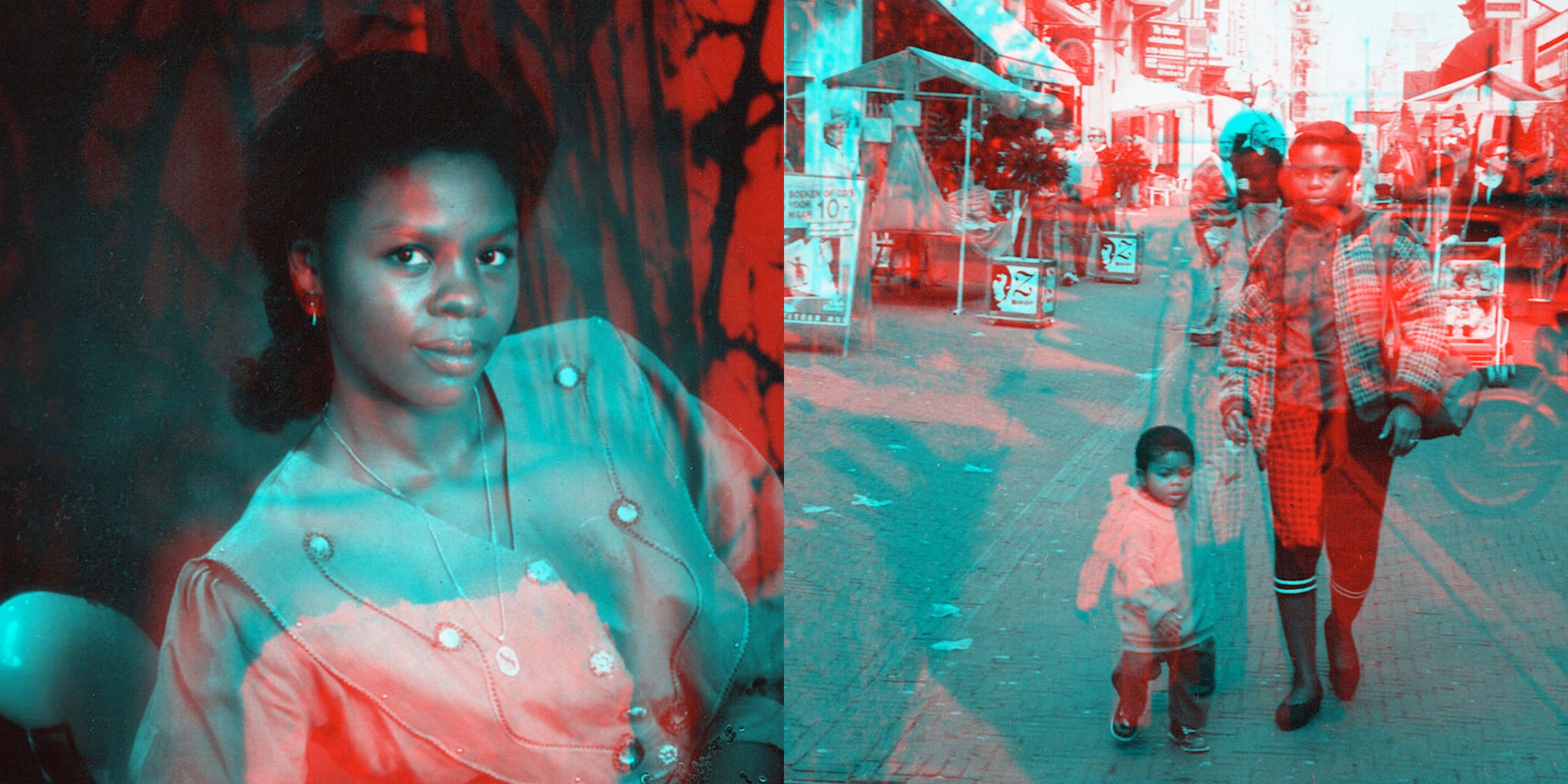
Courtesy of Zainab Aliyu, A litany for past suns (2026)
19 February 2026
Closes: 2 April 2026
BAXTER ST at the Camera Club of New York announces A litany for past suns, a solo exhibition of works by 2025 BAXTER ST Resident, Zainab Aliyu. On view from February 4 to April 2, 2026, this presentation of refigured stereograph images examines the power dynamics inherent to prevailing archival practices, highlighting the role of technology in the silencing and misreading of lived experience, particularly within Black communal histories.
Aliyu’s works juxtapose photographs from her familial archive with those from her broader community to create a selection of stereographic pairings, which will be presented alongside printed matter, installation, text and sculpture. Historically tied to early photographic documentation and colonial ways of seeing, stereoscopy is reworked here as a relational form that links images across place, time and lineage rather than isolating them as data. Works attend to empathic gaps in collective memory across generational experiences marked by migration and forced displacement, and trace how systems that organize knowledge are informed by colonial practices designed to classify and control. The stereographic images require viewers to lean in and look closely, asking for a scale of intimate attention that counters distant and extractive gazes.
This intimacy extends throughout the exhibition, where material forms and spatial gestures reference the quiet interiors of family life shaped by what is remembered, what is lost and what is no longer spoken. Within the installation, domestic objects and architectural cues such as a rug, curtain rod, cupboard, gate fragments, and jewelry appear in subtle dislocation, their familiar functions undone. Checkered floor patterns suggest rooms that recall the tiled surfaces of kitchens and bathrooms, as well as staged West African studio interiors. Fragmented gates bearing Adinkra symbols, alongside a Yorùbá-inspired paired staff form, frame access as something that is negotiated. Earth-toned materials mirror the red and blue logic of the anaglyph images, extending stereoscopy into the gallery and asking viewers to navigate memory by looking through, around, and between objects.
Aliyu worked with two bodies of images in parallel: hundreds of photographs scanned from her late grandmother’s home in Nigeria, and images shared by others through an open invitation. Seeking resonances across these archives, she initially experimented with code to organize and caption the images, only to find that these computational processes failed to register their emotional and historical stakes. Machine-generated captions flattened context and misread lived realities, exposing biases embedded in even the most purportedly neutral systems and reproducing long-standing erasures in the visual record of Black life. These failures are incorporated directly into Aliyu’s stereographs as traces of systems that sort without seeing, underscoring the fiction of technological objectivity and pointing to the colonial frameworks such systems inherit. Rejecting the authority of computational interpretation, Aliyu turned instead to a slower, embodied method: printing each photograph, laying them side by side on the studio floor, and forming each pair by hand. Accompanying the images are speculative captions written from memory and oral history, arranged alongside, and at times redacting, machine-generated captions. These texts interfere with one another, not to correct the record, but to stage a conflict between ways of knowing. This layered approach affirms that the porous nature of memory exceeds what archives and algorithms can contain.
Positioned within a lineage of Black feminist archival critique, A litany for past suns draws on the theoretical frameworks of scholars such as Safiya Noble, Tina Campt, and Saidiya Hartman, who articulate the tensions between machine logic and ancestral memory. The project’s full title, A litany for past suns labeled rituals / A star lit any and all possible futures, is a bilateral anagram that mirrors the exhibition’s conceptual structure. Inspired by Nikki Giovanni’s “A Litany for Peppe” (1970) and Audre Lorde’s “A Litany for Survival” (1978), Aliyu positions her litany as both remembrance and call to action; it is an invitation for viewers to transform shared histories into shared futures.
View more from
Ana Mendieta
Jul 15, 2026–Jan 17, 2027
Beyond Representation
Dec 7, 2023–Dec 31, 2026
C& América Latina curates film program for Cinelogue featuring Films by Afro-Indigenous Directors
Jul 1–Dec 31, 2026
Dignidade e luta: Laudelina de Campos Mello
May 16–Nov 22, 2026
M’barek Bouhchichi: Les mains des poètes
Apr 24–Oct 17, 2026
Belkis Ayón: Mito y desobediencia
Jul 16–Oct 12, 2026