Jonathas de Andrade: A Transition between the Erudite and the Popular
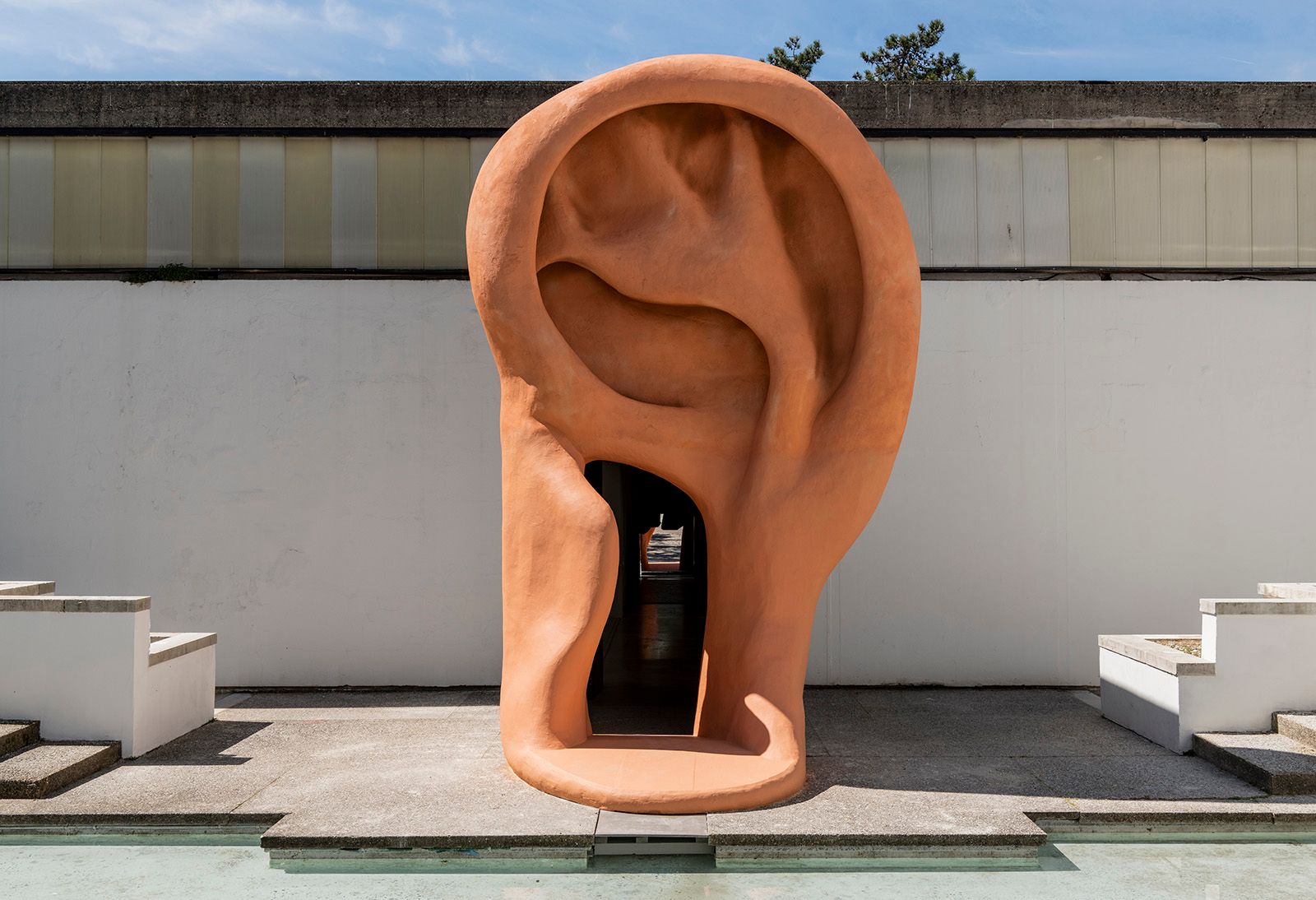
Exhibition view of With the heart coming out of the mouth at the 2022 Brazilian Pavilion. Courtesy Ding Musa / Fundação Bienal de São Paulo
Invited by curator, Jacopo Crivelli Visconti, artist Jonathas de Andrade, from Alagoas, is Brazil’s official representative at the 59th International Art Exhibition – The Venice Biennale. His work Com o coração saindo pela boca (With Your Heart in Your Throat) approaches popular manifestations as absolute sources of cultural strength and reinvention.
C&AL: Brazil has gone through several political and social transformations over the past few years, including the extreme right’s rise to power and the pandemic, which have affected the country significantly. What was your point of departure for thinking about a way to represent Brazil at the Venice Biennale?
Jonathas de Andrade: The title of the project, Com o coração saindo pela boca (With Your Heart in Your Throat), takes as a point of departure a group of popular expressions that are metaphors for the body. Expressions like “a lump in the throat”, “under the nose”, “to turn the stomach”, “sharp tongue”, “carne de pescoço” (a real piece of work, literally neck meat), “sangue de barata” (to be meek and mild, literally to have cockroach blood), “vergonha na cara” (to be ashamed, literally shame on the face), “língua nos dentes” (to spill the beans, literally tongue in one’s teeth), “sangue no olho” (fire in one’s belly, literally blood in the eye), although their figurative meanings, reveal, somehow, the hyperbole of the absurd in the present. If taken literally, each of those expressions are exaggerated or have no meaning. I find it intriguing that the body is so present in popular language and that, its parts, to my surprise, maintain an intense relationship with the political dimension we are living in Brazil today. I think that starting with this group of phrases is to embark on an attempt to explain what is untranslatable in what the Brazilian body is feeling.
C&AL: In your work for the Biennale, Com o coração saindo pela boca (With Your Heart in Your Throat), you opt for bringing up feelings, behaviors and ways of being in the world, to somehow speak about the failure of utopias and ideas. What would those utopias and ideas be, and why that choice?
JA: I am not so clear on how the project can respond to failed utopias. For me, it expresses something about a kind of astonishment toward the present and how that feeling directly impacts the body in an attempt to anesthetize it. I think that new answers and ways out come from the strength of one’s own body, in that it is capable of reinventing, recreating and therefore of responding to a directly political dimension. I think it is very revealing to notice how much language relies on the body to cope with feeling and subjectivity. I think that the works call for a poetic delirium, to speak of the absurd, but also of the symbolic power to pave the way to reinvention of the present in a future with creative libido. Facing a present so loaded and somber, I like to believe that it is possible to call for a renewal of desires to smooth the way for new utopias and inspiration.
C&AL: In your work, you work with Brazilian popular expressions. The popular and the erudite, few exceptions aside, never dialogue well in Brazil. How do you want to articulate those two points in Venice?
JA: I believe there is erudition in popular culture, for instance in manifestations of folklore, in popular dances, in the persistence of carnival marches or of rhythms like frevo, in the allegories of the gigantic dolls in Olinda or in the samba parades in Rio de Janeiro. For me, there is something profoundly erudite in all of that that endures and goes beyond temporalities. For me, it is very natural to think of that transition between the erudite and the popular in contemporary art and, really, the distinction between a popular artist and a contemporary artist always seemed a bit strange to me, for instance, especially if the latter attributed a certain erudition in spite of the other. I feel I am drinking from the source of the popular and much more subjected to its cultural strength to comment on what interests me about the present, the past and the future, and I think that in the pavilion it will be no different.
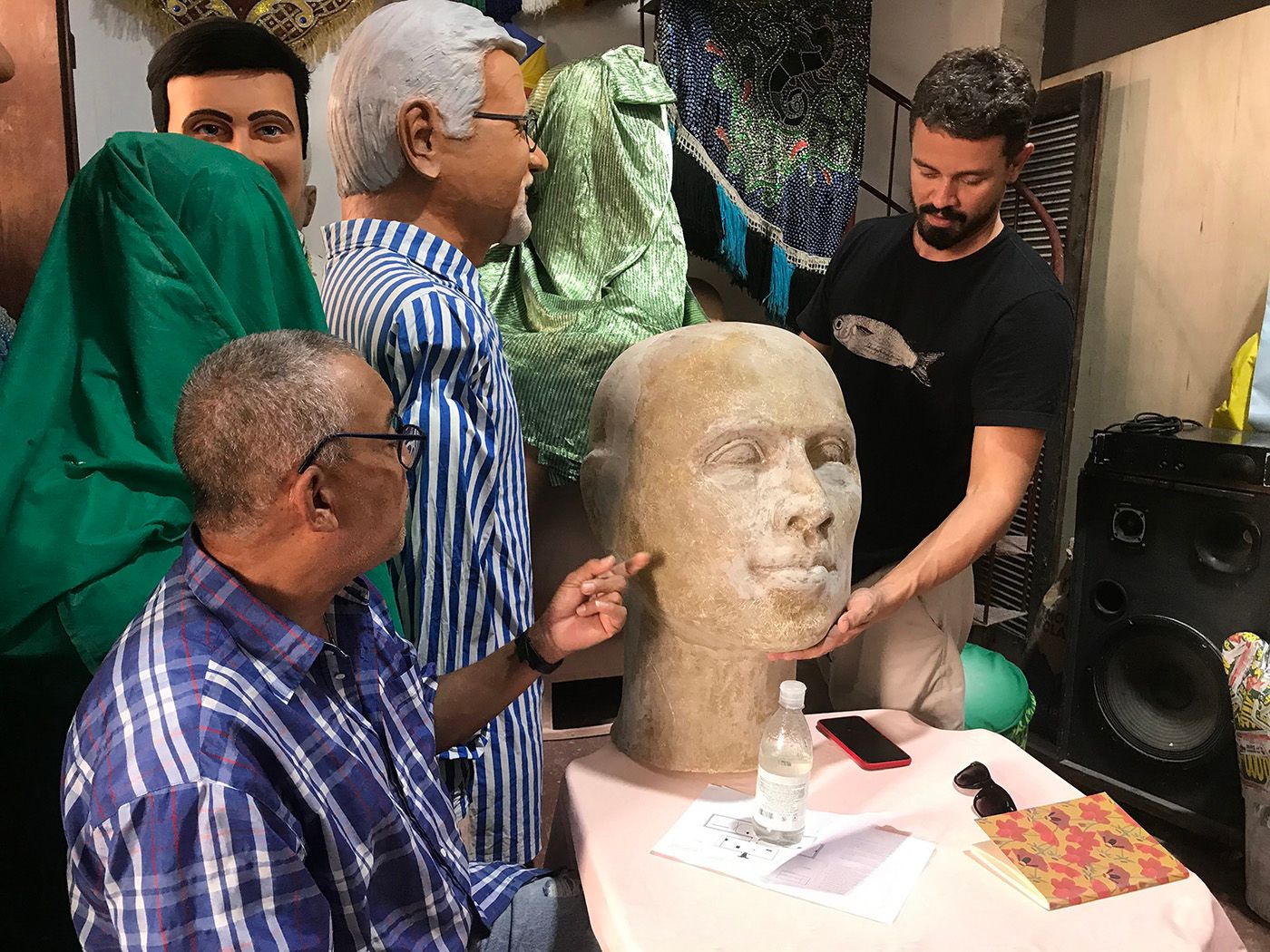
Development process of With Your Heart in Your Throat – the artist working with the sculptor Silvio Botelho in Olinda, Pernambuco, Brazil, 2022.
C&AL: The popular is also present in your earlier work, like in Cartazes para o Museu do Homem do Nordeste (Posters for the Museum of Man of the Northeast). How does your Biennale work dialogue with your previous interests and research?
JA: I think I bring together several of my interests in this project. I see the fascination for language and for the word, looking to popular manifestations as absolute sources of cultural strength and reinvention, the idea of collection and indexing as the backbone for a system of images, the desire to navigate with ambiguity through what is intense in existence and visual metaphors. I like to develop a theme through sets of images, and in this project, I continue that with a photography installation and a video experiment, but also, I ventured a little further in the way of sculpture, which is an area I’ve always been curious about.
C&AL: The body, between the physical force of work and the erotic, or as an identity marker, is also an element that is present in other work of yours. What is the role of the body in Com o coração saindo pela boca?
JA: The body in this work navigates a little through all those areas, but this time, the body gains an allegorical dimension for Brazil. Through language, we can get close to the universal disorder of existence in other cultures, passing through the creative and disconcerting force of the erotic, passing through the contradictions of nature and of ecology, through the prisms of multiple identities, and through the afflictive beauty of existence.
C&AL: For the work you created photographs, sculptures and a video. Why did you choose those media?
JA: With Your Heart in Your Throat is like a feeling of gravity which is both a peak of emotion and an almost vertigo. It always seemed exciting to me to try to handle this conceptual kick in many forms. Sculptures take up space and relate to the modernist building, which is the pavilion. The collection of expressions occupies a constant during the exhibition, as happens in my previous projects, like Ressaca Tropical (Tropical Hangover). I like to think of photographs as a set of images which, as a whole, make up a kind of sensorial complexity. And video brings sound and narrative power, the power of the image in movement, and mythical beauty, Latin American magical realism, and the capacity to add sound to the whole space. Sculptures can have a kinetic and sensorial dimension, which invites the public to behave physically in the space that is there before them. I like to think of art as a medium that I can use to inspire feelings and involve the public in games of meaning that talk about the present and to invite collaboration of those who arrive to complete the meaning of what I try to bring.
Jonathas de Andrade is an artist from Alagoas who works with social issues through installations, video and photography.
Camila Gonzatto is one of the editors of the magazine C& América Latina.
Translation: Sara Hanaburgh
Representing the Desires of the Community in the Work of Jeff Cán Xicay
Confronting the Absence of Latin America in Conversations on African Diasporic Art
I Am Monumental: The Power of African Roots
Jesús Hilário-Reyes: Dissolving Notions of Group and Individual
Biophillick: Connecting Ancestries Through Technology