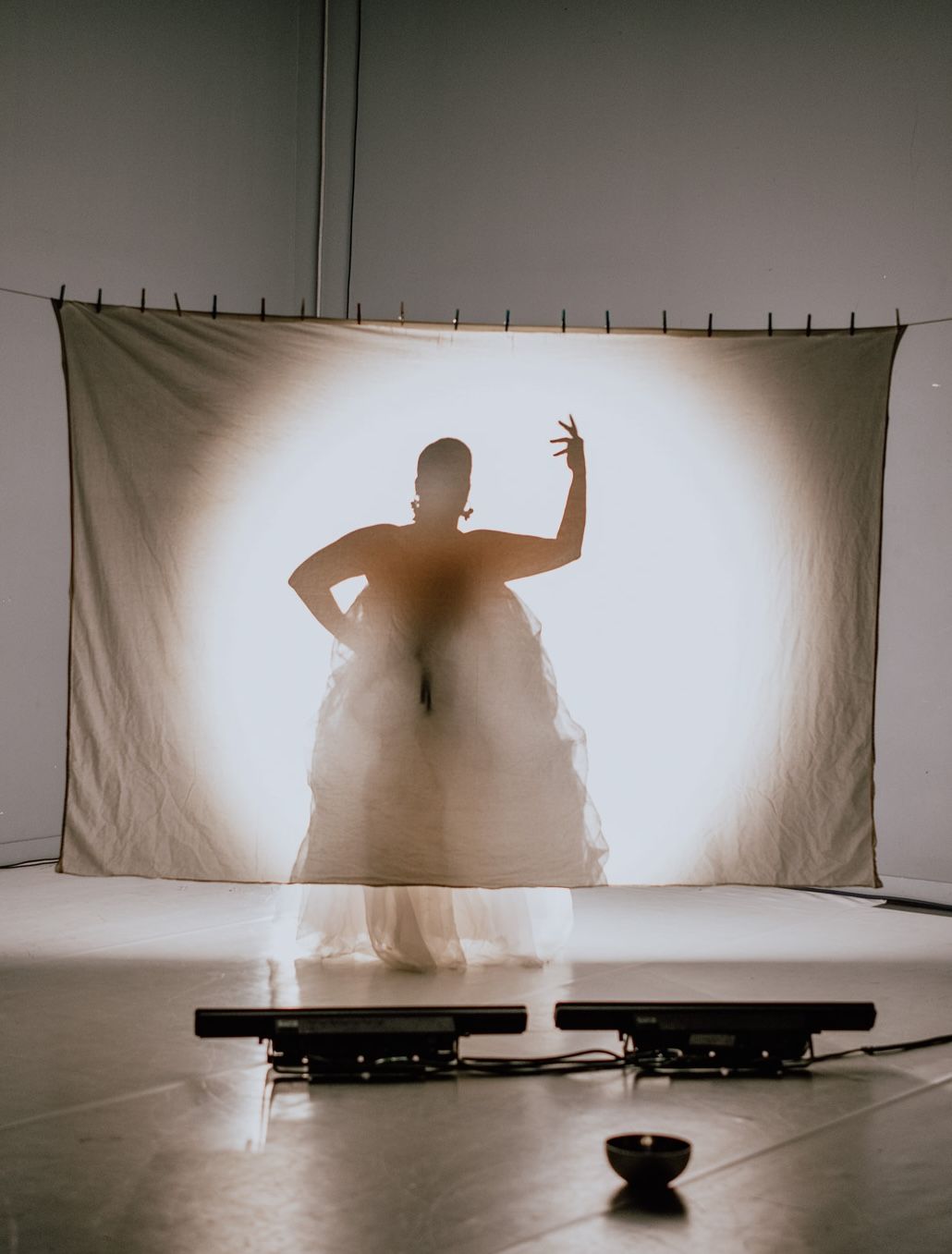
When We Gather: On the Not-Yet-Become in Lagos
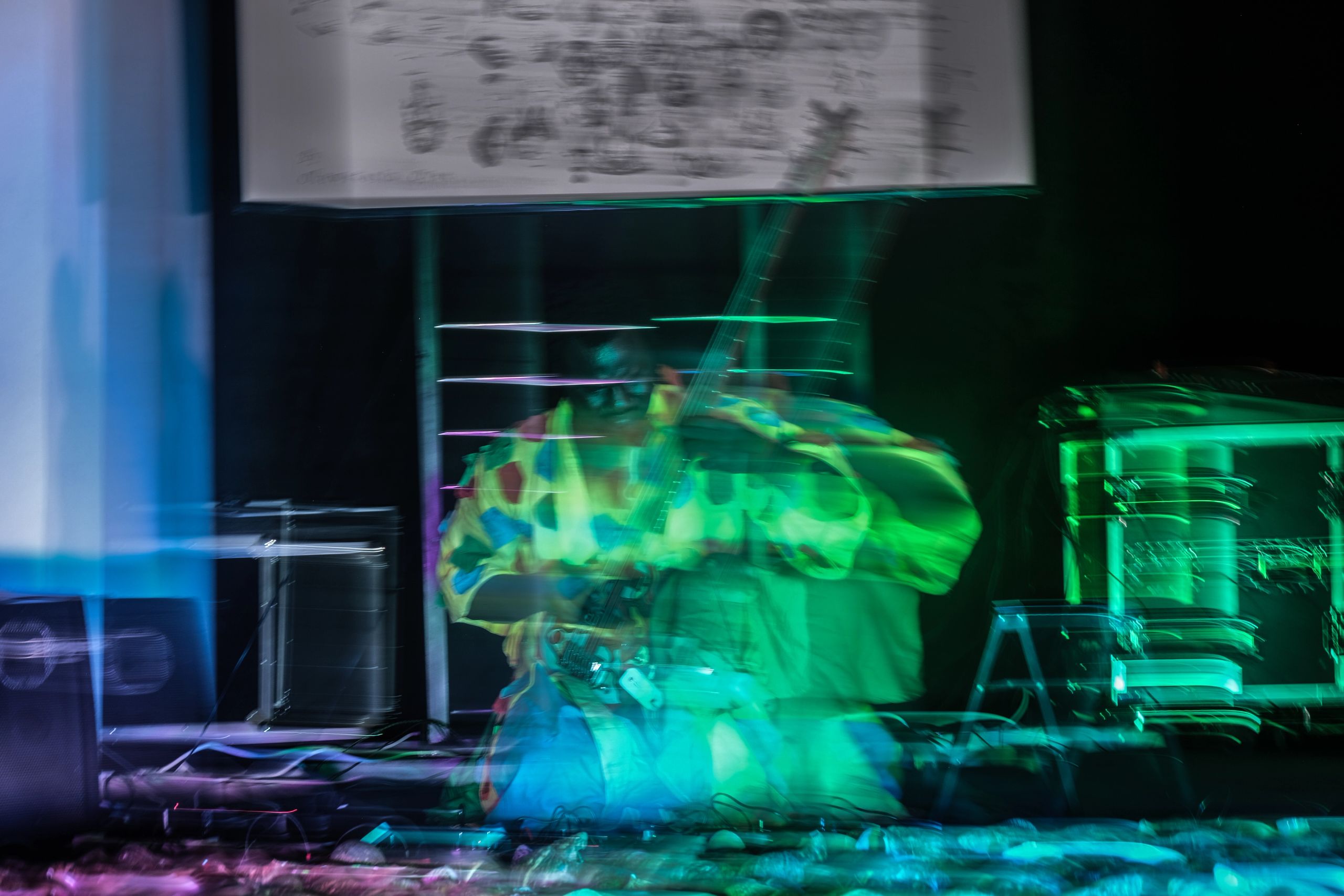
Performance by the Lagos Sound Art Collective (LSAC), J. Randle Centre, 2025. Credit: Damilola Bankole
Found in small gestures — the smell of a plant passed between hands, an ice-breaker that turns strangers into community, a performer buckling under the weight of shells — writer Robert Steinberger explores the concept of the ‘not-yet-become.’ Moving through a workshop, a gathering, and sound performances, Steinberger points to how Lagos cultural producers use cyclical time, ancestral knowledge, and liminal space to rehearse futures that are not yet named. This text is part of the C& and Pro Helvetia Fieldnotes Arts Writing Exchange 2025–2026.
Sensing the Not-Yet-Become
Reality is unfinished and processual, according to philosopher Ernst Bloch’s concept of the “not-yet-become,” developed in his work The Principle of Hope (1954–59). I traveled to Lagos hoping to identify cultural spaces and practices in which such latencies could be sensed or surfaced. During a 10-day residency, I found them in different forms of gathering. Exploring the liminal seemed crucial to many culture custodians I encountered, as did an understanding of time as cyclical — putting past, present and future in constant conversation.
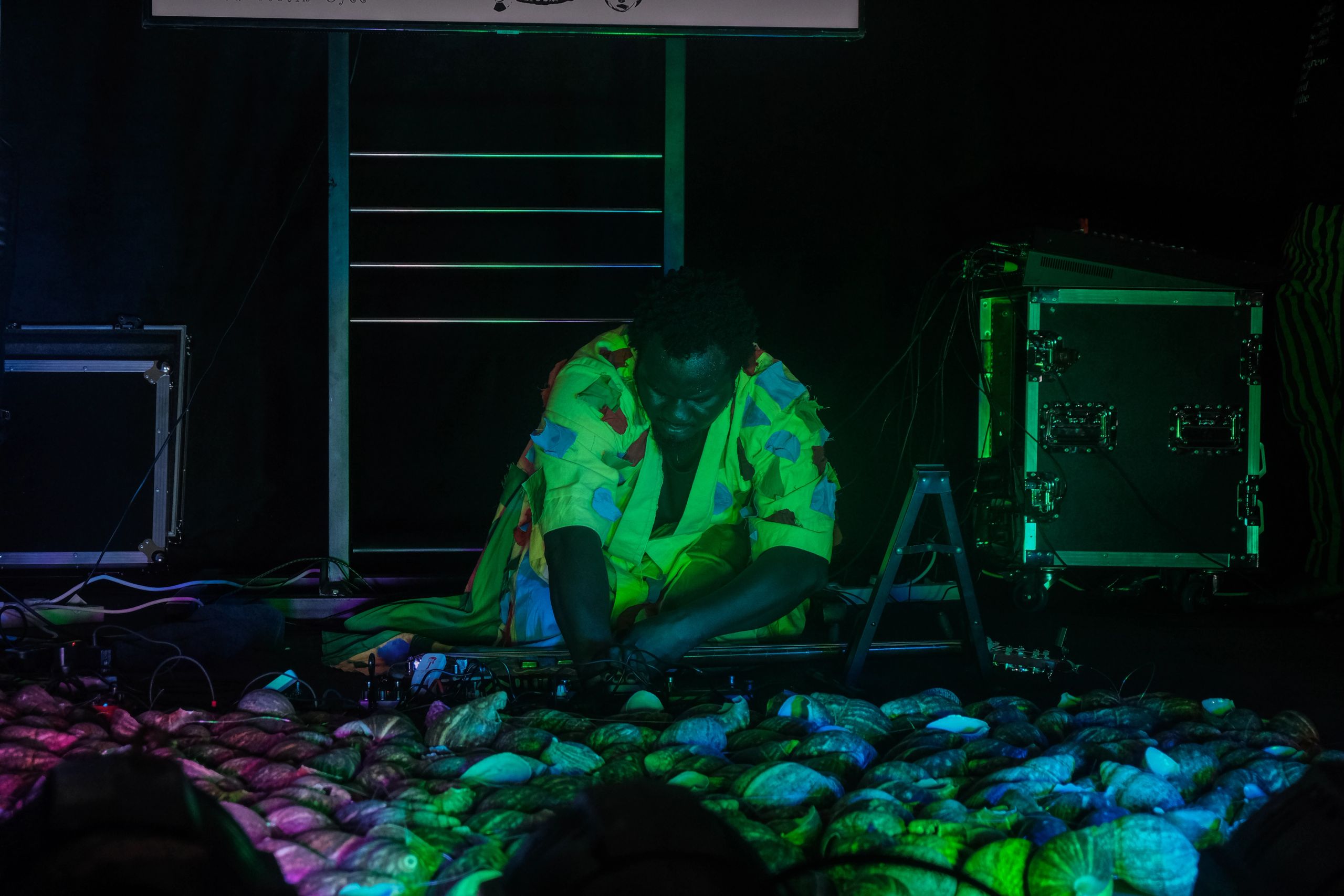
Performance by the Lagos Sound Art Collective (LSAC), J. Randle Centre, 2025. Credit: Damilola Bankole
Rehearsing the Future
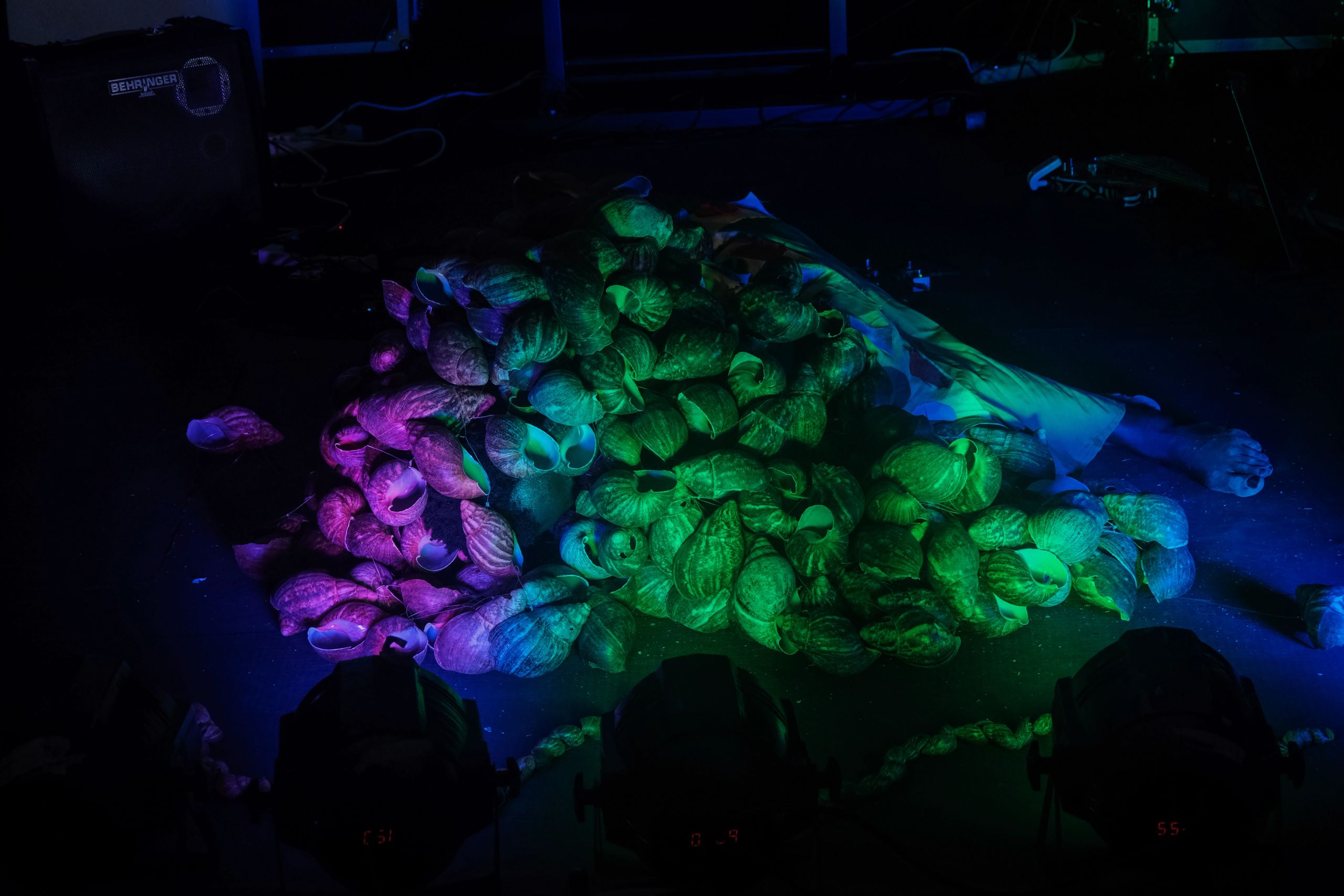
A huge pile of shells strung together by thin nylon thread lay in the middle of the room, lit only by green, pink, and blue spotlights. An assemblage of sound performances by the Lagos Sound Artists Collective (LSAC) activates the room at J. Randle Center for Yorùbá Culture and Heritage. Behind me a drum solo intertwined with voice and video, and in the distance a dance piece involving bells rung with the dancer's feet. The shells are saved for the finale. Sound artist Oluwatosin Oyee starts with a reverb machine to sample and multiply his voice and guitar sounds. Against this distorted soundscape, he moves forward and puts one string of shells after another around his neck. I feel the weight of the shells. A sense of discomfort. Immobility. At the same time their fragility becomes apparent. Will they break if they collide? They begin to chime against each other, becoming instrument, costume, prop — and an obstacle the performer has set himself. It is a difficulty he struggles through, while holding our attention.
According to Nigerian choreographer Qudus Onikeku, performance can be a technology to mediate and restore harmony between the three areas of existence in Yoruba culture: the ancestors, the living, and the unborn. Onikeku founded and runs the QDance Center where several members of LSAC were trained. In conversation, Onikeku highlights how cycles of birth, death, and rebirth are integral to his artistic, curatorial, and community work. In order to talk about inventiveness, we also need to talk about death. This infinite process of dying and rebirth, and the liminal space of becoming in-between, is where he says we rehearse the future — the not-yet-become. It's not about the outcome but the process: “The gathering itself is the goal,” he says.
In order to talk about inventiveness, we also need to talk about death. This infinite process of dying and rebirth, and the liminal space of becoming in-between
The Ancestral Memory Box
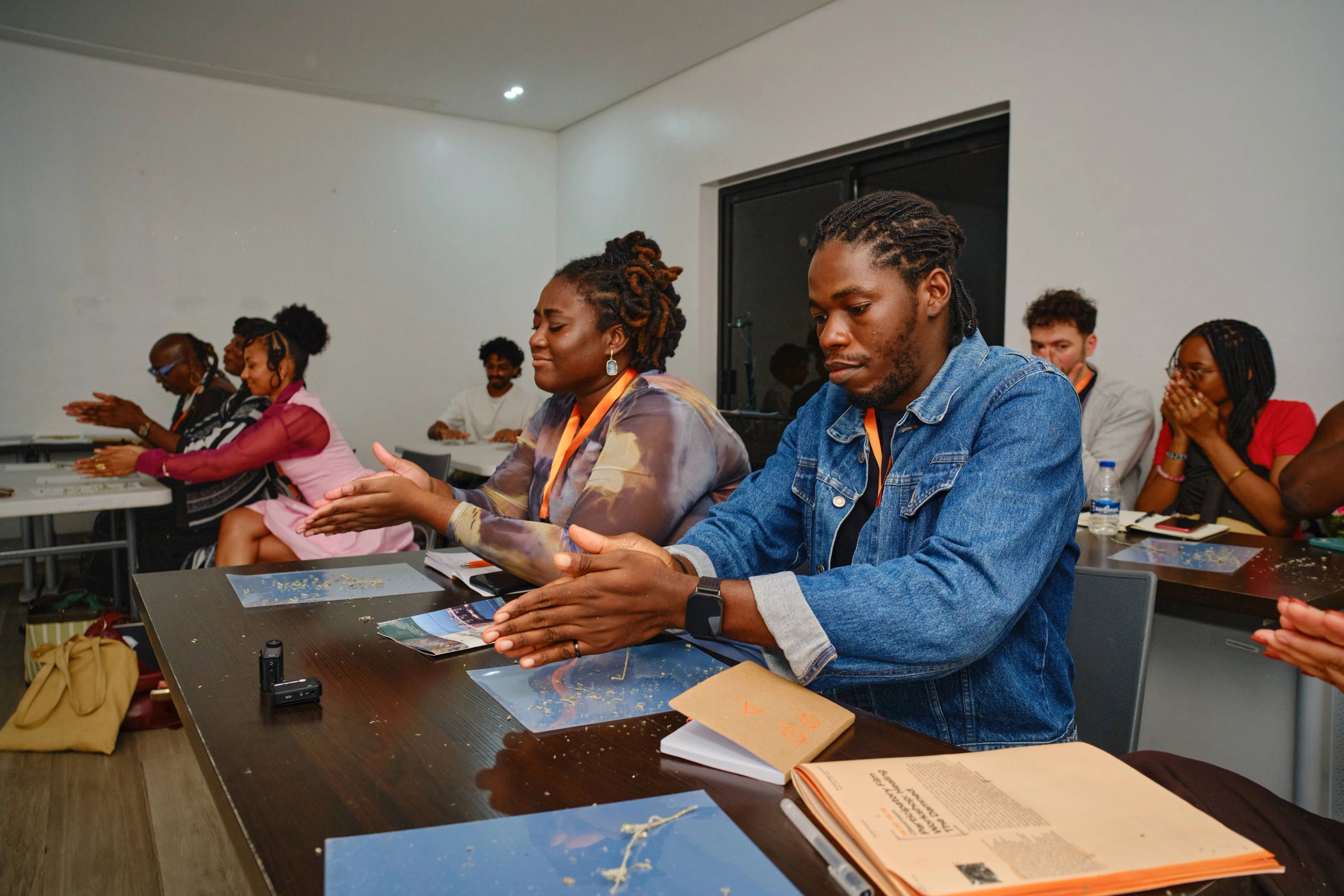
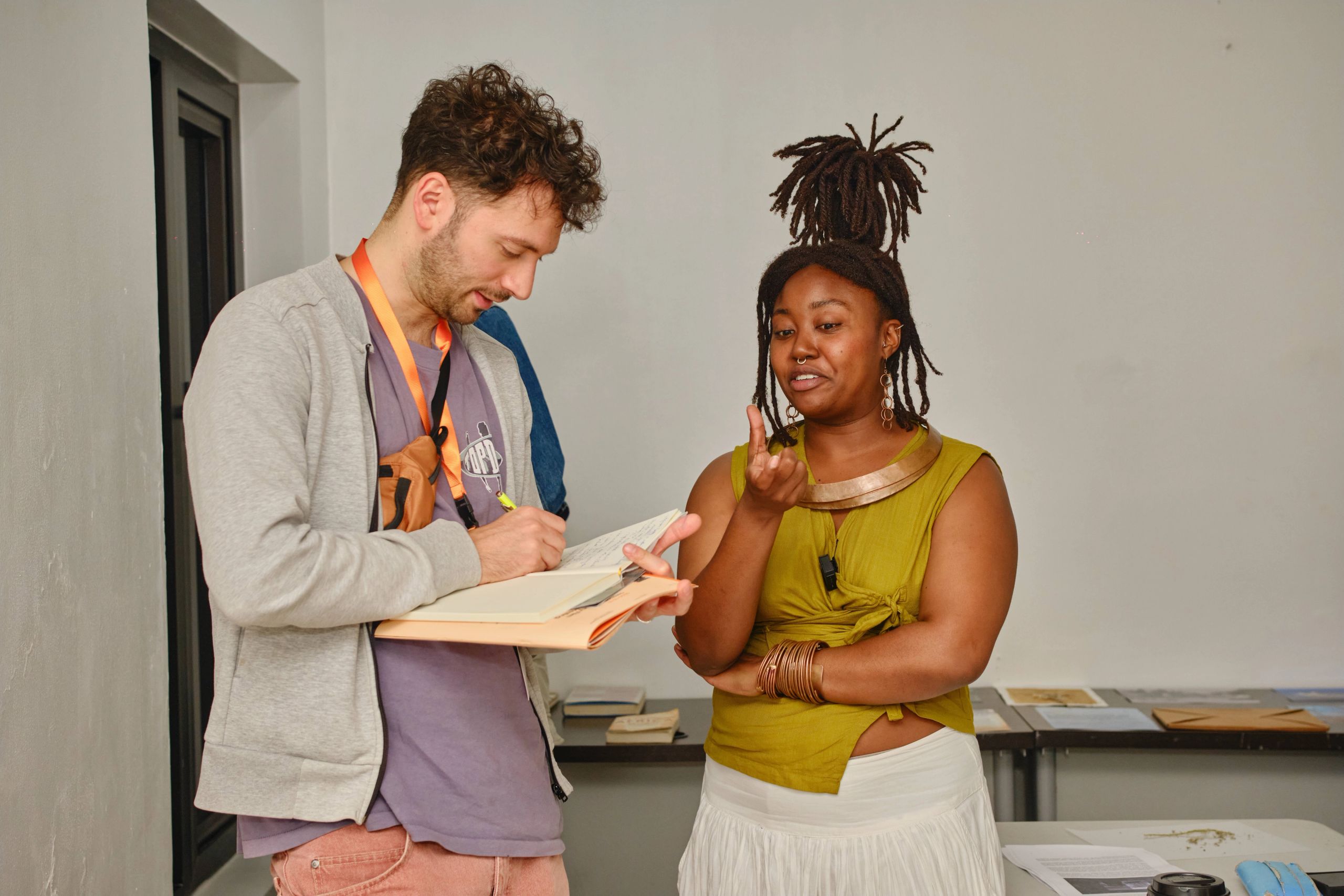
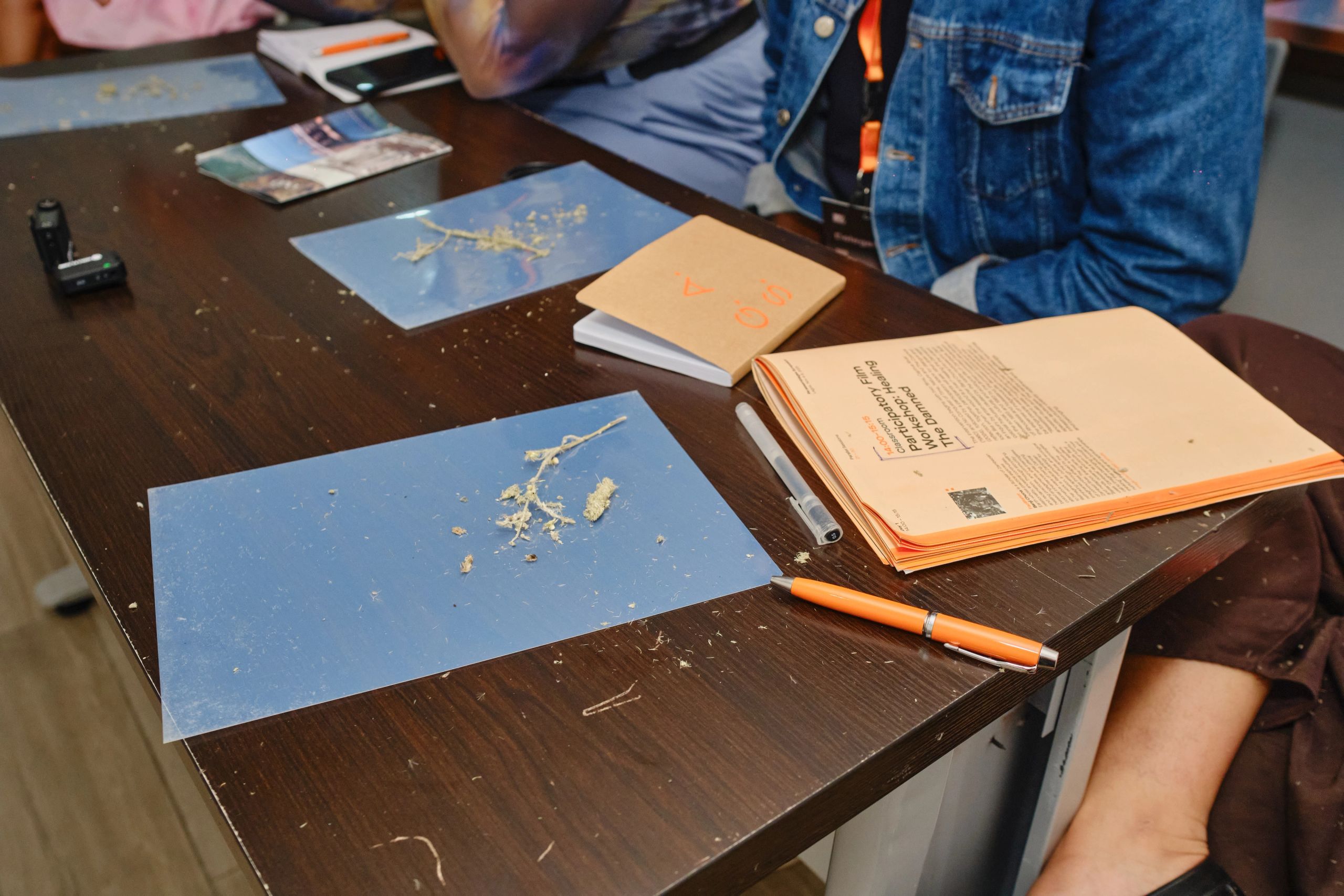
We’re sitting in a little classroom-like space. No windows. The lights are turned off. The projector is humming. On each of our tables lies a zine and a plant. At the start of the workshop, part of Guest Artists Space (G.A.S.) Foundation and Yinka Shonibare Foundation's Re:assemblages Symposium, Zambezian artist Banji Chona asks us to engage with a plant called musampizya in ciTonga (or Lagerra decurrens in Latin), known for its cleansing qualities in baTonga culture. As we rub it in our hands and smell it, I sense a shift in me. A long day of input interrupted by the small gesture of stopping and sensing.
Chona foregrounds the Indigenous name of the plant to reconnect with baTonga spiritual knowledge. She describes how a lot of ancestral knowledge embedded in the ciTonga language is ecological, such as names for plants and waters. The artist first encountered musampizya in text form in a ciTonga dictionary inherited from her grandfather. The description moved her, though she didn’t understand why in the moment. About a year later, when she lived and worked in Simonga, she felt drawn towards a plant during a foraging walk. When her colleague Chuma Haamatimba identified it, Chona immediately connected to the visceral, intuitive interest she had felt when reading about it in the dictionary. For Chona, the plant and the knowledge surrounding it may be a key to what she calls the “ancestral memory box” — and with it, a site of the not-yet-become.
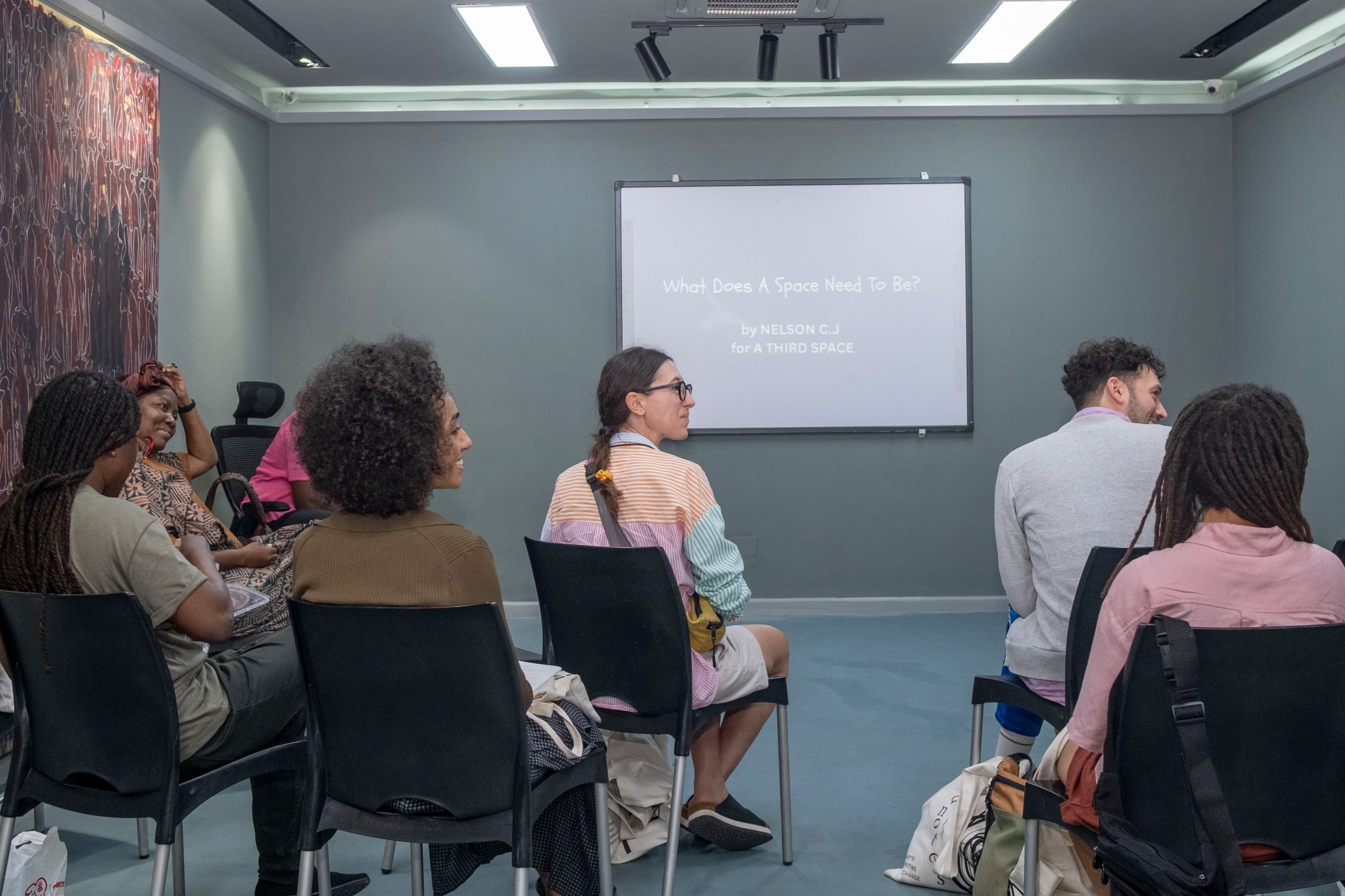
Presentation by Nelson CJ about A Third Space, Angels and Muse, 2025. Credit: Damilare Adeyemi
Dis/Appearing
Writer and cultural producer Nelson CJ asks us each to share our name and a fun fact before he starts his presentation about A Third Space — a multidisciplinary art space he founded in 2024. “I am a horse girl,” says one residency participant; “I am the biggest Adele fan,” says another, and we laugh. Through this simple ice breaker, we become instantly more at ease and connected to each other. I meet Nelson CJ again at Gather House, a cafe and concept store in Lagos dedicated to women-owned brands. Its name suits our conversation, which circles around the need for more distinct gatherings — ones that allow people to disappear from the chaos of city life and the pull of constant online presence. Many of us seem to yearn for spaces of belonging and for occasions to get together. A Third Space answers this by hosting readings, vinyl listening sessions, and art exhibitions that offer chances to slow down and pay attention.
Perspective and specificity are essential for Nelson CJ. When I ask how he chooses who to invite and what to do during gatherings, it comes back to his own taste and wishes — something that he himself wants to go to. He’s not interested in pleasing everyone or shying away from challenging topics. This approach mirrors the idea of having a ‘disputable purpose’ for a gathering, as championed by Priya Parker in The Art of Gathering (2018). For her, planning a gathering starts by defining a need or want in ourselves or in the community — this enables a transformative experience and participants become more specific as a result. As much as Nelson CJ wants to offer moments of escape, his groups are kept small enough that guests don't get lost in the crowd. He invites us into a space where reality can be otherwise. Away from having to perform, to be loud, to sell ourselves in order to be actually seen.
Gathering Attention
If we pay attention to the sensuous, the immaterial, the unfinished, we might stumble upon latencies and help them grow. These tendencies can be explored and revealed in the in-between, liminal, sensory spaces that manifest when we gather.
Like dreaming, the not-yet-become is full of contradiction and ambiguity: the scent of a plant can transport us and simultaneously make us more present; a gathering can allow us to disappear and be seen; to imagine new futures, we must think about the death of old ideas. Tendencies for possible futures are already present in the world today — and we might find them when we gather.
These tendencies can be explored and revealed in the in-between, liminal, sensory spaces that manifest when we gather.
About the author
Robert Steinberger
Robert Steinberger is an artist, curator, writer and researcher based in Zurich. He co-founded the curatorial collective FRICTION and the platform for writing practices DEARS, creating spaces that foster connection and collaboration across disciplines. As a solo artist, Robert has exhibited nationally and internationally. He studied Multimedia Art at San Diego State University, California (BA, 2011) and Management, Organisation Studies and Cultural Theory at the University of St. Gallen (MA, 2024).
Black Orpheus: Who Gets to Frame a Black Cultural Canon?
Public Fiction: How Art Drafts Realities
The Aftercycle: Speculations on Responsive Touch and Restituted Objects
Sounding the Ocean: Spiral Networks of Remembrance and Elation
Notes on Editorial Dis/Continuities