Water is Running: Wura-Natasha Ogunji’s Aquatic Archive
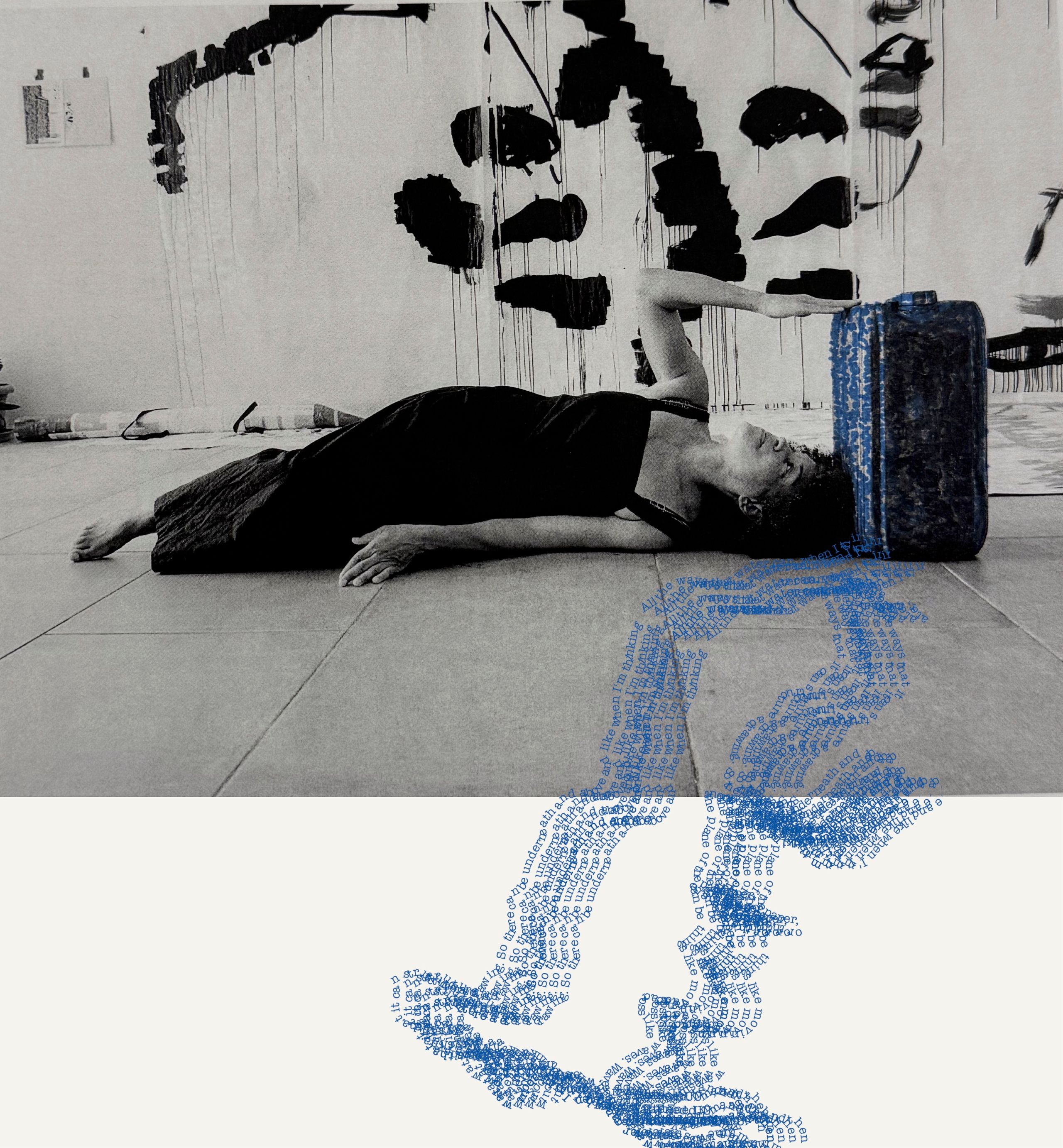
like when, Wura Ogunji in her studio, The Treehouse, Lagos, Nigeria. Credit: Maryam Kazeem.
Writer Maryam Kazeem traces artist Wura-Natasha Ogunji's evolving relationship to the aquatic: from the Atlantic Ocean as a site of diasporic longing, to the Lagos Lagoon as representingsomething murkier, more intimate, and harder to name. Moving between studio visits, Sunday morning swims, and a confrontation on Snake Island, Kazeem finds in Ogunji's thread drawings and water-filled figures a practice that refuses to settle — much like the lagoon itself. This text is part of the C& and Pro Helvetia Fieldnotes Arts Writing Exchange 2025–2026.
“Do you remember the last time you said ‘diaspora’ out loud?” I ask Wura. We’re sitting in the Treehouse, her seventh-floor studio and home. Even when standing inside, away from the two balconies, one can see the Lagos Lagoon below. Diaspora is a word often used to describe Wura-Natasha Ogunji’s work. And at first I am sure I have no need for it in writing about her current practice. But the more I swim through thoughts, the more I am conflicted.
“When I was younger the Atlantic was framed from the Americas and Africa,” says Wura. “My mom would say, we’ll visit your father in Nigeria one day.”
Wura’s relation to the water changed soon after her move to Lagos, which did not dampen her vigilant aquatic study. In recent works, water is often mythical. While the Atlantic appears sporadically, it is no longer the central aquatic body. Lagoons, pools, puddles, and bodies are submerged together, or maintain their distinct figures.
As I attempt to write about Wura, I come upon a sort of discursive challenge. I think of the lagoon which traverses the city — a body of water that can feel like a cage rather than an interstitial zone of the Atlantic Ocean. I wonder if there is a way to situate the lagoon within the context of Diaspora — the distance we can feel. To speak to how we are both connected and disconnected through our waters. How we are both together and apart.
I wonder if there is a way to situate the lagoon within the context of Diaspora — the distance we can feel. To speak to how we are both connected and disconnected through our waters.
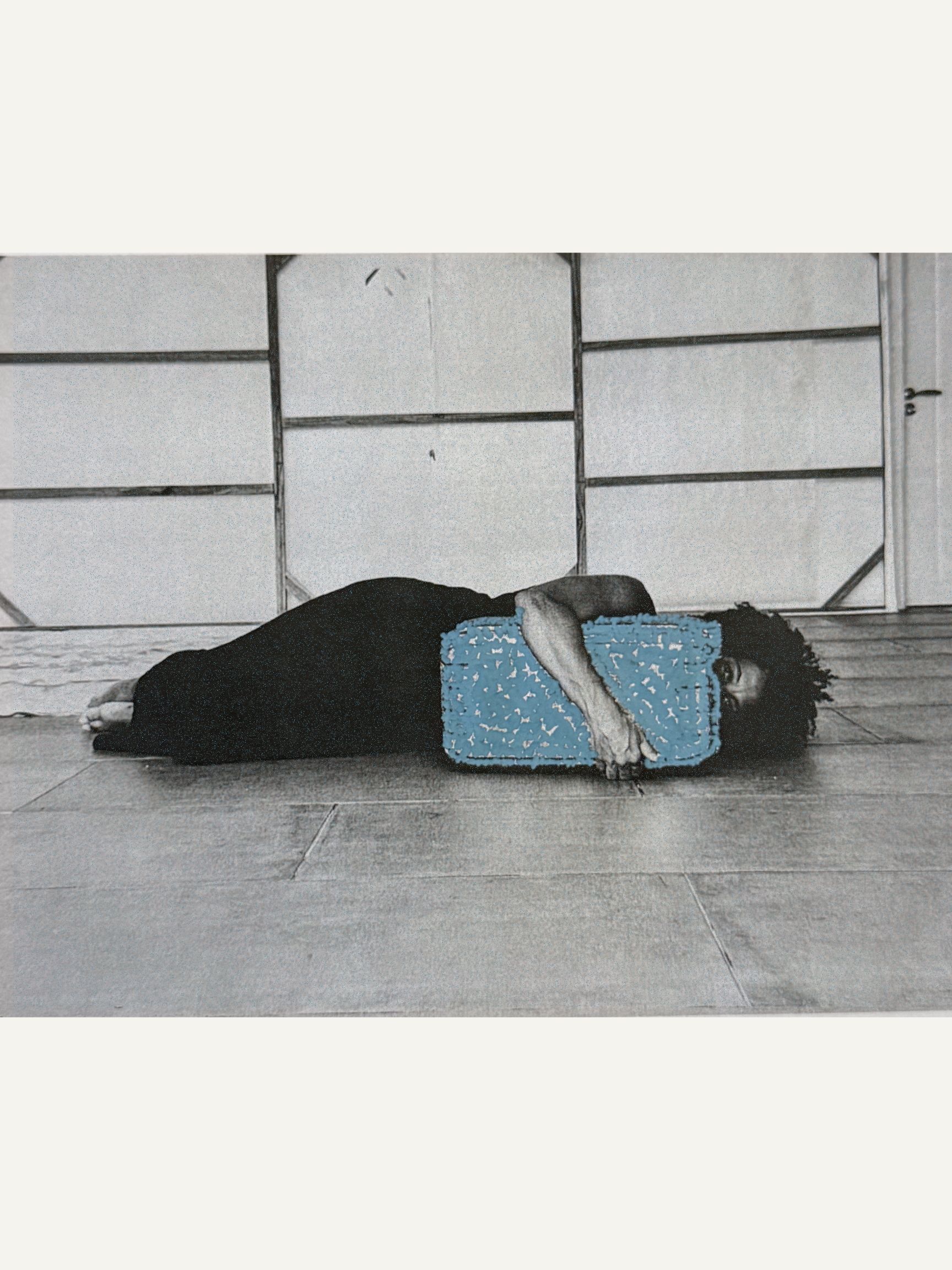
sutures, Wura Ogunji in her studio, The Treehouse, Lagos, Nigeria. Credit: Maryam Kazeem
Lagos, Outside
Over the last ten years, Wura’s practice has shifted from public-leaning performance works to studio practice. As she lays on the floor with a bronze-cast jerrycan she made in Benin, I ask how she now thinks about her 2013 performance will I still carry water when I am a deadwoman?
“Do you think that your relationship to performance in public space has changed the longer you’ve spent in Lagos?”
“Of course. Sometimes it’s beautiful and sometimes I’m almost afraid to go out and be in the world.”
These conflicting feelings about living in Lagos seem to come with the territory. I am not sure there is anyone in Lagos who does not oscillate between love for and exasperation with a city staggering so comfortably between joy and chaos. Almost everyone has a moment — perhaps there’s vexing traffic or no running water — when they are overcome with the desire to leave. To be at least momentarily part of the diaspora.
The Littoral
In Lagoons and Lagoons and Lagoons, Wura sutures a scene into six panels of tracing paper. Two faces are interconnected through the flow of lagoons which they both see, make, and secrete. Wura made this drawing in 2021, when she lived in a compound in front of the Lagos Lagoon.
I remember visits to her house when the water was smelly, and the dog insisted on running along the concrete wall and sniffing the terminated waves. We joked about who would jump in the water and save him if he fell in, but we barely spoke of the water as there was no need. We were situated littorally. The waves crashing against the concrete provided commas, sentences, spaces. The Atlantic and its histories present, but somehow distant.
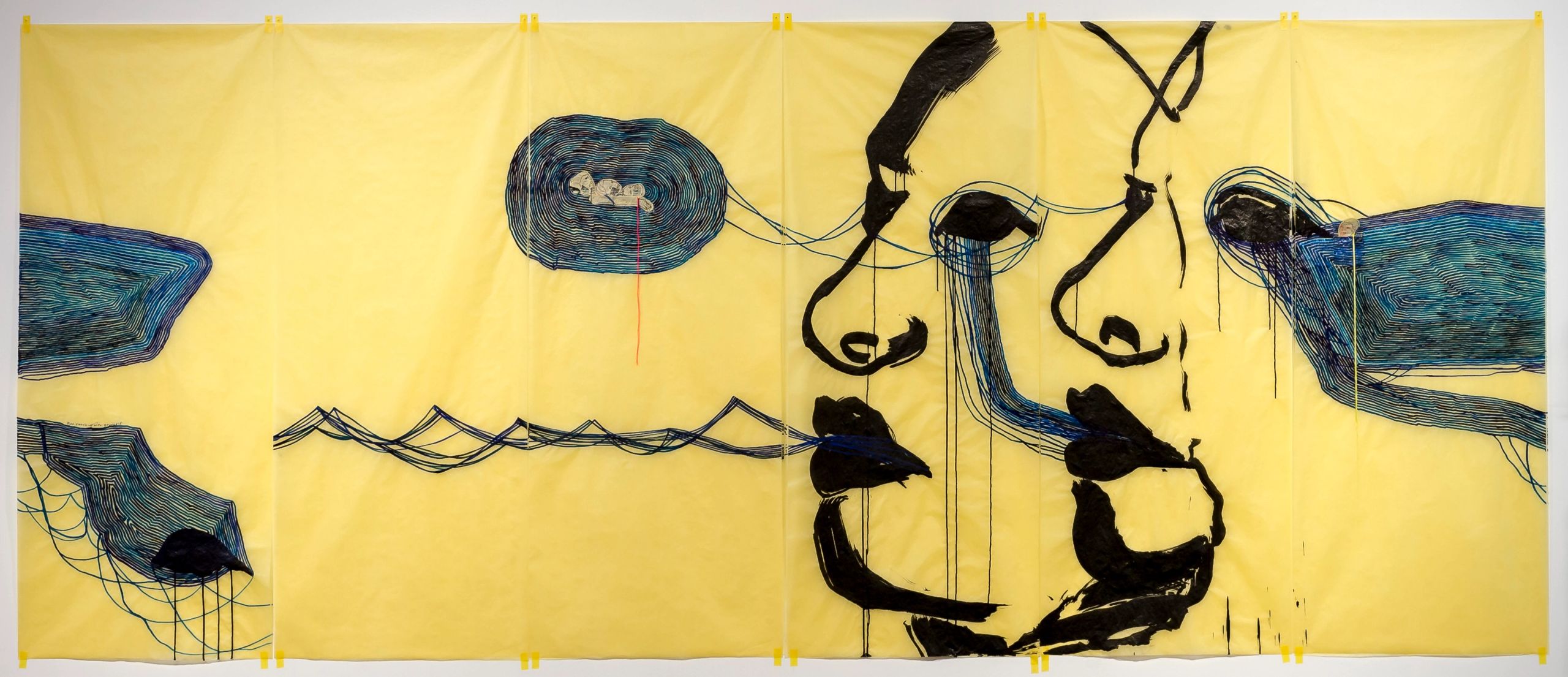
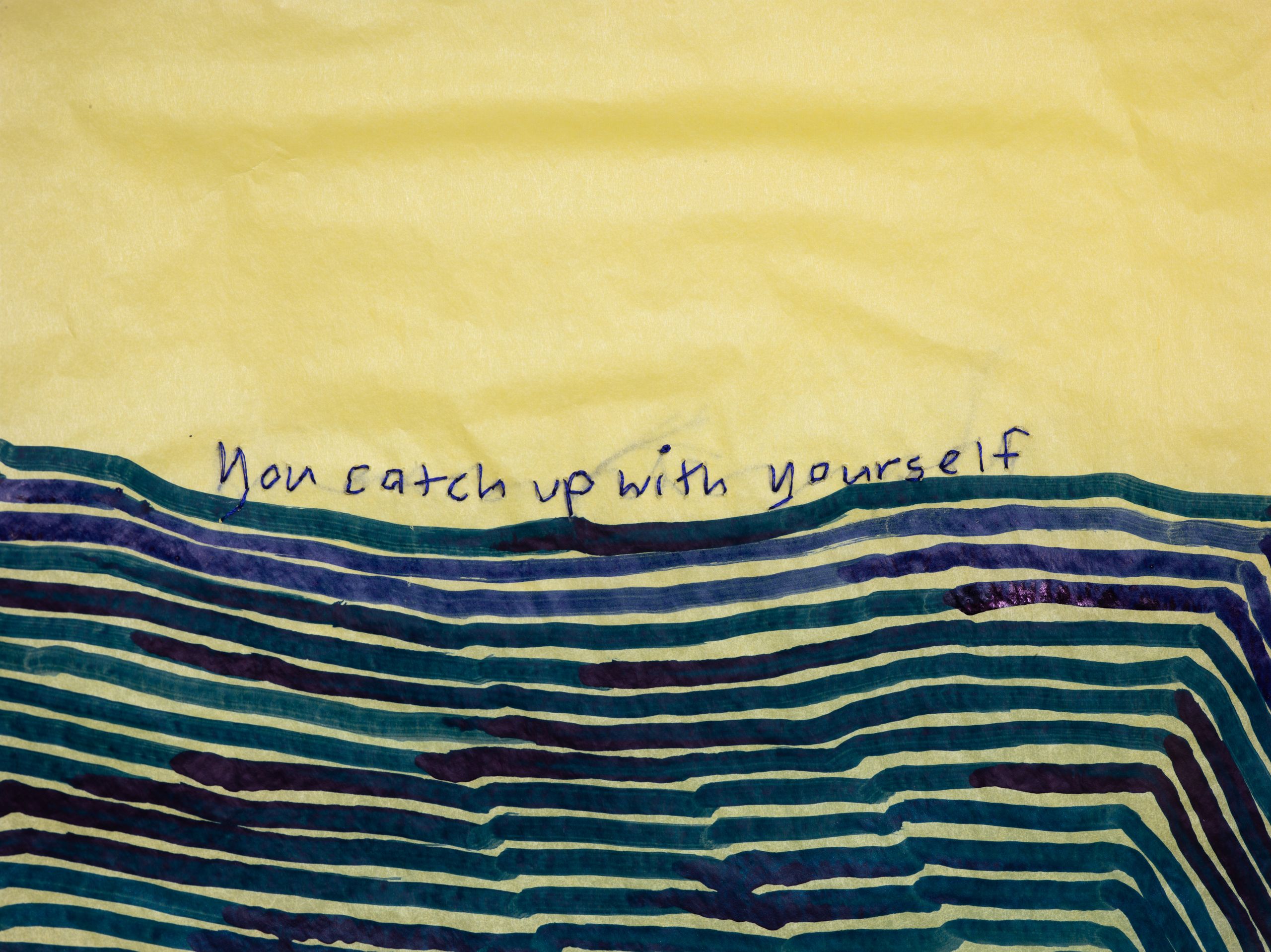
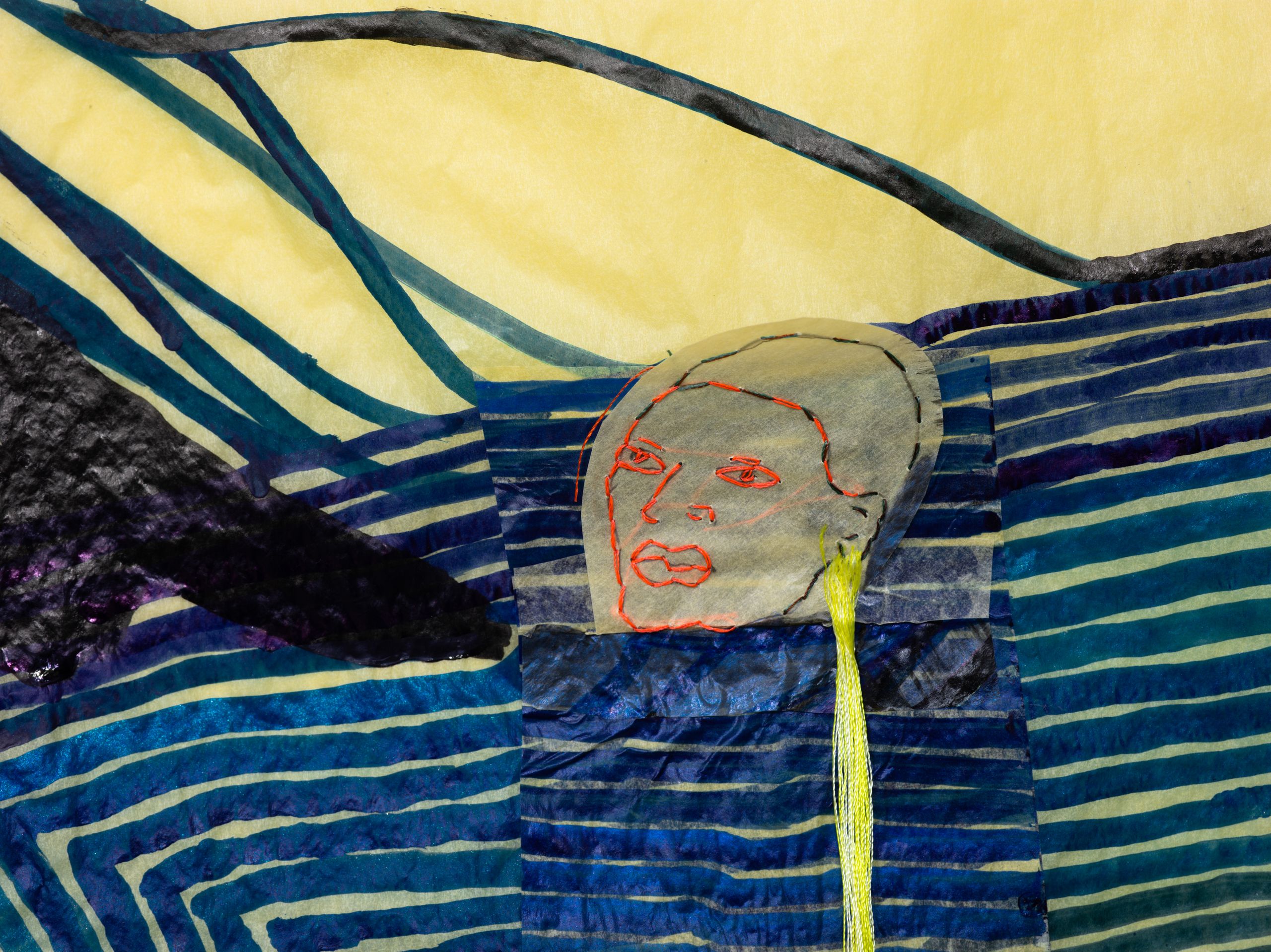
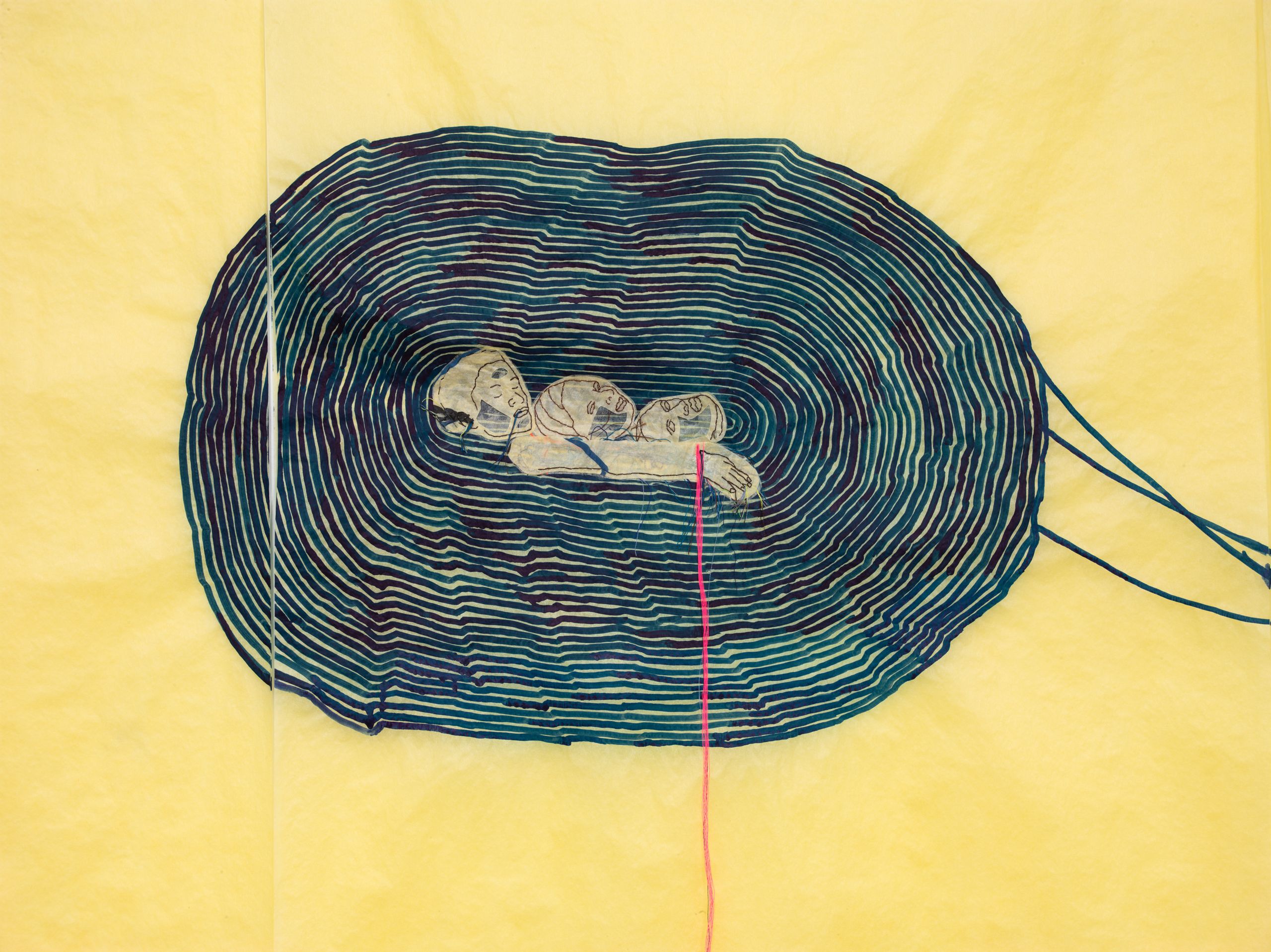
The eyes in this work are recording devices — takers and makers of images, envisioning a material water that holds memories. In this particular memory and image is a lagoon carrying Wura, who carries two Ife heads. In an interview with Eva Barois de Caevel for AWARE, Ogunji states that she “uses this image to reaffirm the idea that history is always present.”
The black lagoonal
Each time I encounter water as method and material in Ogunji’s works, I remember that the lagoon around us is alive and that the material convergence between body and lagoon, which can feel irrelevant as one seeks out the day, can occur not just through touch but through vision — the act of looking.
“I’m thinking about something that I haven’t quite figured out yet, it’s called the black lagoonal,” I share.
“I love that,” Wura immediately responds.
One of the reasons has stayed in Lagos is due to a certain way of being that is imposed in the United States. “Quite frankly, there is a racial terror. And many of my actions are to live a life without having to constantly be in conversation with that, and if nothing else, I think Nigeria gives that,” she adds.
At times I agree, and then on certain occasions I’m not so sure. Driving across Third Mainland Bridge, what used to be a murky view of infinite water is now a view of buildings at the water’s edge. A thought which I am releasing to let sink or settle by the shore: one can feel free from racial terror even if...
1) its legacies are floating in the waters that engulf the city.
2) its legacies inform how the state continues to disappear the lagoon, its environment, and displace the people living around it.
3) its logic informs how the state treats the land solely as capital.
“When I go beyond this creek lagoon and to the ocean, it feels more open and expansive,” says Wura. “I want to say the lagoon is troubled, but it’s also home. I think I’ve accepted that there’s nothing to really repair.”
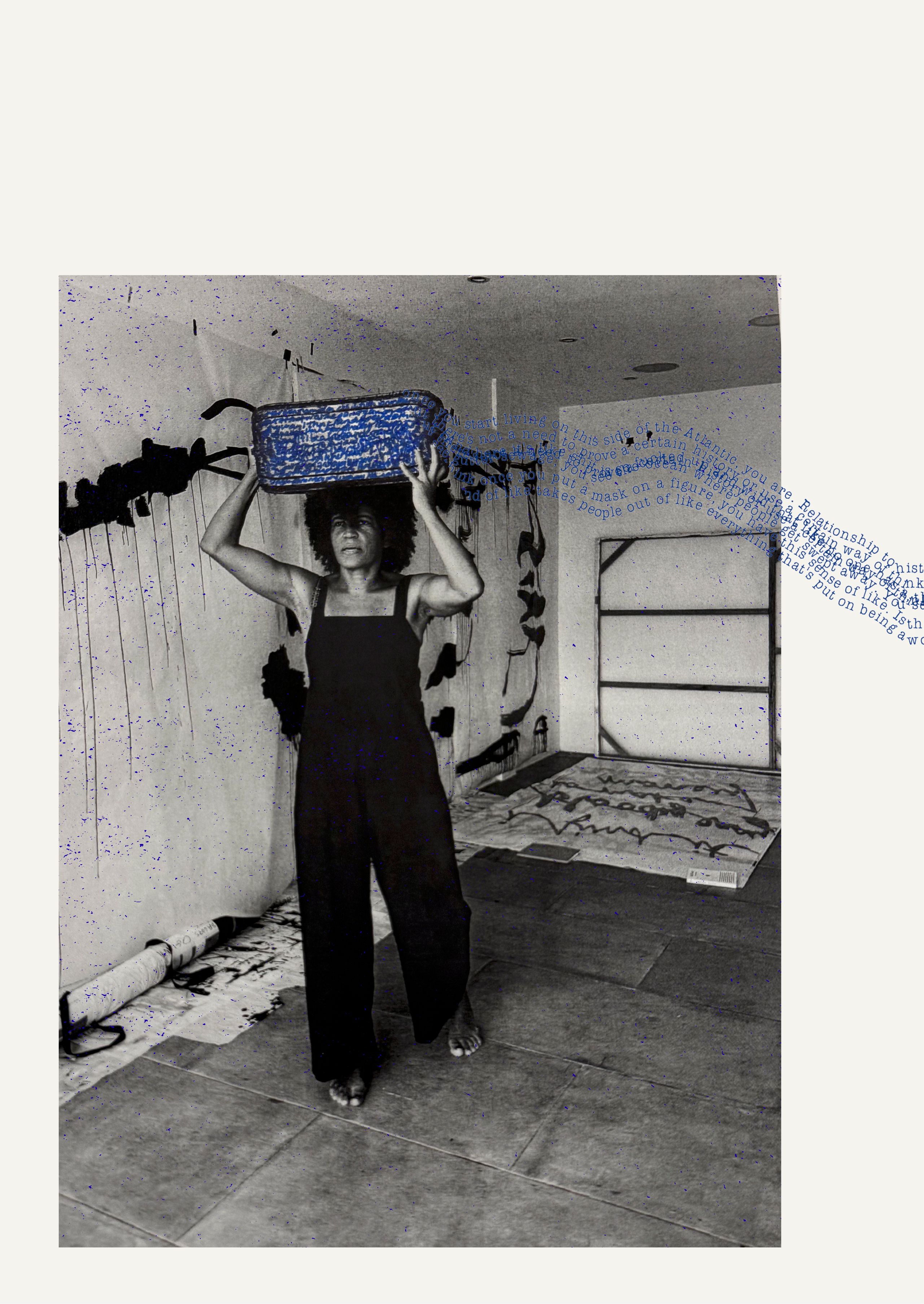
a mask, Wura Ogunji in her studio, The Treehouse, Lagos, Nigeria. Credit: Maryam Kazeem
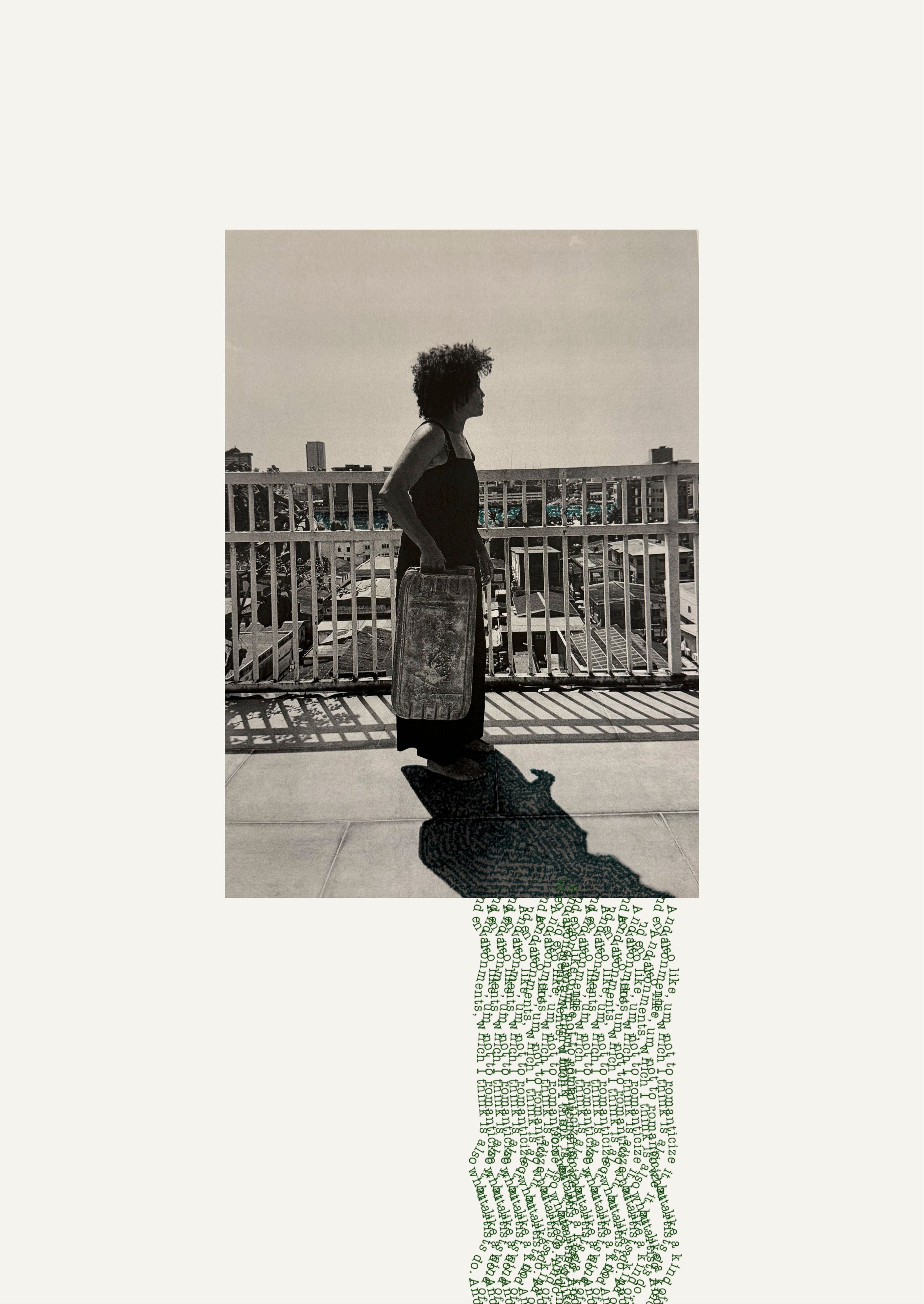
romanticize it, Wura Ogunji on the balcony of her studio, The Treehouse, Lagos, Nigeria. Credit: Maryam Kazeem
Scenes of Terror
We take a boat on the lagoon to Snake Island. After a walk, we sit beneath tall palm trees drinking coconut water, cutting tiny pieces of coconut meat for the rooster, who distributes a piece to each of the hens before he swallows his own. We joke of our awe at such a well-behaved male specimen. We come upon a marsh with mangroves and climb the walkway, taking only a few steps before a badly behaved male specimen obstructs our departure from the island. He comes up close to Wura saying:
“May I know you?”
“No, you may not,” Wura abruptly responds.
The man claims to be an immigration official. His vision of Wura tells him she is not Nigerian. His eyes are bloody and he is likely inebriated. Nisreen suggests Wura show him her documents, which she refuses to do. The man keeps trying to get close to her. All too aware that the situation could quickly turn worse, Nisreen calls her father, who he tells the man on the phone to go away. After curt deliberation with another man miles away, he does, and Wura’s scalding fury seems to melt away almost instantly. We get on another boat and in thirty minutes we are dipping our toes in the Atlantic. We don’t speak again about the incident, but I continue to think about the man’s aggression and how easy it is for him, with just four words, “May I know you?,” to turn the lagoon’s shoreside into a scene of terror.
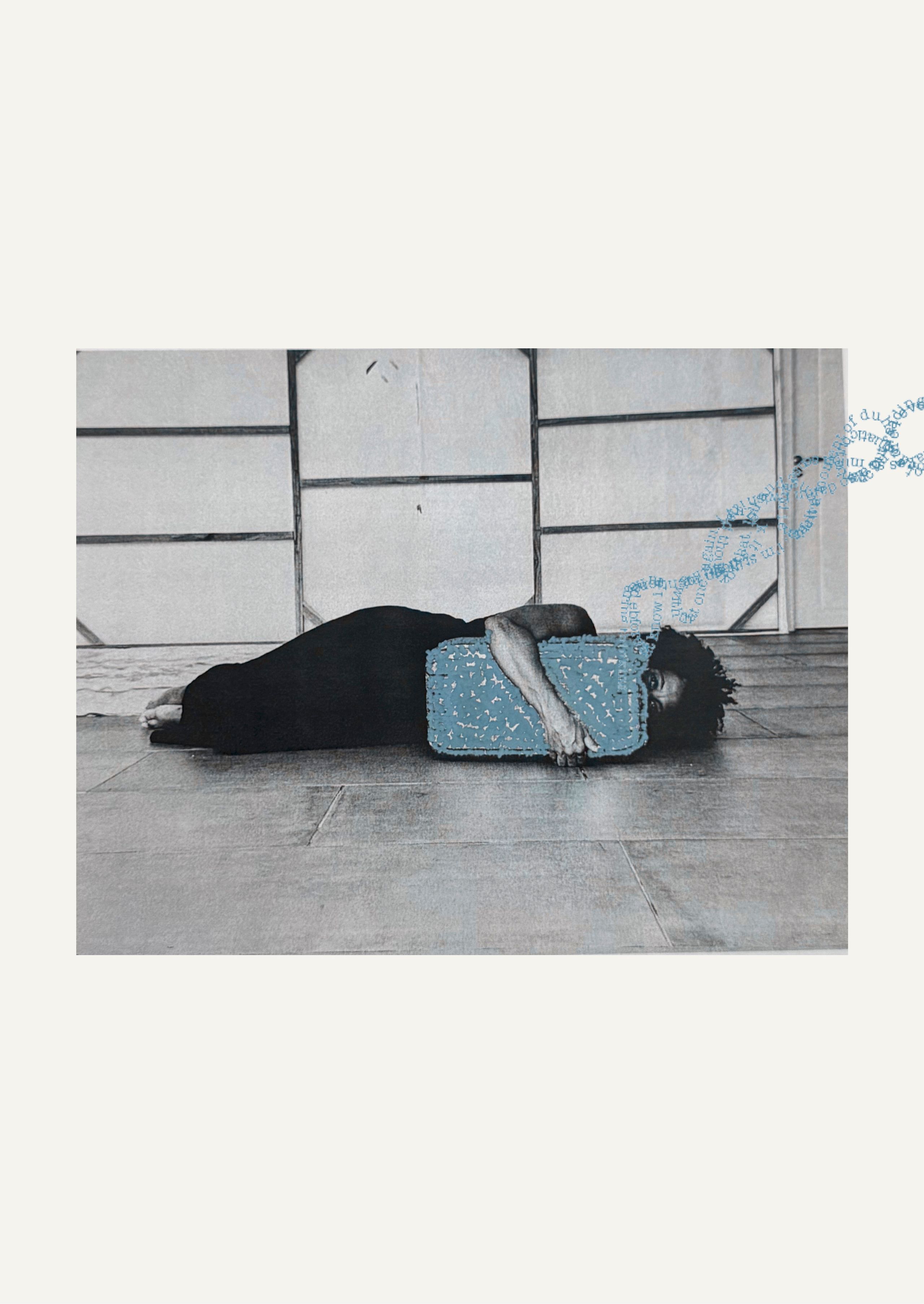
like when, Wura Ogunji in her studio, The Treehouse, Lagos, Nigeria. Credit: Maryam Kazeem
Diaspora at Home
On a Saturday morning, Wura and I are running around Eko Atlantic — a Lagos district built on reclaimed land. She casually asks where Federal Palace is, and we end up debating it, using sticks from the ground to make a miniature Victoria Island by our feet. We cannot make sense of our direction as the sand-filled city has made curves of the shoreline. What do we make of diaspora now that we too can own the initial site of black dispersal?
Even though we know Lagos has always been changing, we talk about how we find the last decade of development hard to stomach. It is not why the city must develop, but why the development must be so particularly glutinous. We wonder whether a time is approaching when we will no longer be able to afford to live in Lagos. Where then will we seek home? Maybe then diaspora will easily slip again off our tongues.
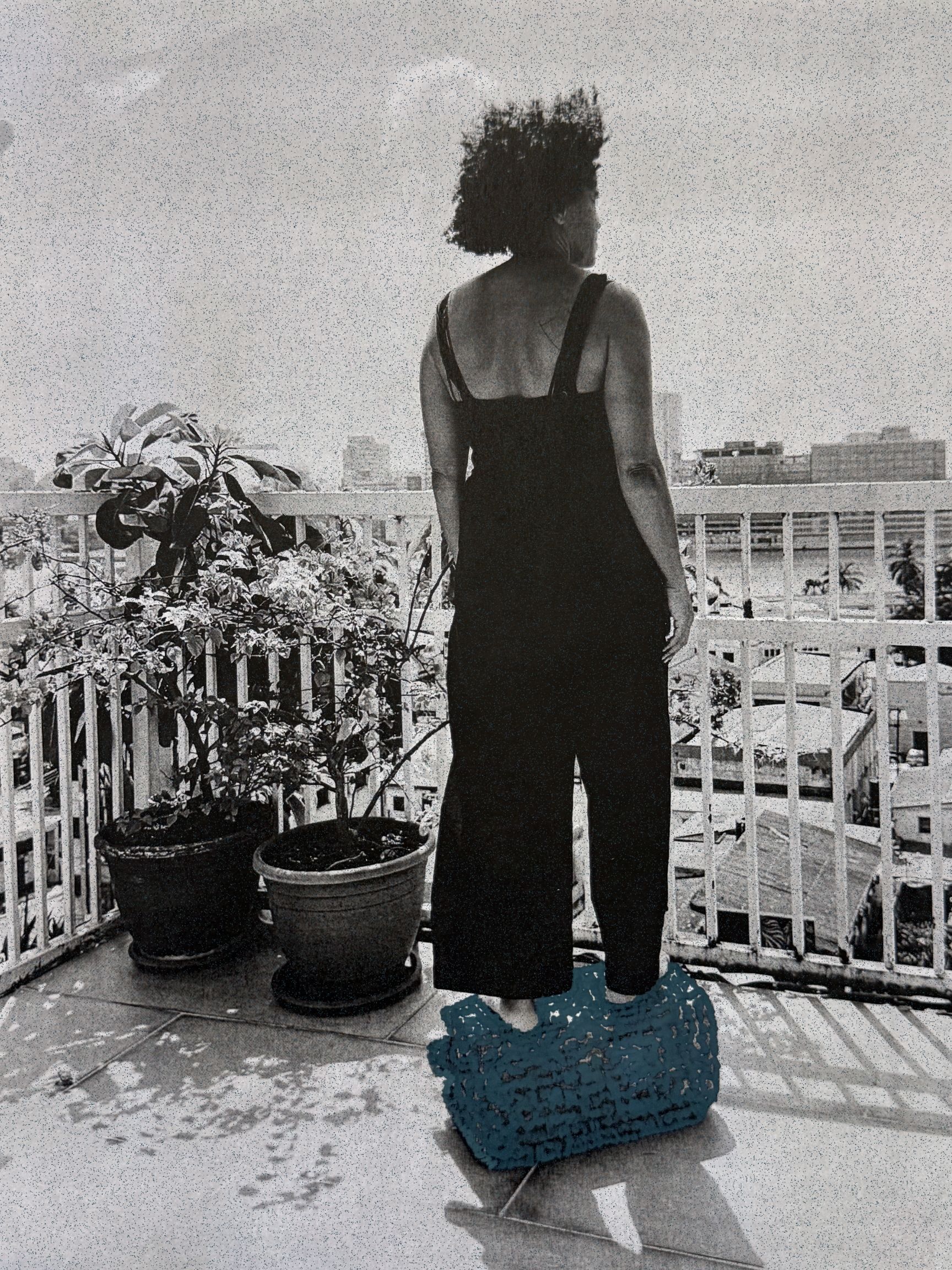
i was just thinking, Wura Ogunji on the balcony of her studio, The Treehouse, Lagos, Nigeria. Credit: Maryam Kazeem.
Lately, diaspora is often most enunciated on the continent through economic capital. If we in the homeland long for the diaspora, we seem to long for its money (think ‘The Year of Return’ in Ghana or ‘Detty December’ in Lagos) and the diaspora seems equally eager to seize economic opportunity. Perhaps some theory is unavoidable. In Rewriting the African Diaspora: Beyond the Black Atlantic, Malawian scholar Paul Zeleza provides a detailed definition:
Diaspora is simultaneously a state of being and a process of becoming, a kind of voyage that encompasses the possibility of never arriving or returning, a navigation of multiple belongings.
At first I think the lagoon is our blind spot, inconspicuous in some ways. But Zeleza’s articulation of diaspora destabilizes the idea of a fixed home, perhaps best situated on a body of water. Perhaps this is how to begin (and end), with speaking about diaspora at home, by framing the beginnings of the black lagoonal as part of the diaspora — by a desire to see what floats beneath the water’s depth with open eyes.
About the author
Maryam Kazeem
Maryam Kazeem is a writer and independent researcher whose work explores the intersections of archives, the multidimensional life of language, and place. Through iranti press, a Lagos-based publishing experiment, she approaches publishing as a social practice and site of collective inquiry. Her work has been supported by the New York Foundation for the Arts, the Prince Claus Fund, and other institutions.
The Heart of the Matter: Carrie Mae Weems at FOMU Antwerp
Aggregates of Plunder: Ndidi Dike’s Rare Earth Rare Justice
Thenjiwe Niki Nkosi Frames Printmaking As A Relay Process
Olukemi Lijadu: Feedback, Friction and Black Atlantic Music
The Deconstructive Lens of Ngadi Smart: From Drag to Climate Change