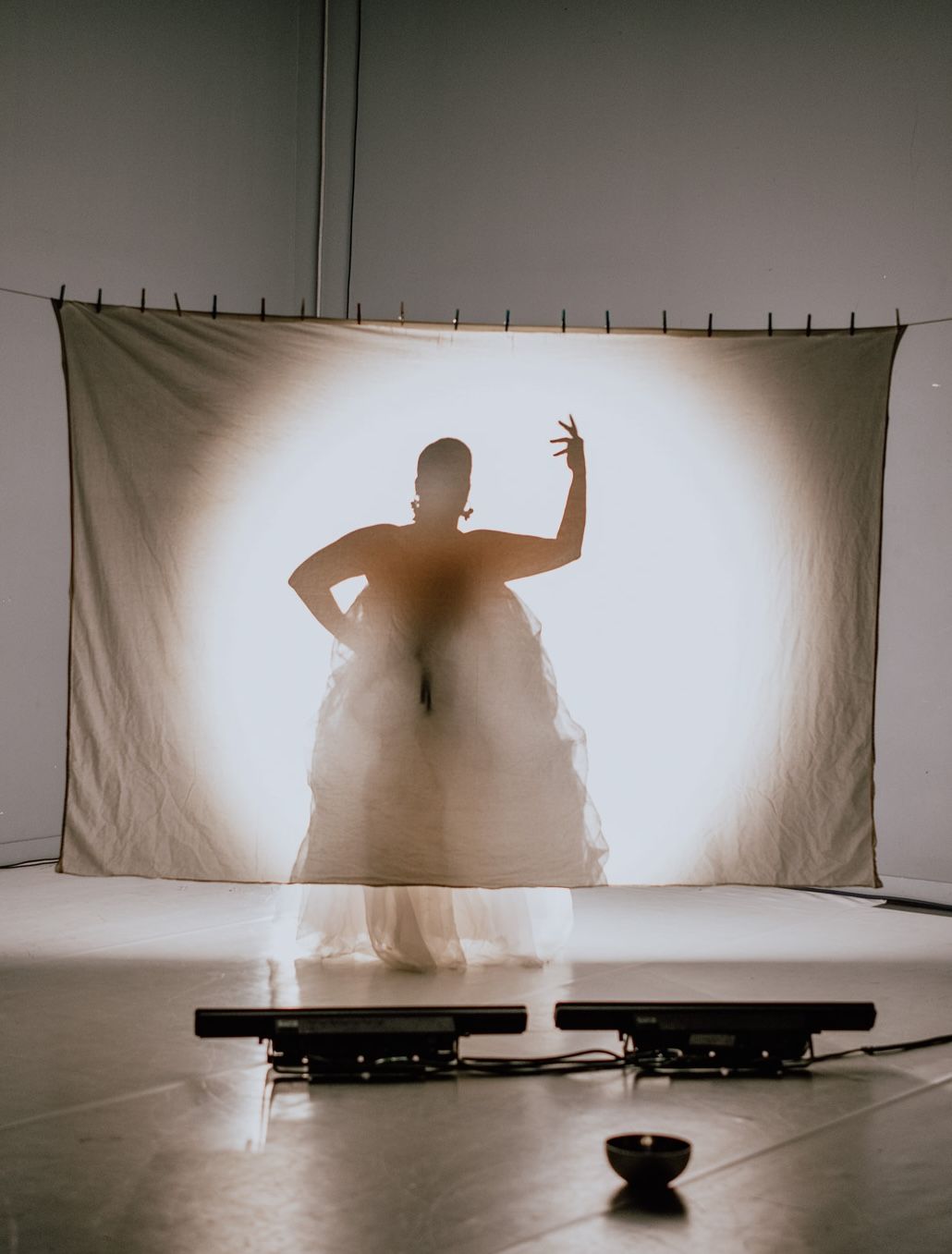
Sounding the Ocean: Spiral Networks of Remembrance and Elation
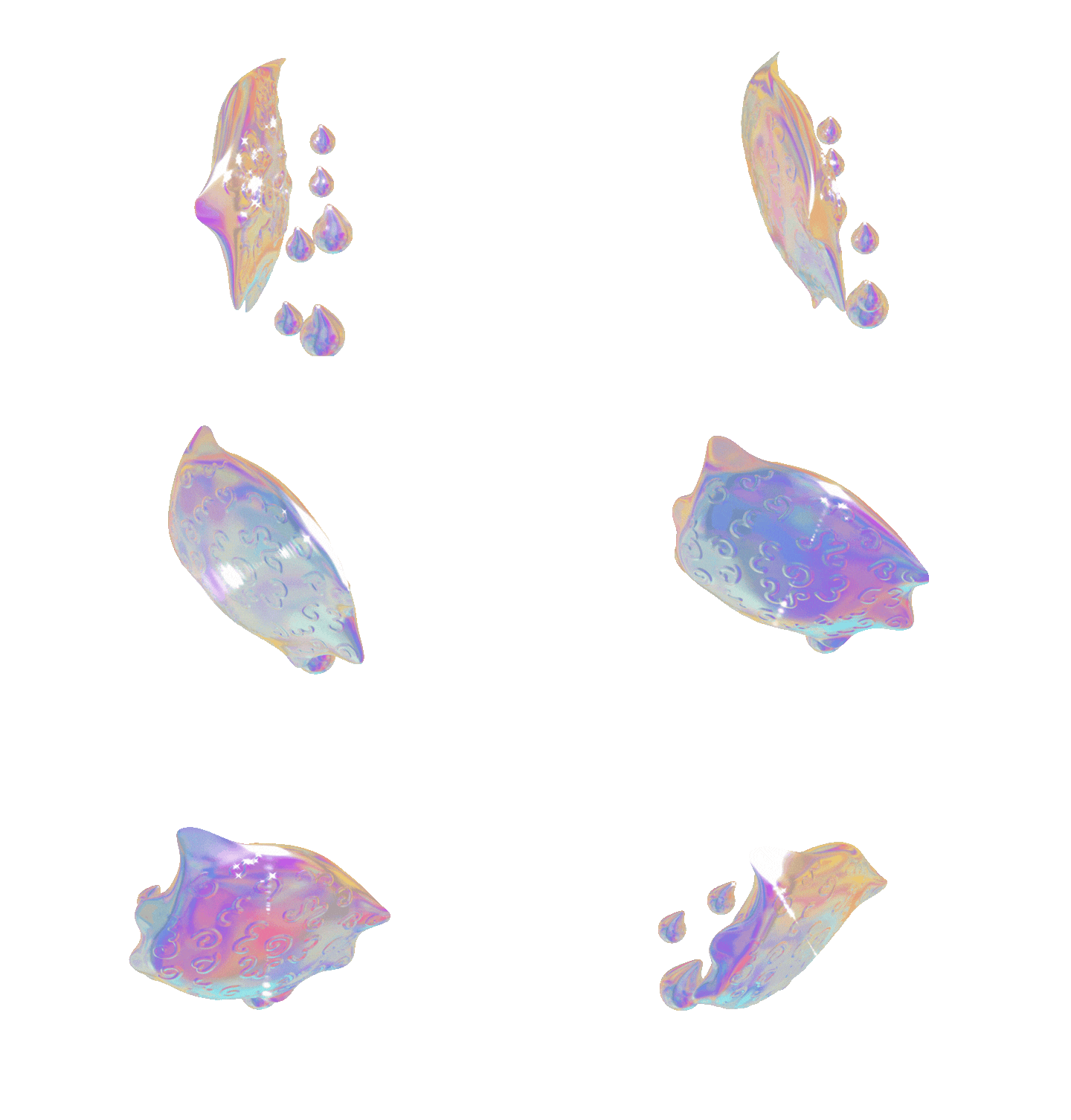
Hiba Ali, Opalescent Tears, 3D rendering, 2026. Courtesy of the artist.
Dr. Hiba Ali’s work sits at the intersection of audiovisual storytelling, worldbuilding, immersive media, artistic research, and the sonic practice of ocean sensing. The following performance lecture, titled Sounding the Ocean: Spiral Networks of Remembrance and Elation, has been excerpted and adapted, and was originally performed at Transmediale 2026 curated by Neema Githere and Juan Carlos Garcia Sossa. It forms a larger body of work entitled Spiral Networks of Remembrance and Elation where research was conducted over three years in Saudi Arabia, Zanzibar and India through various fellowships and connections including the American Institute of Indian Studies, Deccan Archive and the Dhow Countries Music Academy.
A volcano erupts. It blows ash into the air. This ash travels through the wind and water.
It disrupts air travel, flights are cancelled, people who live on pastoral land, animals across the Swahili Sea, the Indian Ocean world.
Ocean-sensing is an immersive, somatic, and durational practice of listening. Not as metaphor — as method. This is where experience reorients our senses, bodies and the way we move.
Ocean-sensing is process where we, as listeners, undergo a process of transmogrification:
- from vibration to matter,
- from plasma to volcanic ash,
- from ash to water
- from water to relation.
Ocean time is non-linear and recursive — tidal rather than progressive — after Kamau Brathwaite in his 1984 book ‘History of the Voice’.
To listen, here, is to attune the body — it is to feel:
- Texture
- Pressure
- Resonance
The ocean calls with splendor and sorrow, abundance and degradation. Listening becomes ecological and ancestral accountability. A call to channel the ocean.
Kamau Brathwaite describes tidaletics as non-linear, recursive movement of ocean tides as a counter to unilateral historical progression:
“To listen, in the context of ocean-sensing, is not simply to hear, it is to attune somatically, to feel the textures of water through the body, mind, and heart. The ocean’s call is both splendor and sorrow, abundance and degradation. It asks us not only to witness its beauty, but to reckon with its pollution, its extraction, its pain. Listening, here, is a practice of ecological and ancestral accountability. This is a call to heal the ocean, a call to channel the ocean.”
Feminist ocean-sensing builds on traditions of listening as an embodied ethical act. Dylan Robinson’s concept of Hungry Listening critiques extractive modes of reception that prioritize information over relation, capture over care. He writes, “Hungry listening prioritizes the capture and certainty of information over the affective feel, timbre, touch, and texture of sound.” Listening becomes a means of power who gets to be heard, who listens, and who is reduced to data.
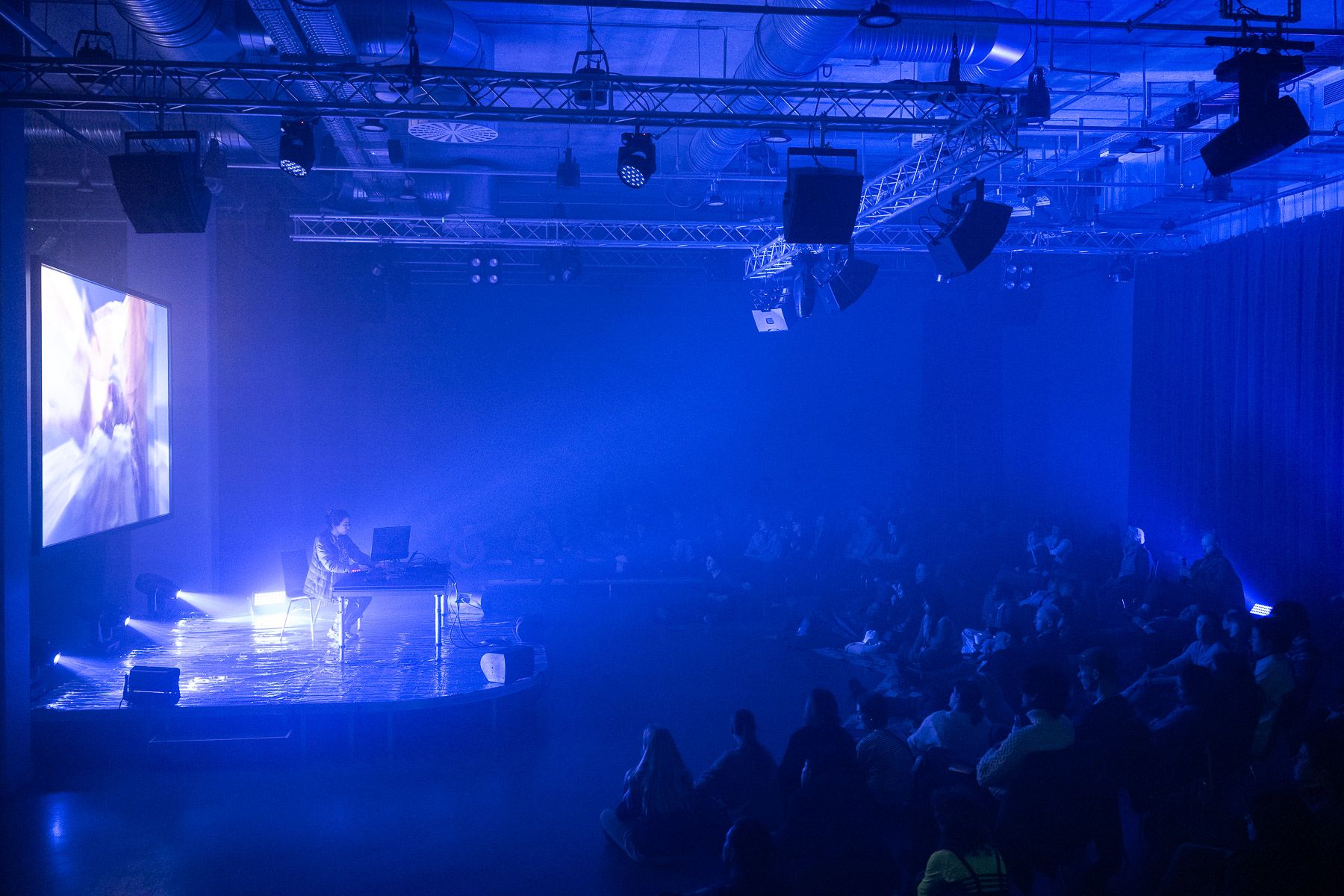
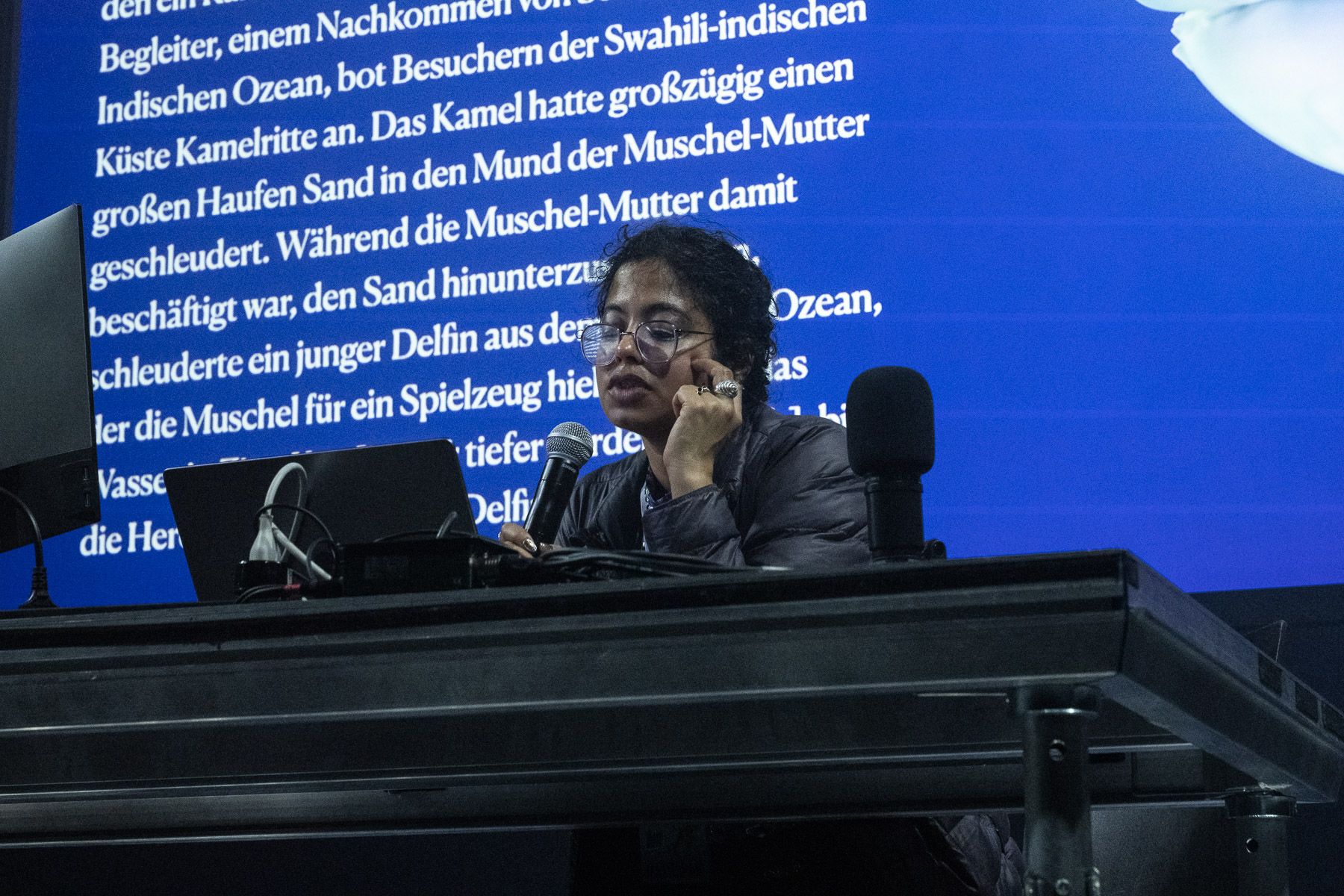
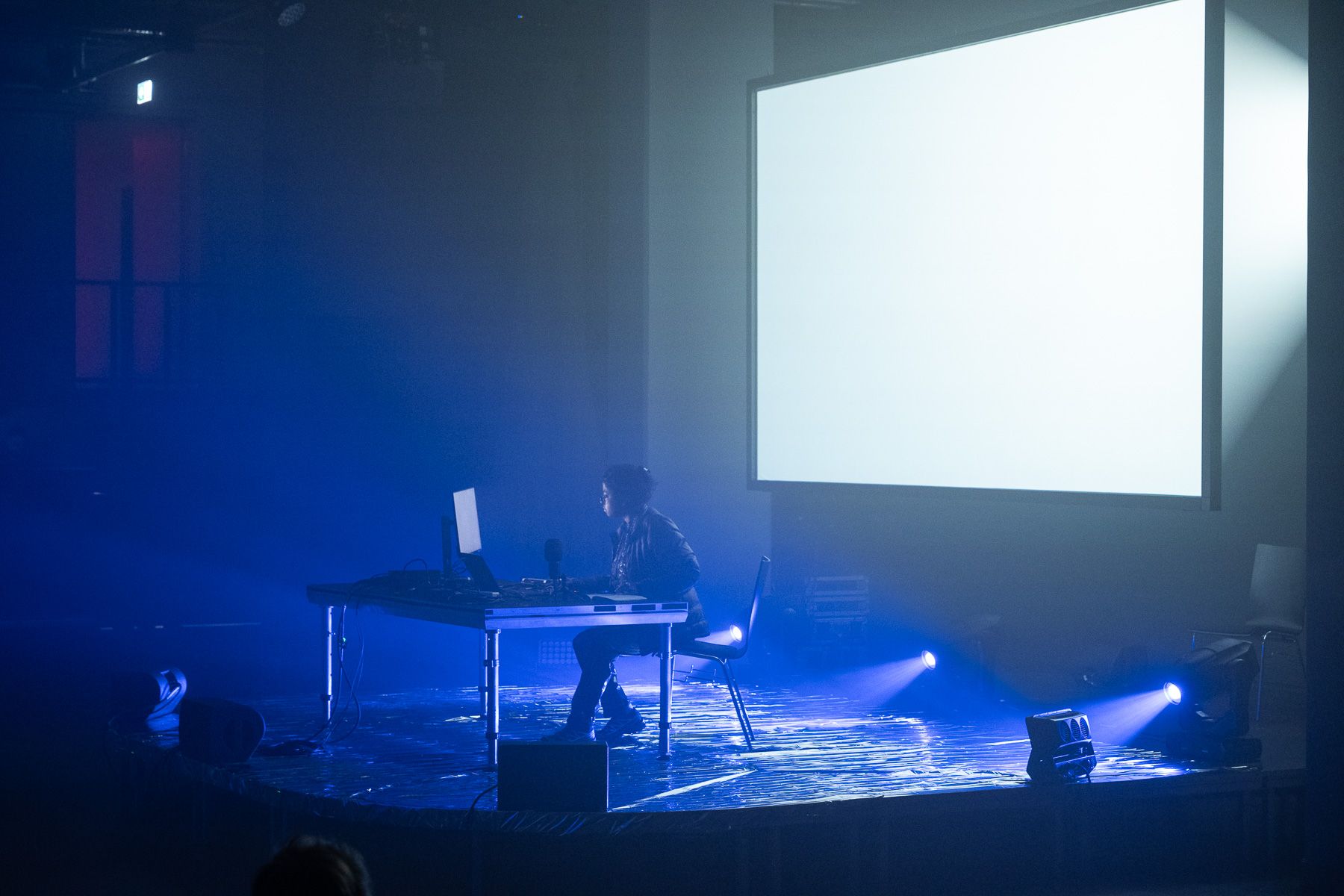
In this performance, I embody volcanic ash, plasma and oceanic eruption. I sing through a voice modulator in the microphone with music from Chema Bent Hammoud - Daq El Hub, shared by Maqam tv and Vugo Matondoni, uploaded by Suleiman Mohammed.
In prototyping this work, I employed ocean sensing through game mechanics and devised the following rules for navigation:
- You are no longer human.
- You are anchored underwater.
- Gravity is unstable.
- Vision is partial.
- Movement is slow.
I invite you to choose a body: fish · microbe · volcanic ash · ocean current · sediment
Questions:
- How do you move?
- What orients you?
- What feels distant or impossible?
- What suddenly matters?
Stay with this perspective.
“Let go of standing upright.
Let go of being centered.
Let go of mastery.”
“Feel your weight redistribute.
Notice how gravity loosens underwater.”
“Don’t analyze this.
Just notice what changes.”
(Hold silence for 20–30 seconds)
“This is ocean-sensing.
A reorientation of space, agency, and attention.”
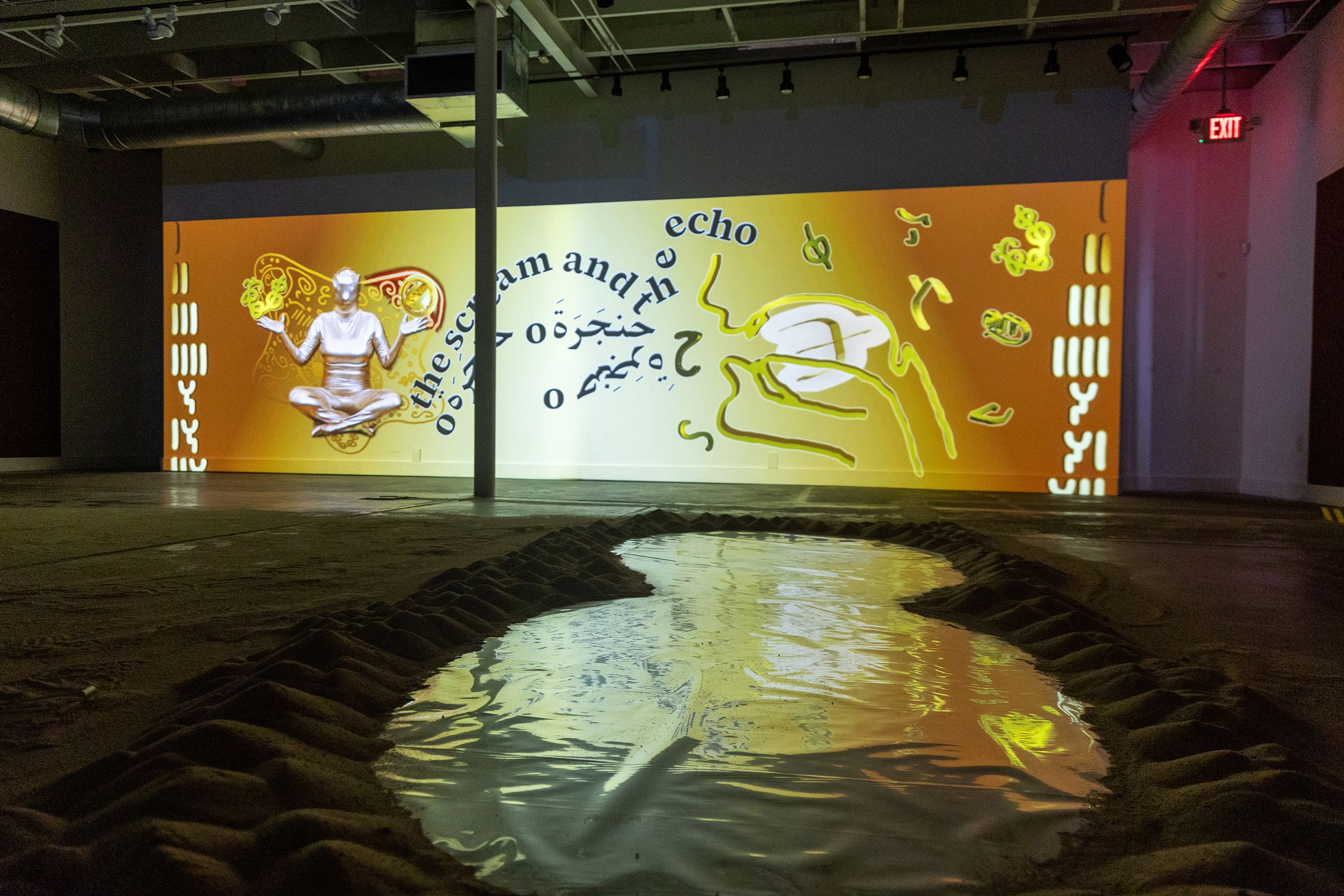
Hiba Ali, Songs of hs installation, Lullabies for the Stars in our eyes exhibition, Women and Their Work, Austin, TX, 6 video projections, VR headset, bakhoor incense, headphones, vinyl stickers, sand, and reflective material, 2024. Courtesy of Essentials Creative.
In a previous work Songs of the hs (2019-2024) I explored the Arabic letter “h” and its sisters in Aramaic, Phonencian, Hebrew and Ge’ez through songs that reclaims the back of the throat as a metaphoric and literal space for healing. This part of the body holds the thyroid gland that due to intergenerational and compressed life-stressors can trigger auto-immune diseases. It is oft referred to as the throat chakra, a place of communication and expression, and in turns of phrase, as a place where "words get stuck." In this work, through a series of songs that are remixed in succession throughout the 18 minute and 33 second-long video, I reclaim the throat as a space of release and of collective power, where we are not only heard but understood. I also build on Indian Ocean Mixes (2020) where I examined the music cultures of the Swahili Seas that crisscrossed Zanzibar’s taraab, the Gulf's fjiri, South Asia’s qawwali tuned to the scale of the Persian scale and the maqaam. I started this series concurrently with Black Indian Ocean series, a reading group and film series that visualizes the histories and futures of African descent communities in the Indian Ocean region through curated film screenings and generative pedagogy with a Substack channel.
I would like you to consider what happens when perspective changes. What if we navigate as a fish, as a microbe, as volcanic ash suspended in water? Underwater, gravity loosens. Orientation becomes unstable. Up and down lose certainty.
Ocean-sensing asks us to inhabit unfamiliar scales and agencies —
to feel how space reorganizes when the body is no longer centered,
no longer dominant,
no longer upright.
This is not escapism.
It is a practice of reorientation.
Hiba Ali, The Pearl, 3D rendering, 2026. Courtesy of the artist.
In line with this practice I will be reading you a short story, in English and then in Swahili:
“The pearl had slipped out of the shell and into the little girl’s hand. She and the pearl were babies no more than two. The little girl has dropped the pearl, now, lost and it had started rolling, through the ground, toward a lake, to the river, to the ocean. Turning over and around, the pearl thought about the shell, the maternal, clam-mother, that had been its home. It rolled and rolled and rolled, thinking about the clam-mother that had created it and birthed it. The clam-mother had shivered through the pains of creation and child-birth of the pearl. Thinking about the origins of the pearl’s birth, the pearl thought about the ocean sediment that had gotten lodged inside the clam-mother. The pearl imagined the clam-mother feeling the irritation, an intrusion pulling in from the outside. The sediment consisted of fragments of other beings, and gems like Tanzanite and Aqeeq [quartz]. Small fragments are all that the clam-parent shell needed to birth a brand-new being. As the pearls layer grew, one upon the other, the clam-mother became estranged upon them-self.
The developing pearl could hear the clam-mother’s thoughts, “Who is this developing inside me? Who is this creature? Will it hurt me?” Previously, the clam was used to being enveloped by the freedom of the wind, the seeming endless deliciousness of sediment and ocean brine that flowed past. The different gyres of the Swahili-Indian ocean allowed it to be so, the waves would come sometimes slowly and at other times, they would come with great gush and verisimilitude. The clam would move scalloping by with great enthusiasm. Though, this was not to be anymore, since the pearl had lodged inside the clam-mother, the clam had a duty enforced upon itself to take care of this being. It wasn’t so much a divine right but a part of a compulsory technology. The clam thought, “I must grow this abomination, so it can be expelled." The clam had been really good about not getting any piece of ocean detritus get caught in it and in the strange case that did happen, the clam was quick to spit it out. “To birth or not to birth is always a question, but never the answer”, the clam-mother had thought. But this one, this unfortunate pearl, the sediment of old beings and gems, had sneaked in and made host where it was not welcome, so the clam does as they do.
The clam became an infrastructure of birth, release and amnesia, the forgetfulness that comes with the traumatic process of pearl-birth. So, day by day, it would try to hurry the process and eat what it needed. Yesterday, it was motia [jasmine], that a divorcing bride in Karachi threw into the Arabian sea. Next, sand sediment splashed by a camel. The camel with their attendant, a descendant of Indian Ocean sailors, was giving visitors of the Swahili-Indian coast camel rides. The camel has generously flicked a large heap of sand inside the clam-mother’s mouth. As the clam-mother busied themselves with choking down the sand, a young Indian Ocean dolphin thinking of clam as a toy, flicked it across the water in Ziwa Kuu [deeper and deeper depth] water until the pod [the pack of dolphins] were on Pemba Island.
There, the sediment contained particles of old mangrove growth shared by both coasts and the water here was turquoise. The clam was happy to lap up the rich sediment. The clam heard a traveller sing to Ocean, with the heated scent of camphor and ylang ylang being offered as they sang. In their low vibrato, they mentioned their queer loves, dedicating a nasheed [Islamic hymn] to them. They sang about the prophetess and divine goddesses and called upon the spirits of sultanas [queens, guardian angels] dropping rose petals into the water so that became accented by floral essences. The clam luxuriated in these sensorial experiences; it had never thought that pearl-birthing would lead them to such a great journey. For a small period of time, they came to accept their bulbous self and revel in the rich sensuous world before them. Then another wave came in from the bamboo oar of a catamaran on its way to Kerala and the masuum [Swahili-indian ocean wind pattern] of the ocean current pulled them there. The clam wondered, what will become of me and this pearl?”
So I turn and ask you what kind of volcanic ash will you be come? What kind of pearl , clam-mother will you become? What kind of water will you become? What kind of water do you carry? What kind of ocean will you become? What kind of ocean do you want to be a part of?
Hiba Ali, Calling from Below, 3D rendering, 2026. Courtesy of the artist.
"Lulu ilikuwa imeteleza kutoka kwenye ganda na kuingia mkononi mwa msichana mdogo. Huyu msichana na lulu walikuwa watoto wachanga wasiozidi miaka miwili. Msichana mdogo ameiachilia lulu, sasa, imepotea, na ikaanza kubingirika, ardhini, kuelekea ziwani, kuelekea mtoni, kuelekea baharini. Ikizunguka na kugeuka, lulu iliwaza kuhusu ganda, mama mzazi, kombe-mama, ambayo ilikuwa nyumba yake. Ilibiringia, tena na tena, ikiwaza kuhusu kombe-mama, iliyo muumba na kumzaa. Kombe-mama ilikuwa imetetemeka kupitia maumivu ya uumbaji na kuzaa lulu. Ikitafakari asili ya kuzaliwa kwake, lulu iliwaza kuhusu mchanga wa bahari ulioingia na kukwama ndani ya kombe-mama. Lulu ilifikiria kuhusu namna kombe-mama ilihisi mwasho, na uvamizi unaovuta kutoka nje. Ule mchanga ulikuwa na chembechembe ya vitu vingine, na vito kama Tanzanite na akiki (Quartz). Chembechembe chache tu ndio kombe-mama ilihitajia ili kuzaa kiumbe kipya kabisa. Tabaka za lulu zilivyoendelea kukua, moja juu ya nyingine, kombe-mama ilianza kujitenga kivyake.
Lulu ilivyozidi kukua iliskia mawazo ya kombe-mama, “Ni nani huyu anayekua ndani yangu? Ni kiumbe kipi hichi? Je, kitaniumiza?” Hapo awali, ganda lilikuwa limeshazoea kuzungukwa na uhuru wa upepo, na utamu usio na mwisho wa mchanga na maji yenye chumvi ya bahari yaliyopita karibu naye. Mikondo mbalimbali ya bahari hindi ya Uswahilini ilimruhusu kuwa hivyo, mawimbi wakati mwingine yalikuja polepole na wakati mwingine yalikuja kwa kishindo kikubwa cha uhakika. Ganda lingeendelea kusonga likitapa-tapa kwa hamasa kubwa. Lakini hali haingeendelea kuwa hivi tena, tangu lulu ilipoganda ndani ya kombe-mama, ganda lilitwikwa jukumu la kulea kiumbe hichi. Haikuwa tu haki ya ki-ungu, bali teknolojia ya kimaumbile. Ganda liliwaza, “kwa hakika lazma nilee laana hii ili iondoke”. Ganda lilikuwa makini kuhakikisha uchafu wa bahari haukwami ndani yake, na kama kwa nadra lingetokea, ganda lilitema uchafu ule. “Kuzaa ama kutozaa daima huwa ndio swali, lakini kamwe sio jibu,” kombe-mama iliwaza. Lakini hii, hii lulu yenye bahati mbaya, mchanga wa viumbe vya zamani na madini, ilikuwa imepenya na kupata makazi pasipo karibishwa, sasa ganda likafanya kazi ya ganda.
Ganda likageuka kuwa kifaa cha uzazi, kuachilia na kusahau, usahaulifu unaokuja na hali ngumu ya mchakato wa kuzaa lulu. Sasa, siku baada ya siku, ganda lilijaribu kuharakisha huu mchakato na kula kilicho hitajika. Jana iilikuwa motia (muyasmini), ambao mke aliyeachika Karachi aliutupa kwenya Bahari ya Arabia. Kisha, chembe za mchanga uliorushwa na ngamia. Ngamia na mchungaji wake, mzawa wa wabaharia wa Bahari Hindi, alikuwa anawapa wageni wa Pwani ya bahari hindi ya Uswahilini safari za ngamia. Ngamia alikuwa amerusha fungu kubwa la mchanga katika mdomo wa kombe-mama. Wakati kombe-mama ilijishughulisha kuumeza mchanga huo kwa tabu, pomboo mchanga wa Bahari Hindi akidhani kuwa ganda ni kitu cha kuchezea, aliendelea kumrusha-rusha chini ya maji ya Ziwa Kuu (kina kirefu zaidi na zaidi) hadi kikundi cha pomboo walipofika kisiwa cha Pemba.
Hapo, mchanga ulikuwa na chembe za mabaki ya mizizi ya mikoko yaliyokuwa kwenye pwani zote mbili, na maji hapa yalikuwa yenye rangi ya samawati iliochanganya na kijani kibichi kwa mbali. Ganda liliridhika kulamba mchanga huu wenye madini. Ganda liliskia msafiri akiimbia Bahari, huku akifukiza kafuri na mlangi-langi. Kwa sauti ya chini, mwimbaji alitaja mpenziwe, akimwimbia nasheed (nyimbo za kiisalmu). Aliimba kuhusu watume wa kike na miungu wa kike na kurai mapepo ya masultana (Malkia, Malaika walinzi), wakidondosha mawaridi kwenye maji hadi yakanukia harufu nzuri ya maua. Ganda lilifurahikia kwa hisia hizi za kusisimua; kamwe halikudhani kuwa kuzaa lulu litaitunuku safari nzuri kama hii. Kwa muda mdogo tu, walikubali hali yao na kufurahikia mandhari nzuri iliyokuwa mbele yao. Kisha wimbi lingine likaja kutokana na kasia la mianzi la jahazi aina ya katamaran iliyokuwa njiani kuelekea Kerala lakini ikavutwa pale na masuum (mfumo wa upepo katika Bahari Hindi ya Uswahilini). Ganda lilistaajabu, “hatima yangu na lulu hii ni ipi?”
Kwa hivyo nageuka nakuuliza, je utakuwa jivu la volcano la aina gani? Utakuwa lulu au kombe-mama ya aina gani? Utakuwa maji ya aina gani? Unabeba maji ya aina gani? Unataka kuwa bahari ya aina gani? Unataka kuwasehemu ya Bahari ya aina gani?
With gratitude to the thinkers, practices, and relations that shaped this work:
Githere & Sossa / Johnson, Water School / Ross, Data Trauma / Graves, Qadir, Shroff & Ali / Owuor, Gratitude for the sensuous scents of Dragonfly sea and beyond / Bulter, for all the worlds you built and expanded / Donderer, Akademie Schloss Solitude / Brathwaite, Tidalectics / Hessler, MIT Press / Robinson, Hungry Listening / Beyer + Dorr, Equipment / Ancestral echoes of stardust / Volcanic ash / Pearl divers of Kuwait & Bahrain / H₂O/H / My parents and the many that came before them / Siti Bint Saad / Madosini via Dumama / Chema Bent Hammoud via Maqam.tv / Suleiman Mohammed / Bi Kidude / Pia Menon / So many star guides in the sky that I cannot name / Many invisible hands guiding me / djinns
The short story Lulu (originally “The Pearl”) was translated from English into Swahili by Abdulrahman Ndegwa.
About the author
Hiba Ali
Dr. Hiba Ali is a digital artist, scholar, and educator working across performance, immersive environments, installation, moving image, and sound.
At the intersection of technology, embodiment, and care, their practice explores how digital space can become a site of rest, healing, and collective transformation. Rooted in worldbuilding and digital somatics, Ali creates XR-based environments that center refuge, agency, and embodied connection, particularly for bodies shaped by migration, diaspora, and colonial histories.
They are the recipient of the 2024 Performing and Creative Arts Fellowship from the American Institute of Indian Studies, a 2024–2025 member of NEW INC’s Art & Code track, and a Fellow in Digital at Akademie Schloss Solitude in Stuttgart from 2024 to 2026.
Black Orpheus: Who Gets to Frame a Black Cultural Canon?
Public Fiction: How Art Drafts Realities
When We Gather: On the Not-Yet-Become in Lagos
The Aftercycle: Speculations on Responsive Touch and Restituted Objects
Notes on Editorial Dis/Continuities