Rest in/as Freedom: kiarita and Black Politics of Liberation
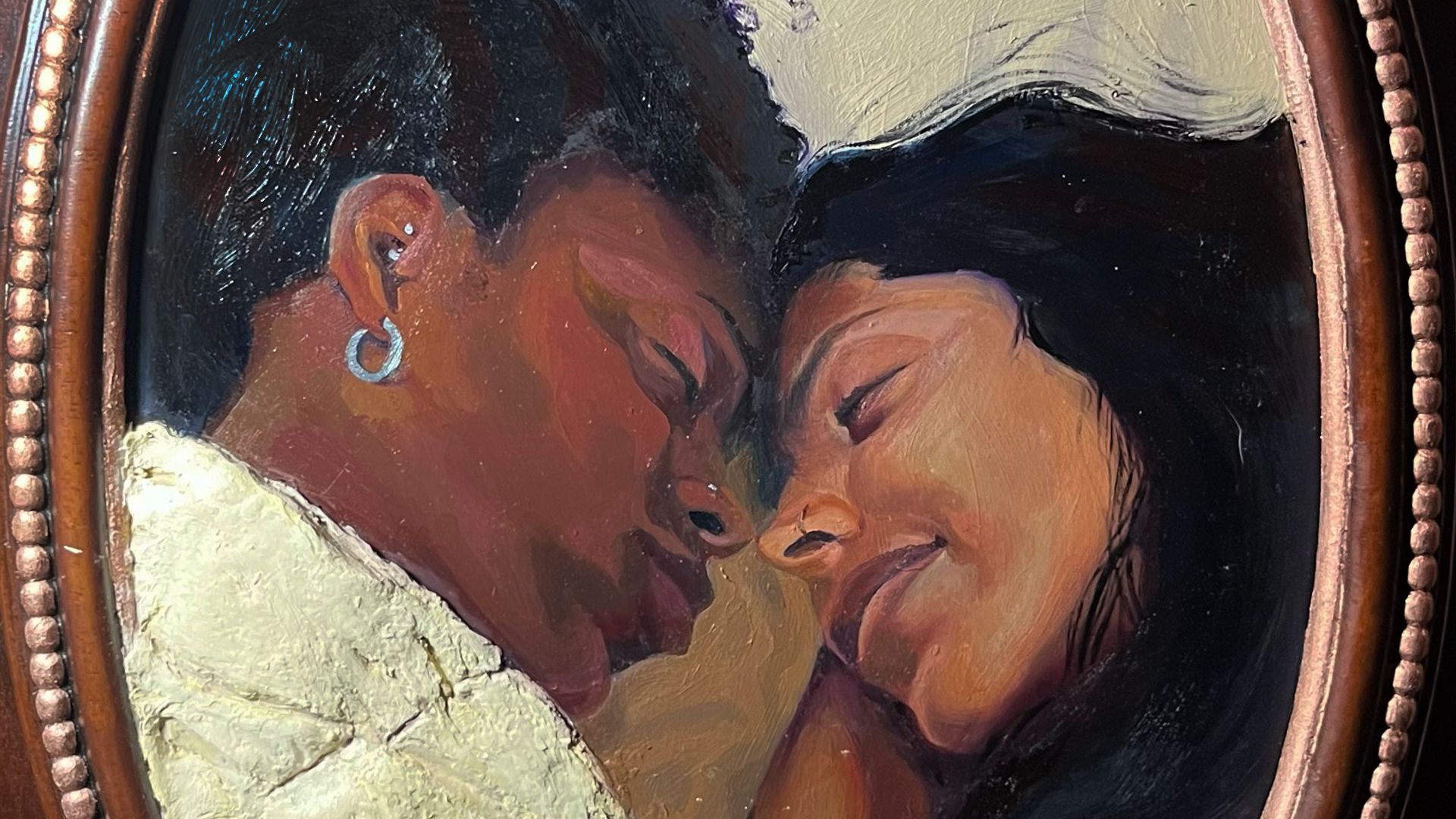
kiarita, from my hair follicle to my toenails (you love me), (detail), 2023. 78x54x55”. Courtesy of the artist.
This article discusses works by the U.S. American multidisciplinary artist of Dominican decent kiarita as visual explorations of the political potential of rest. Synthesising various branches of Black studies and decolonial thought, rest is positioned as a means of grieving the past and present trauma of racial capitalism, of evading and ‘un-doing’ its authority over one’s mind and body, and of conceiving an alternative future.
‘What happens to a dream deferred?’
— Langston Hughes, ‘Harlem (A Dream Deferred)’
Eyes closed, faces tenderly turned towards each other, and the tips of noses almost touching, they breathe the same air. Fast asleep, their faces of burnt sienna, light ochre and pale pinks are framed by the soft ripples of dark, curly hair and the homely weight of a cream-coloured comforter: two lovers kept safe in the oval central plate of the headboard to a queen-sized bed. Around them, lightweight, playful ornaments ebb and flow through the structure of dark, reddish wood, while, on the footboard, another oval panel depicts the lovers’ entangled feet peeking out from the gentle waves created by an off-white blanket and sheets. Mirroring the installation’s reach from head- to footboard and sleeping faces to commingled toes, its title proclaims: ‘from my hair follicle to my toenails (you love me).’ In this sense, the lovers’ portraits frame the empty bed like a sweet embrace while neatly made, soft pink sheets seem to invite the viewer to step into the piece, to lay their body down, and to rest.
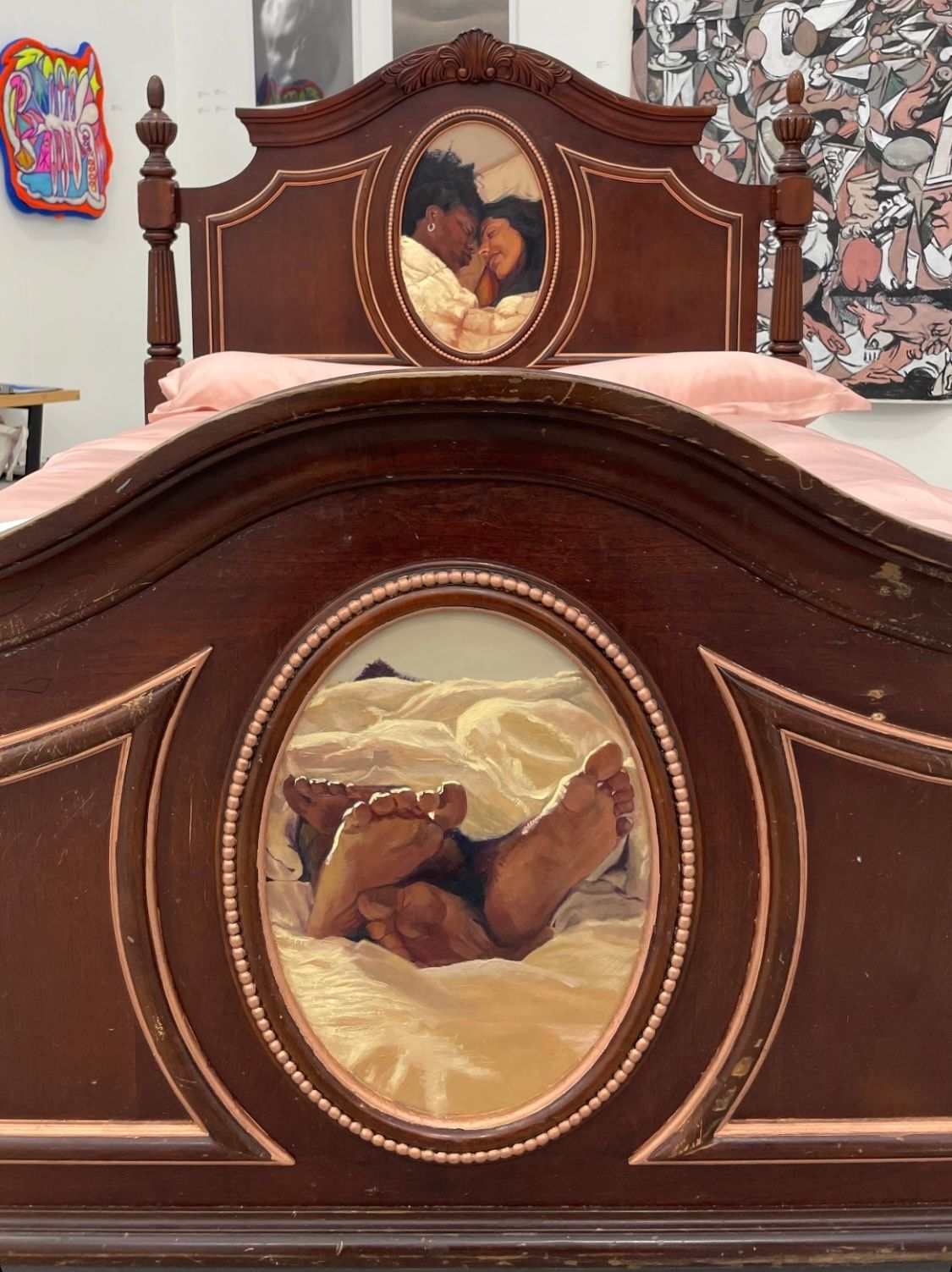
kiarita, from my hair follicle to my toenails (you love me), 2023. 78x54x55”. Courtesy of the artist.
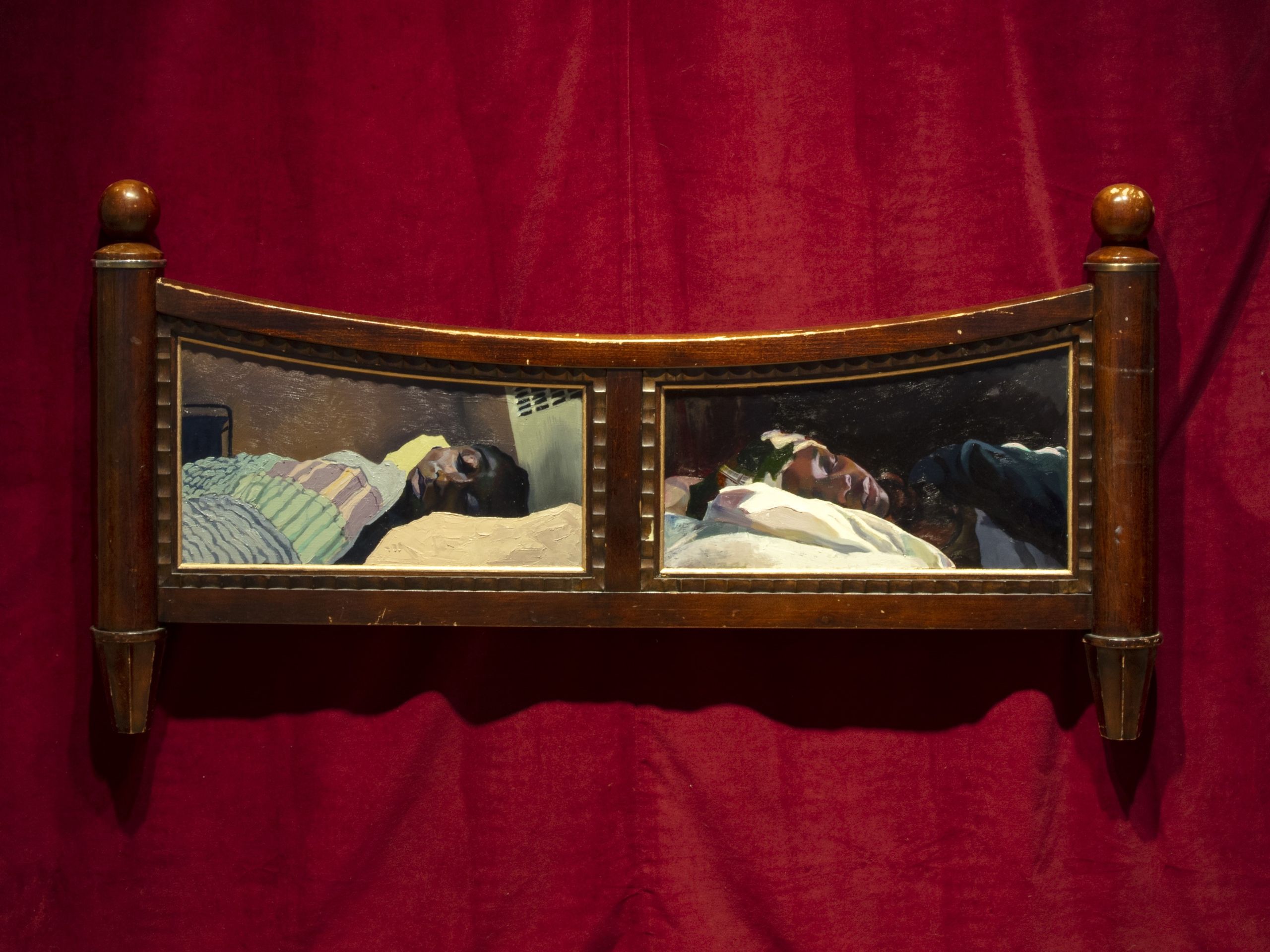
kiarita, i hope you’re dreaming sweetly, 2023. 64x34.5”. Courtesy of the artist.
Of Rest and Intimacy…
The installation is the largest-scale example of a reoccurring visual exploration in kiarita’s oeuvre. Over and over, the young artist paints these deeply personal portraits of their loved ones fast asleep onto wood repurposed from found furniture. i hope you’re dreaming sweetly, for instance, incorporates the double-portrait of two sleeping Black subjects into another headboard. With its close-up frame and intimate perspective, the composition transports the viewer right into the scene as if we were lying down right next to Devin and Danielle. As if it were us they entrusted with the vulnerability required to fall asleep next to someone.
This delicate intimacy is ever present and all-encompassing whenever kiarita employs their meticulous brushwork to immortalise their chosen family in this fleeting state of complete relaxation. To this effect, their works document the rituals of platonic and queer romantic love kiarita has found within their social circle in New York City. About their life in the city that never lets you sleep, the Brooklyn-based artist explains: ‘Schedules misalign and there’s always so much going on that it’s hard to even be with my loved ones. So, at times, sleepovers are the only dedicated time we can share with one another, especially without spending money. Resting near someone is a deep indication of safety and trust, and it is deeply important to me that, when we have a moment to share with each other, rest is prioritized—in whatever shape that comes to be.’(1)
… Exhaustion and Grief…
But prioritising rest is more than just a bonding activity to the painter. In a ‘white supremacist, capitalist, ableist, heteropatriarchal settler-colonial nation state’(2), where grind culture works tirelessly to grind your body down and where the hoax of the American dream robs you of any peace of mind to actually dream, resting with intentionality is an inherently political act. As such, the writer, activist, and theologian Tricia Hersey links it to an exhaustive history of U.S. American capitalism and racial hegemony. Tracing back its roots to ‘the violence and theft’ of the plantation (3)Hersey emphasises that the U.S. American nation was built on the restless exploitation of BIPOC bodies.
As a matter of fact, kiarita’s current hometown NYC, 290 Broadway in Lower Manhattan to be exact, can attest to this truth in a material manner as the area was developed on top of the final resting place of ten to twenty thousand Black enslaved people. Black feminist scholar Katherine McKitterick discusses the site that is now the African Burial Ground National Memorial as an example of how the slavocratic past is still imminent in and literally foundational to US American city life.3 In this context, the political dimensions of rest cannot be reduced to the mere regeneration of one’s productive capacities for the capitalist system. On the contrary, rest, to Hersey, becomes a potent means of grieving both the historic violence that robbed her Ancestors (4) of ‘their labor and their DreamSpace’ as well as the ways in which this exploitation prevails until today.(5) Moreover, every time kiarita paints their Black subjects fast asleep, they, therefore, commemorate and process this historic grief and contemporary exhaustion.
… Resistance and Revolutionary Dreaming
In addition, as Hersey explains in her manifesto Rest is Resistance, rest is also about actively refusing to surrender one’s body and mind to this past and present trauma. ‘We are grind culture,’ the founder of the Nap Ministry posits, ‘Grind culture is our everyday behaviors, expectations, and engagements with each other and the world around us.(6) 'Even internally, capitalist exploitation penetrates the mind in a way that prohibits us from offering ourselves the rest our bodies ask for,’ kiarita adds. Like the original zonbi, who was conceived in Haitian folklore to grapple with dehumanisation under chattel slavery, we are ‘at once denied [our] own bodies and yet trapped inside them—soulless zombies’(7) within the logic of the capitalist economy. In contrast, Hersey and kiarita advocate for rest as a vital strategy for self-preservation. In the spirit of marronage,(8) it is an invaluable refuge from the inhuman realities of life under capitalism and white supremacy, echoing the manyfold resistance to the physical and spiritual death on the plantation. It is a means of evading and ‘un-doing’(9) the power capitalism holds over our bodies and mind—a refusal to surrender to the condition of the zonbi.
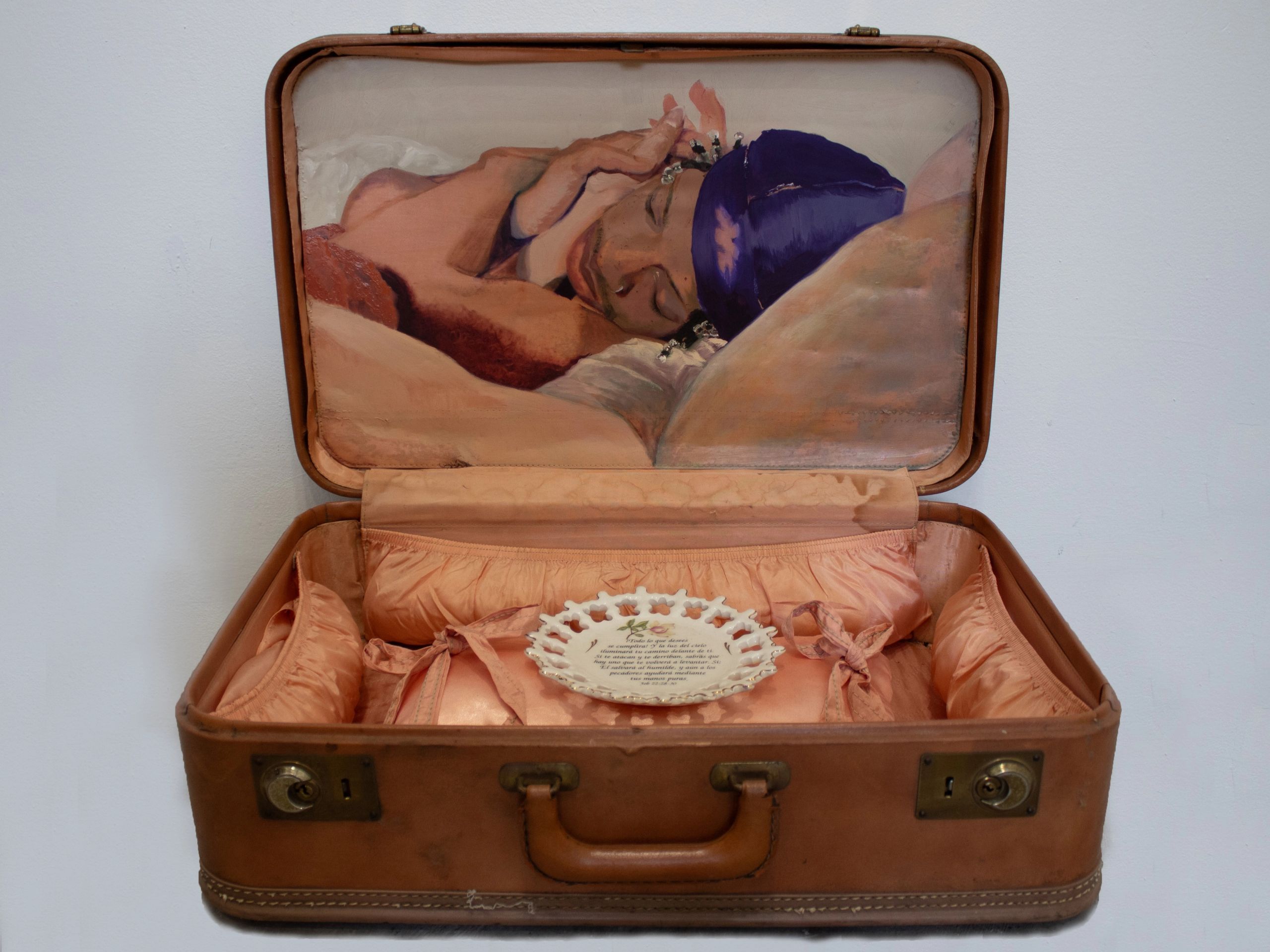
kiarita, the only thing i feel for you is love, 2024. 21x13.5x6”. Courtesy of the artist.

kiarita, the only thing i feel for you is love (detail), 2024. 21x13.5x6”. Courtesy of the artist.
Lastly, kiarita affirms: ‘We need rest and equilibrium to dream of a future where our needs and desires in this world are better attended to. Without rest to focus in, our dreams are deferred—they weigh, they sag, they explode.’ After all, it is in dreams at nighttime where, according to revolutionary thinker Frantz Fanon, the oppressed free themselves for the first time.(10) Likewise, it was a dream, dreamed still amidst slavery’s reign of terror, that led abolitionist heroine Harriet Tubman to prophetically proclaim: ‘My people are free!’ In front of this backdrop, the suitcase in the only thing i feel for you is love, which bears yet another delicately sleepy portrait, manifests rest as a voyage into a more just future. The only luggage kiarita offers on this journey is their mamá’s porcelain plate. Engraved with three Spanish verses from the biblical Book of Job, they read as an affirmation of all that is possible if one dares to rest and to dream:
All that you desire will be fulfilled! And the light of heaven will illuminate the path in front of you. If you’re attacked or torn down, know that there’s one that will lift you up. Yes; He saves the humble, and even the sinners with the help of your pure hands.(11)
Bibliography
- Bledsoe, Adam, ‘Marronage as a Past and Present Geography in the Americas.’ Southeastern
Geographer 57, no. 1 (2015): pp. 31-32. https://doi.org/10.1353/sgo.2017.0004. - Bona, Dénètem Touam, Fugitive, Where Are You Running? Translated by Laura Hengehold.
Polity, 2023. - Dubuisson, Darlene, ‘The Haitian Zombie Motif: Against the Banality of Antiblack Violence.’ Journal of Visual Culture 21, no. 2 (2022): p. 255-76. https://doi.org/10.1177/14704129221112976.
- Fanon, Frantz, The Wretched of the Earth. Translated by Richard Philcox. Grove Press, 1963.
- Hersey, Tricia, Rest is Resistance: A Manifesto. London: Octopus Publishing Group Ltd, 2022
- Kim, Jina B., and Sami Schalk, ‘Reclaiming the Radical Politics of Self-Care: A Crip-of-Color Critique.’ South Atlantic Quarterly 120, no. 2 (2021): p. 325-342. https://doi.org/10.1215/00382876-8916074.
- Mariani, Mike, ‘The Tragic, Forgotten History of Zombies.’ The Atlantic. October 28, 2015. https://www-theatlantic-com.proxy.ub.uni-frankfurt.de/entertainment/archive/2015/10/how-america-erased-the-tragic-history-of-the-zombie/412264/.
- McKitterick, Katherine, ‘Plantation Futures.’ Small Axe 17, no. 3(42) (2013): pp. 1-15. https://doi.org/10.1215/07990537-2378892.
Footnotes
- All quotes by kiarita are taken from a private interview the artist kindly gave me.
- Tricia Hersey, Rest is Resistance. A Manifesto (Little, Brown Spark, 2022), https://a.co/d/3WK9Bpj.
- Katherine McKitterick, ‘Plantation Futures,’ Small Axe 17 (2013) No. 3 (42): pp. 1-2.
- In keeping with Hersey’s writing, I capitalise ‘Ancestors’ to foreground them not just as a genealogical but also spiritual frame of reference.
- Hersey 2022, p. 4.
- Hersey 2022, p. 23.
- Mike Mariani, ‘The Tragic, Forgotten History of Zombies,’ The Atlantic,October 28, 2015, https://www-theatlantic-com.proxy.ub.uni-frankfurt.de/entertainment/archive/2015/10/how-america-erased-the-tragic-history-of-the-zombie/412264/; see also: Darlene Dubuisson, ‘The Haitian Zombie Motif: Against the Banality of Antiblack Violence,’ Journal of Visual Culture 21, No. 2 (2022): p. 272. https://doi.org/10.1177/14704129221112976.
- Maroons are the descendants of enslaved Africans in the Americas and the Isles of the Indian Ocean who fled the plantation and built their own societies. There, they often mixed with freed Black, Indigenous, and poor white people. Maroon settlements, thus, became some of the very few spaces committed to the protection of marginalised groups and Black self-governance within the slave economy. Marronage, in its very essence, therefore is a refusal to engage with the anti-Black violence of racial capitalism (Adam Bledsoe, ‘Marronage as a Past and Present Geography in the Americas,’ Southeastern Geographer 57 No.1 (2015): pp. 31-32. https://doi.org/10.1353/sgo.2017.0004).
- Dénètem Touam Bona, Fugitive, Where Are You Running?, trans. Laura Hengehold (Polity, 2023), p. 106.
- Frantz Fanon, The Wretched of the Earth, trans. Richard Philcox (Grove Press, 1963), p. 15.
- Job 22:28-30 translated faithfully from the Spanish by Iuliano Moretti Paredes.
About the author
Aaliyah Lauterkranz
Aaliyah Lauterkranz (she/her) studied Art History, Sociology and American Studies at Goethe University, Frankfurt. She works as a freelance art educator and writer. Aaliyah has coordinated a publication project between theARTicle and Atelier Goldstein, served as the artistic assistant to James Gregory Atkinson, and currently interns with Grada Kilomba in Lisbon, Portugal. Her writing, which centres Black ontologies, cultural expression, and resilience, has featured in the official catalogue for the Biennial for Freiburg, the SCHIRNMag, and Contemporary And. Currently, she is working on the launch of her own blog 4opacity, which will blend academic and creative writing to highlight decolonial perspectives in and around the arts.
Black Orpheus: Who Gets to Frame a Black Cultural Canon?
Public Fiction: How Art Drafts Realities
When We Gather: On the Not-Yet-Become in Lagos
The Aftercycle: Speculations on Responsive Touch and Restituted Objects

Sounding the Ocean: Spiral Networks of Remembrance and Elation