Three Artists Redefining the Human-Plant Relationship in Martinique and Guadeloupe
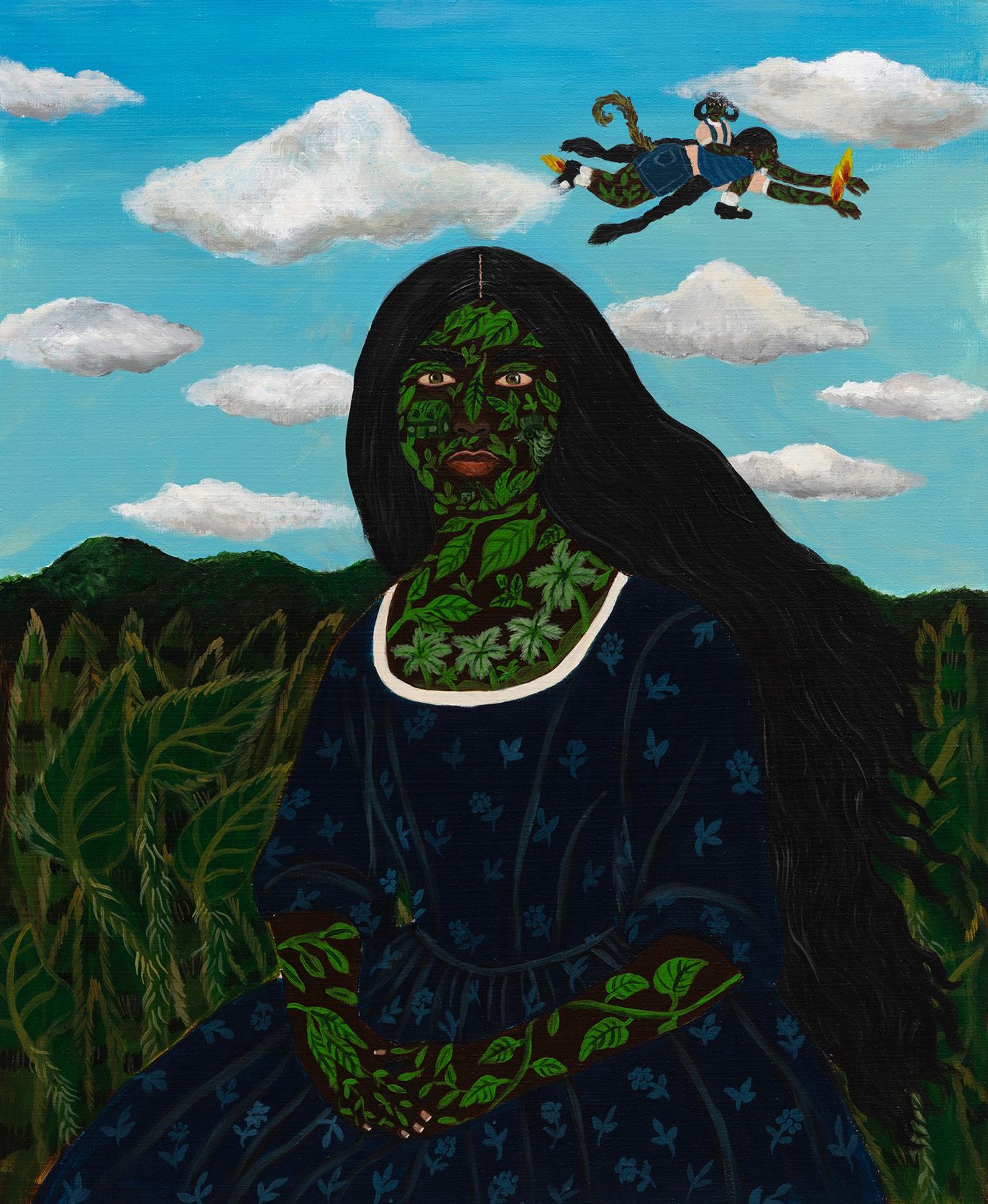
The Book of Violette: Hélène, 2025 Acrylic on canvas24 x 19 3/4 in61 x 50 cm © Kelly Sinnapah Mary 2025. Courtesy the artist and JamesCohan, New York.Photo by Nicolas Brasseur
Three Caribbean art practitioners reimagine human-nature relationships, countering colonial violence while creating embodied visual languages. Through plant metaphors and agro-ecology, they seek sovereignty and a renewed ethic of love for the Earth.
In her essay Malaise d’une civilisation (The Malaise of a Civilization), Suzanne Césaire evokes Martinican identity as “homme-plante” (human-plant). In an osmosis between the non-human and the human, the earth and the flesh, she establishes a Martinican ontology that finds its emancipation in its connection with its organic environment, far from doudouist perceptions. In 2020, the colonial and environmental injustices of the chlordecone scandal exploded, giving rise to anti-colonialist demonstrations, and the problem persists to this day. Mirroring this, in Martinique and Guadeloupe, conscientious agro-ecological initiatives are forming and gaining strength. We want food sovereignty and to re-anchor ourselves in ancestral practices that are beneficial to Earth. We want to move beyond a relationship conditioned by capitalist colonial violence to renew a relationship and a transformative politics of love, as theorized by Malcom Ferdinand in S'aimer la terre (Loving the Earth, 2024).
During my time in Martinique and Guadeloupe, I observed and discussed the creative impulse of local artists and members of civil society who are taking up the subject of the Anthropocene. In the last few years there have been several exhibition projects in Martinique such as Elise Fitte-Duval's “Être en Lieux Blessés” (Being in Wounded Places), Remèdes et poisons (Remedies and Poisons), the Homo Sargassum exhibition , as well asWelto and the Sacred Bushes in Berlin, Germany. In Guadeloupe there were projects by Guy Gabon and Minia Biabiany, as well as Anaïs Verspan’s Rimèd Razyé.
How do artists enable us to transform and rethink our relationship with living beings? How do they enable us to repair this relationship? Here, I pay tribute and express my deep respect to the people, particularly women, who are working to develop a renewed awareness of life on Earth. In this text, I focus on the work of Gwladys Gambie, Kelly Sinnapah Mary, and Tomeskä, three Caribbean practitioners who are paying attention to how we live on these islands. As bell hooks once wrote: we must “reclaim a spiritual legacy where we connect our well-being to the well-being of the earth”, it constitutes a “necessary dimension of healing.”
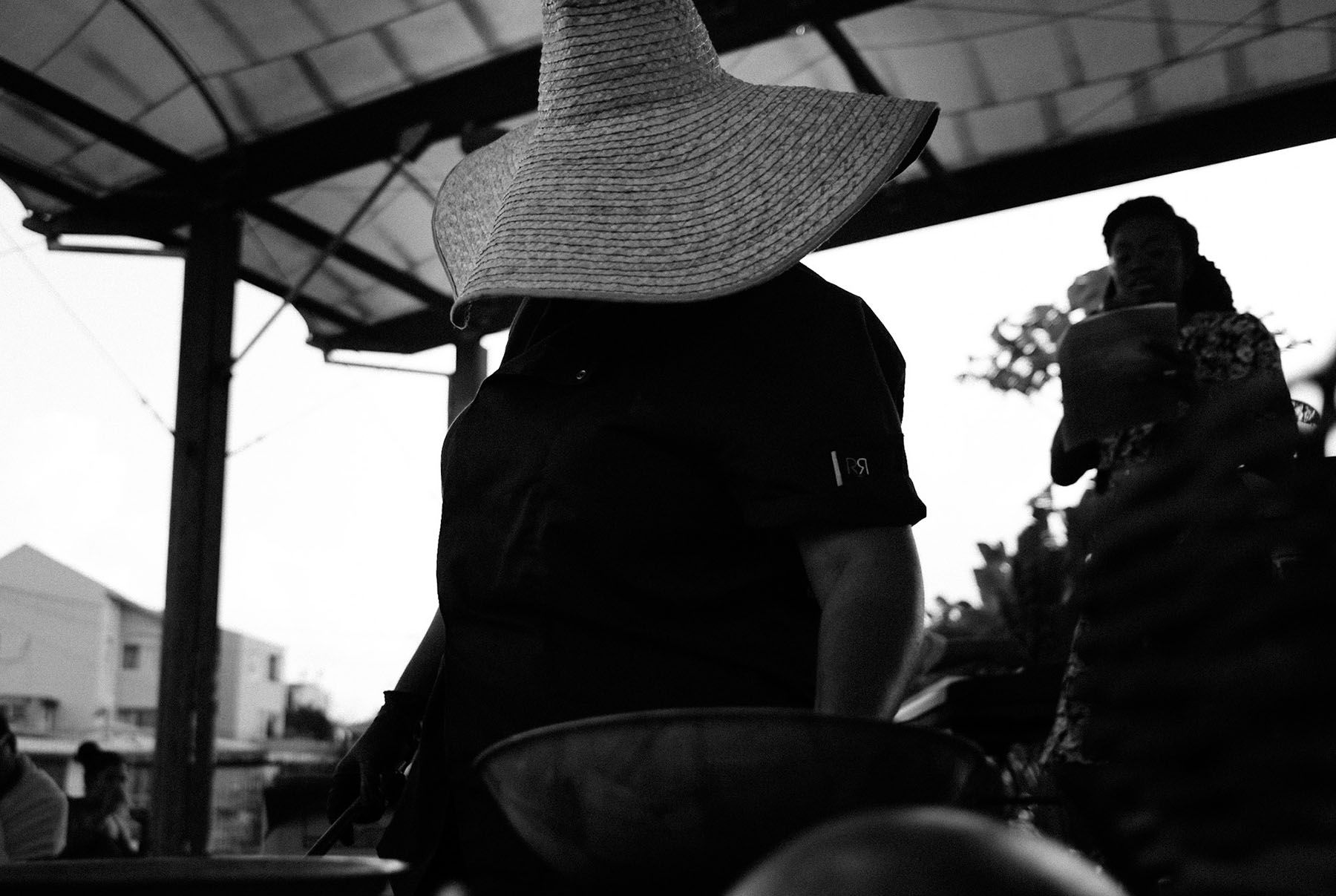
Tomeskä, Kannari experience at Labadijou Festival, 2025. Courtesy of the artist. Photo: Sentwòz.
Gwladys Gambie is a visual artist from Martinique, who works on the representation of Caribbean female bodies and coloniality. Through her new project on pyékoko (coconut palms), she explores, the memory the tree carries within it through hand-drawn or embroidered portraits. Long exoticized by the colonial gaze, it is taken up here as a motif—sometimes wounded, cut, thorny—as an iconic symbol, which she repositions as a witness to this colonial reality. By presenting it as the main character, she also reveals the close relationship that the population has with it, an infinite source of memories for all the children who grew up in the Antilles. These can include the grandfather who climbs up the tree and cuts the coconuts with a machete, the fresh coconut water, the rustling and shade of the fronds during a hurricane, the necessary presence.
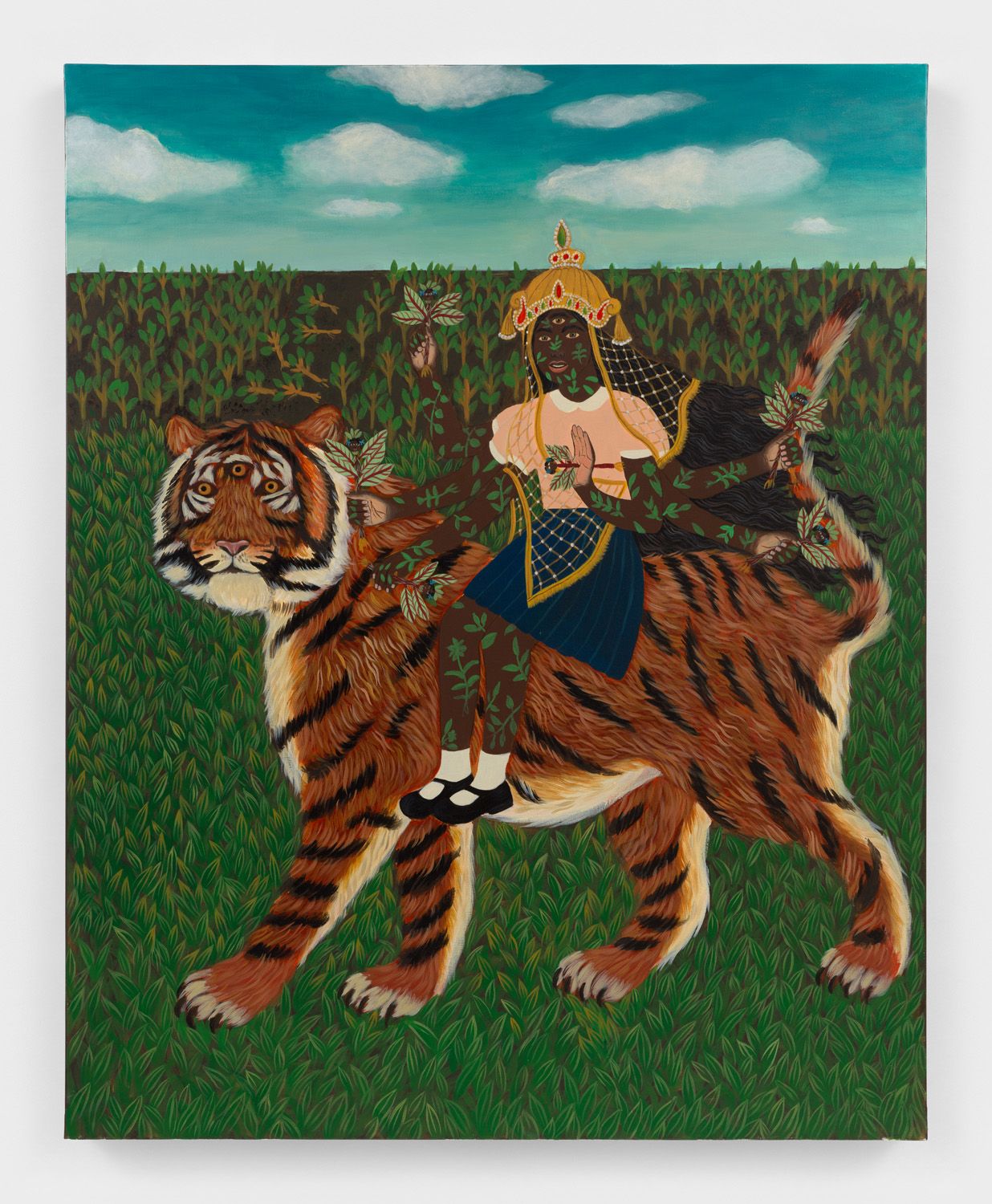
Kelly Sinnapah Mary is a Guadeloupean artist whose works narrate Indo-Caribbean memory through polymorphous characters and symbols. Plants—agents of the narrative—cover the body of the main figure. They are not just backdrops but characters in their own right, protectors, healing and camouflaging like balms that the Western gaze is unable to decipher, reminding us of an indestructible osmosis between the non-human and the human. The artist places the knowledge and power of medicinal plants, such as atoumo (shell ginger) and chadon beni (sawtooth coriander), at the center of her research, as they are indispensable plants in Caribbean culture. Drawing inspiration from authors such as Maryse Condé and Edouard Glissant, Mary creates her own eco-poetics under the symbol of the plant, transforming literature into a figurative aesthetic.
Rolland Pavilla, the late educator, artist, poet, and plant expert, expressed it this way: “gardening is an art, and it is almost more spiritual than painting”. The art of cultivation is a creative act in itself that is complementary to artistic work. With this in mind, I attended a performance by Tomeskä, in which she rethinks culinary design and heritage in Martinique. Informed by Maryse Condé’s book Victoire, les saveurs et les mots (Victoire: My Mother’s Mother, 2006), the performance combined literary, choreographic, and musical fragments, staged with the Labadijou festival troupe. It was a beautiful experience, where suddenly a cocktail turned blue thanks to the butterfly pea flower, or a cake placed on a banana leaf was adorned with edible flowers,offering us the opportunity to rediscover this heritage. Tomeskä is the leader and founder of Gangan Nikwa, an artistic and culinary practice that rethinks the socio-cultural relationship to food and living things through culinary designs, installations, and the creation of new recipes. She anchors her creations in anthropological research and is committed to self-determination and collective care through food, weaving together the story of ancestral memories.
About the author
Eva Shané Augustine
Raised in Martinique, Eva Shané Augustine (@evethealchemist) works between Paris and Martinique as a poet, curator, and cultural programmer. She is particularly interested in political ecology, metaphysics and perceives art as a transformative force for social change.
Feature
Archivo Honduras Cuir: The Art of Trans Life and Friendship in Central America
Iahra: Addressing Marine Ecology Through Industrial Materialities
The Convergence of African and Indian Lives in Kelly Sinnapah Mary’s Paintings
Feature
Transforming Memories of State Violence through Poetic Justice
Seed Archives: Celebrating African and Caribbean Design and Culture in London