The Convergence of African and Indian Lives in Kelly Sinnapah Mary’s Paintings
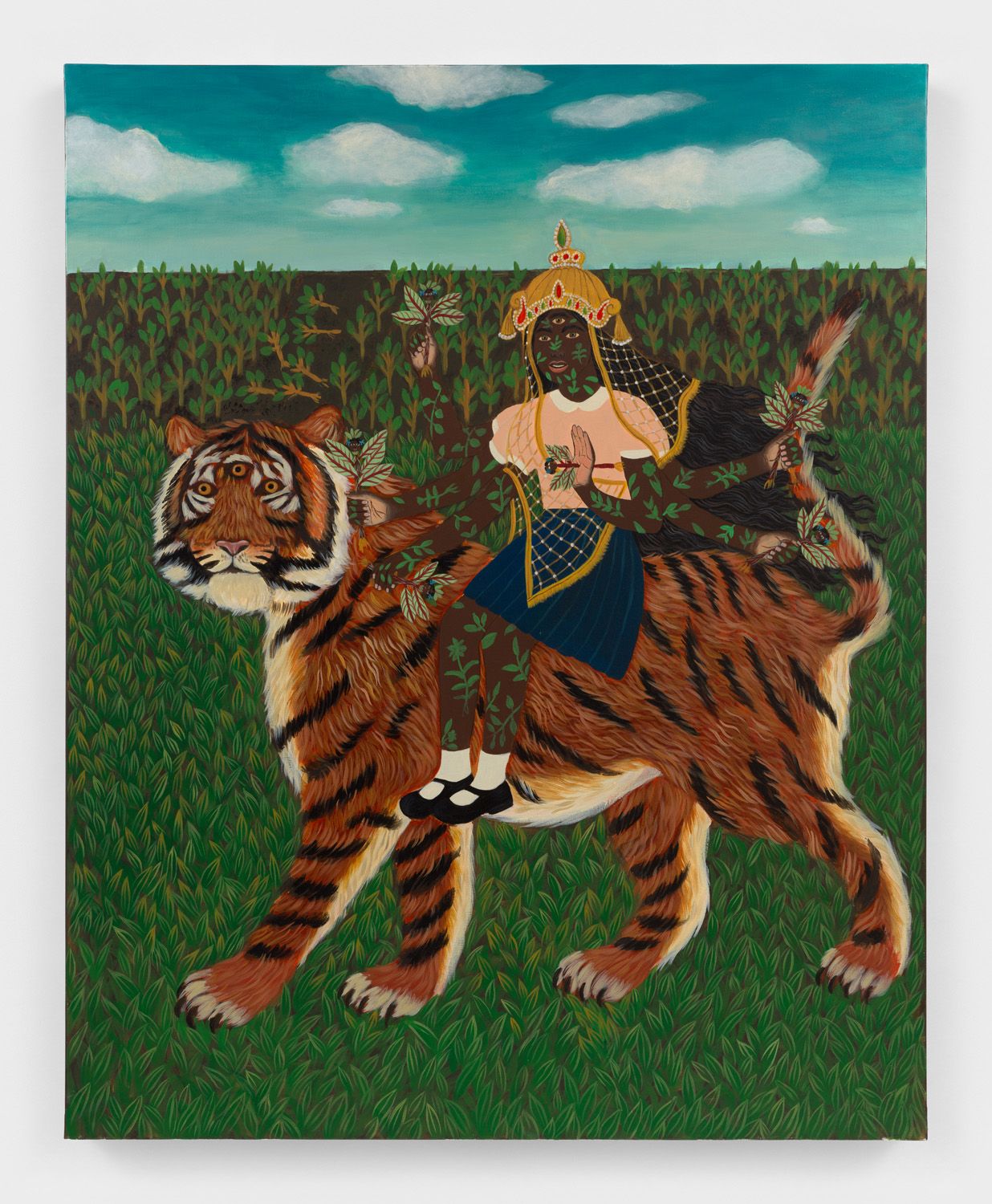
Kelly Sinnapah Mary, The Book of Violette: La Ballade, 2025. Acrylic on canvas 162 x 130 cm. Courtesy of the artist and James Cohan, New York. Photo: Dan Bradica Studio
Colonial powers have bound African and Indian lives to the same exploitative plantation system in the Caribbean, while engineering racial divisions. Guadeloupean artist Kelly Sinnapah Mary depicts these “complicated intimacies” by embodying the Caribbean experience of rupture and connection. [Read below a version of this article in Creole. | Zot pé touvé artik-tala an kréyol Matinik pa anba.]
When my paternal grandparents left Guyana for the United States, they placed my father and his brother in the care of my grandfather’s sister Clarice, an Indo-Guyanese woman with no children of her own. For my father, who is Dougla (or Batta in the French islands, denoting a person of African and Indian ancestry), his upbringing unfolded amid often unspoken but felt racial tensions between the different sides of his family. Such tensions are to be located in Guyana’s colonial history, as for example in the 1905 Ruimveldt Riots, where union protests unfolded amongst British colonial authorities’ divide-and-rule strategic use of Indo-Guyanese workers to replace striking Afro-Guyanese laborers. The riots exposed how exploiting racial divisions was a persistent and entrenched tactic in Guyanese plantation society.The way those politics bled into and strained my own familial relationships reveals both the difficulty (and necessity) of African and Indian entanglement throughout the region.
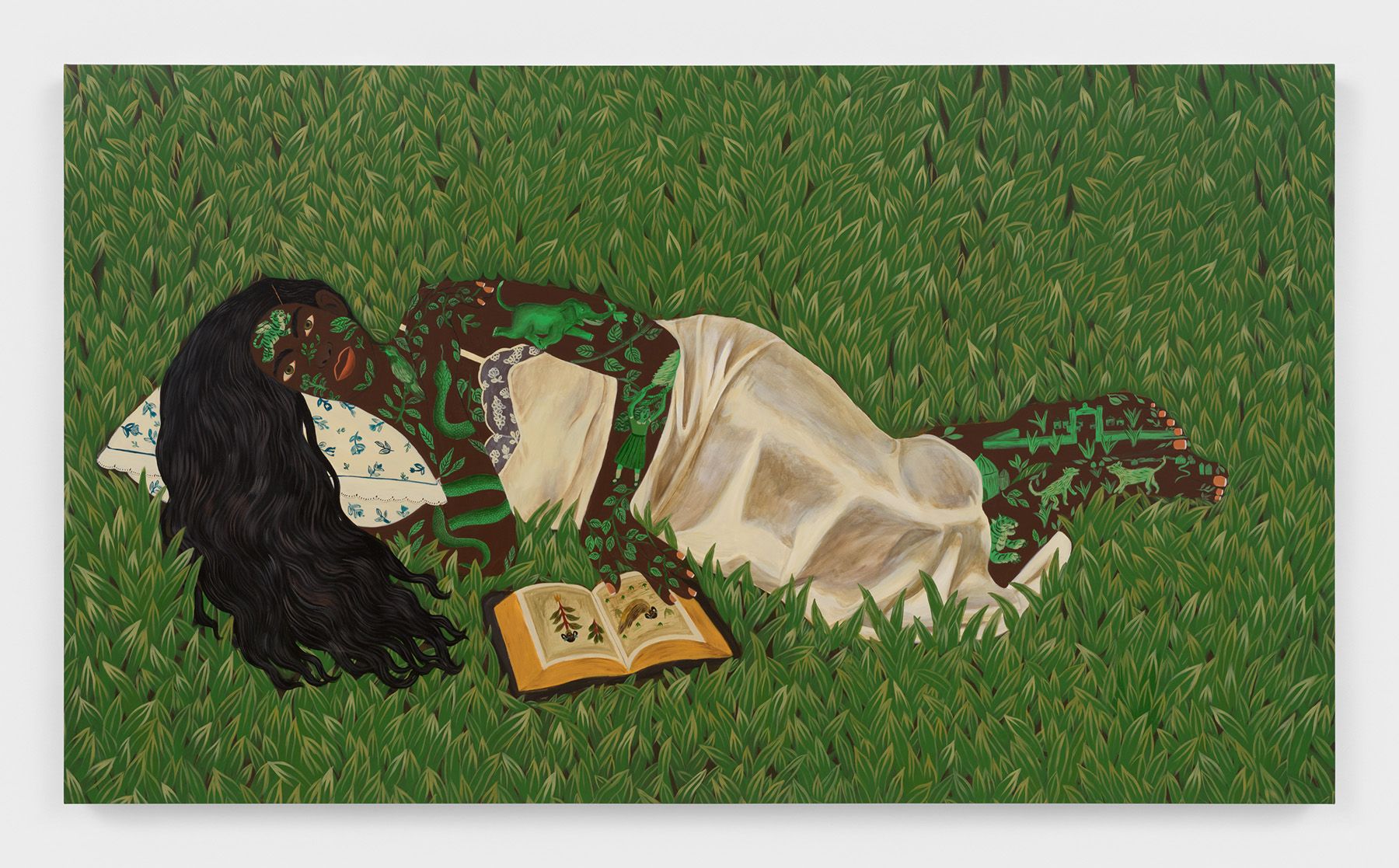
Kelly Sinnapah Mary, The Book of Violette: The Great Camouflage, 2025. Acrylic on canvas 198,1 x 340,4 cm. Courtesy of the artist and James Cohan, New York. Photo: Dan Bradica Studio
Despite what the tension may cause one to perceive, the lives of Indian and African people in the region are deeply connected to one another. After the abolition of slavery, Indian indentured laborers were brought to the Caribbean to replace formerly enslaved Africans on plantations. This new system tied African and Indian lives to the same exploitative system while systemically separating them by race. Many of these indentured workers landed first in Guyana before being dispersed to work strenuously and tirelessly on plantations throughout the Caribbean. In recognizing our past we too need to position the Caribbean not simply as a geographic region, but a convergence of peoples bound by these complicated intimacies.
It is within this context that the work of Guadeloupean artist Kelly Sinnapah Mary resonates so powerfully. Sinnapah Mary approaches Caribbean-ness not as a fixed inheritance but instead as an ongoing process reconstructed through both memory and imagination. Her art considers the entanglements of African, Indian, Indigenous, and European histories, exploring how the past continues to inform contemporary Caribbean life. For much of her life, Sinnapah Mary identified as Afro-Caribbean, only learning of her indentured Tamil heritage as an adult. The journey of this identity and realization is clear in her work and is perhaps a reminder that to be Caribbean is to hold all of it: Indigenous, African, Indian, Chinese and other histories alike. To understand that it is a shared pain of our past that we can only hold and heal from when we come together. Sinnapah Mary has drawn on Édouard Glissant’s concept of Tremblement (a refusal of fixed, imperial thought) as central to her practice, offering a way to build the self through relation without erasure.
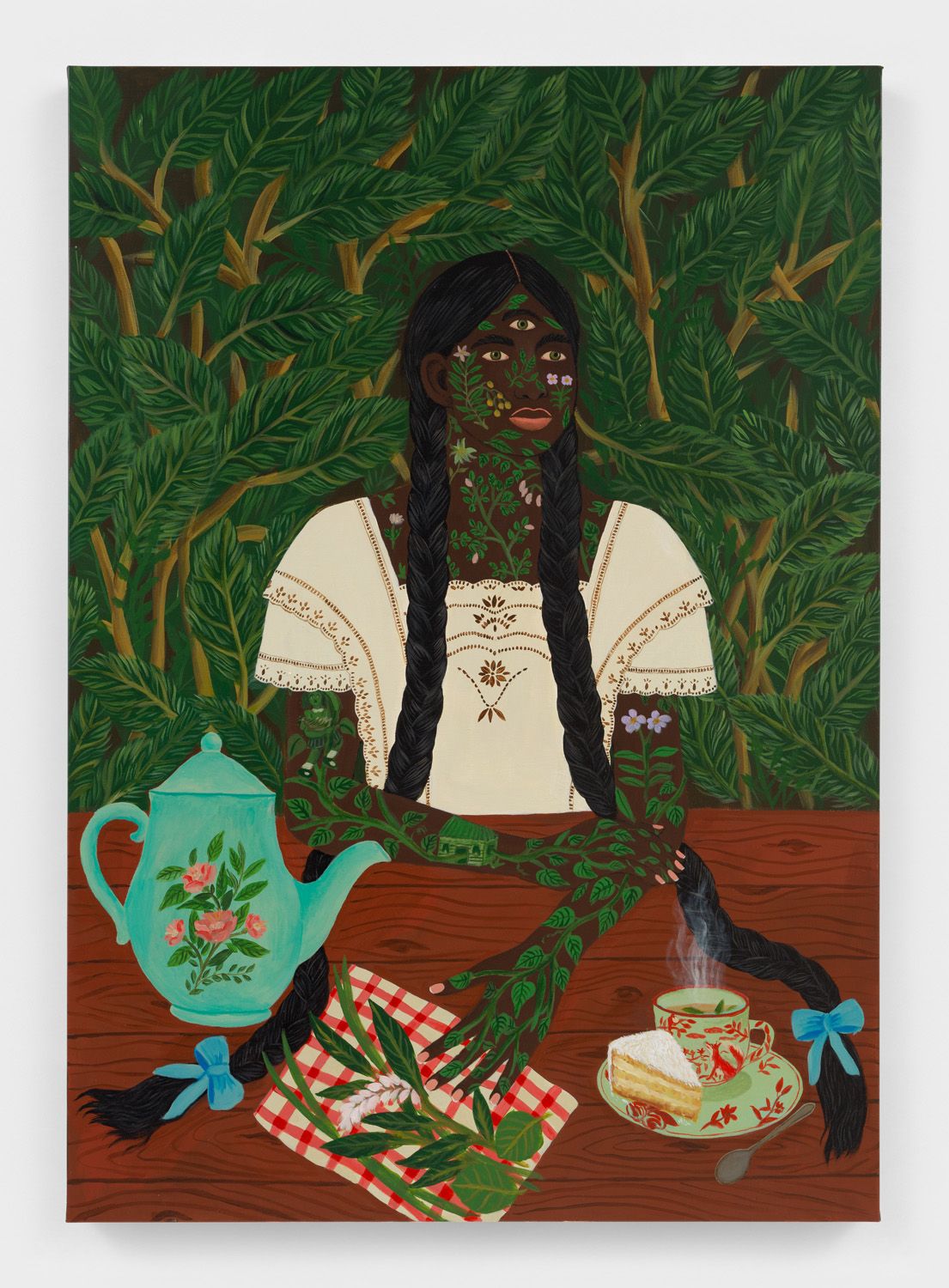
Kelly Sinnapah Mary, The Book of Violette: Man Yaya taught me about plants, 2025. Acrylic on canvas 162 x 114,3 cm. Courtesy of the artist and James Cohan, New York. Photo:Dan Bradica Studio
For all of us, our self-images up until the mid-20th century were often not our own, but rather reflections of European travelers’ perception of us as imperial subjects. Colonial imagery of East Indian indentured women throughout the Caribbean has them carefully posed and beautifully adorned in saris, namelessly labeled “East Indian girl” or “Coolie Girl”. Violette, the artist’s grandmother, recurs across the artist’s recent works with an intimate sense of ancestral authority. Through Violette, Sinnapah Mary reimagines Indo Caribbean female imagery, transforming them into figures of spiritual, emotional, and cultural power. These women, once erased or objectified in colonial records, are reanimated as carriers of memory and agents of resistance.
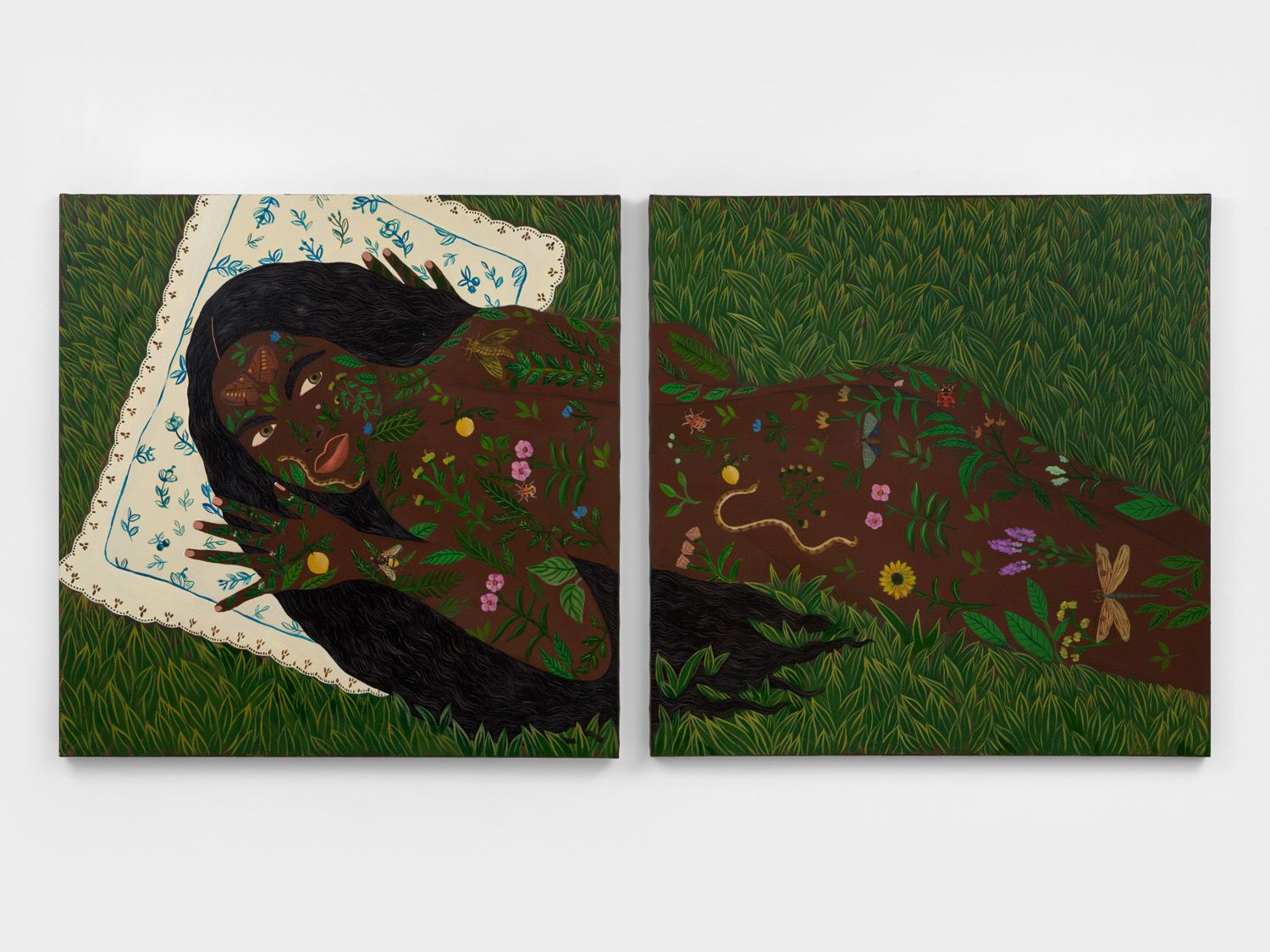
Kelly Sinnapah Mary, The Book of Violette: Invisible Vegetation of Desire, 2025. Acrylic on canvas 100 x 200 cm. Courtesy of the artist and James Cohan, New York. Photo: Dan Bradica Studio
The Book of Violette: Invisible Vegetation of Desire (2025) is a painting in which Violette’s body is etched with plants and insects, summoning the relationship to the natural world that shapes many Caribbean childhoods. The plants recall how African, Indian, and Indigenous communities transmit ecological knowledge in ways that exceed language and instead persist through embodied practice. The repetition of the “tattooed" flora across multiple images of Violette binds her visually and symbolically to the land, rendering her inseparable from it. The work is remnant of Latin American feminist invocations of cuerpos-territorios (bodies as territories), a decolonial framework drawing from grassroots Indigenous women where the body is a living terrain shaped by colonial histories, state violence, and resistance. Inseparable from struggles over land and sovereignty, through Violette we witness the body not merely situated within territory, but constituted by it.
In Man Yaya Taught Me About Plants (2025), Violette sits at a colonial high tea (a vestige of British imperial culture popular throughout the Caribbean) yet the third eye marked on her forehead invokes Hindu cosmology. When my mother encountered the image, she immediately read it as a reference to a “see far” person, someone in the Caribbean with the capacity to intuit, someone who may have been here before. In truth, like the Caribbean itself, it can hold all of these meanings at once. This layering of references from Hinduism to African spiritual systems; from Caribbean folklore to French fables creates a field of expressive possibility where the artist’s history, identity, and imagination converge. Sinnapah Mary’s work refuses immediate transparency, instead using the language of the Caribbean where identity is fluid, relational, and continually emerging.
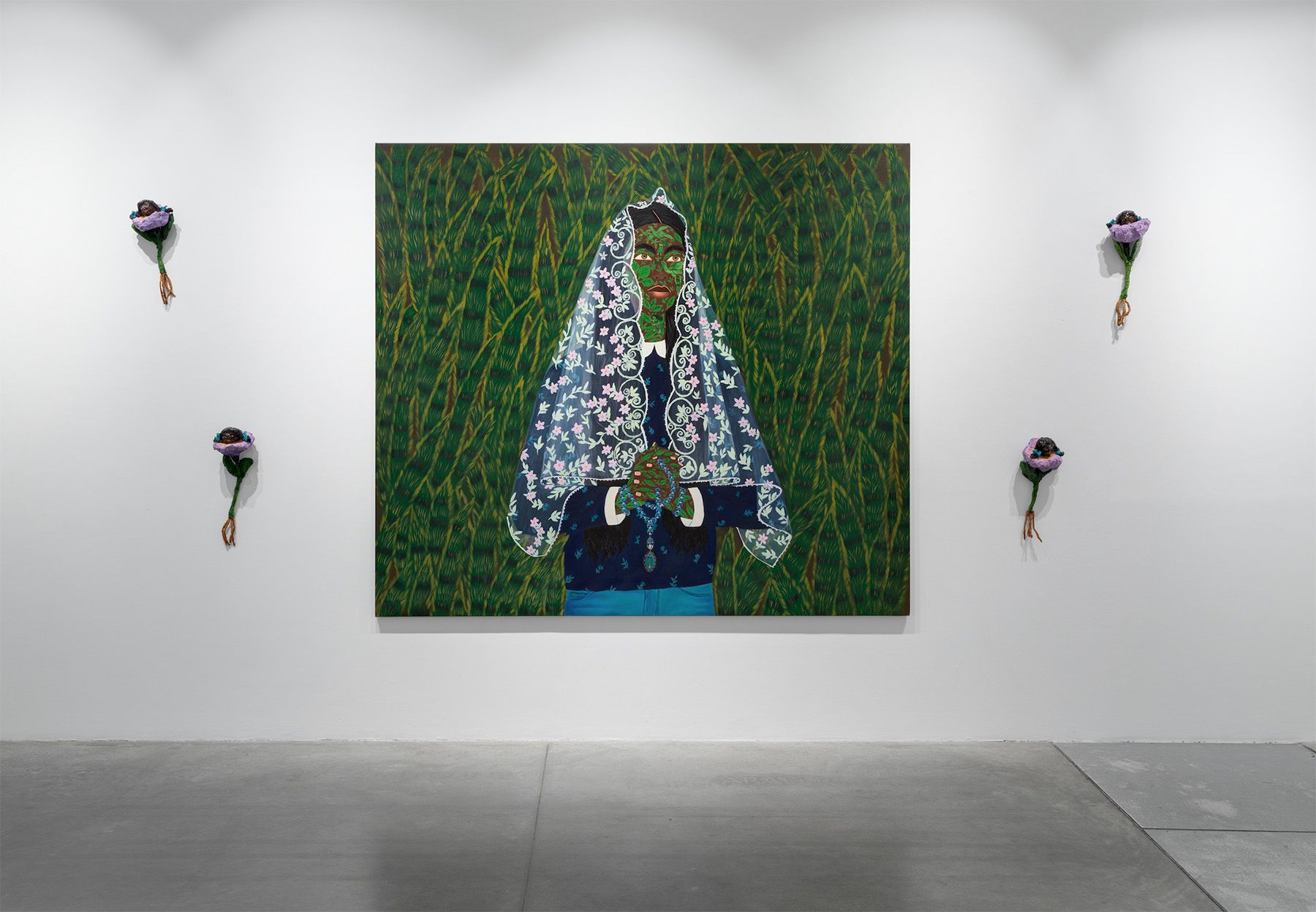
Installation view, Kelly Sinnapah Mary, Tout germe encore dans la nuit des terres, James Cohan, 43 Rue de Montmorency, Paris, France, October 20-26, 2025. Photo: Erin Brady – Dan Bradica Studio.
In the opening pages of Coolie Woman (2014), a book that traces the story of an indentured Indian woman, the author Gaiutra Bahadur writes that even when a language has been fractured or partially lost, we can still “wrap our tongues possessively around the world it expresses and implies.” I return to this when I think about the worlds these boats severed when carrying enslaved Africans across the Atlantic and later, indentured Indians across the kala pani to the Caribbean. Though their conditions and statuses differed, both journeys, marked by rupture, ultimately bound African and Indian peoples to the same plantations. With Kelly Sinnapah Mary’s work on my screen and my father's family in my mind, I am reminded that our shared point of departure is not simply loss, but also connection. Our forced and coerced movement scattered us across different islands, where we spoke different languages, and looked up towards different empires, yet it produced a people forever tethered beneath these differences. When we piece together our fragments, we are not assembling separate pasts but recognizing that we arrived, however differently, to the same Caribbean.
Creole Version: Lapenti Kelly Sinnapah Mary ka montré manniè lavi manmay l’Afrik ek manmay l’End suiv an menm chimen
Até la Karayib, sé gwo-mòdan kolonizatè-a lianné lavi moun l’Afrik kon lavi moun l’End adan an menm sistem pwofitasion asou bitasion, toupannan yo té ka mété doubout dé siparézon rasial ant yo. Kelly Sinnapah Mary, ki sé an awtis Gwadloup, ka mété sé “liannaj tjokanblok tala” douvan,lè i ka penn manniè la Karayib viv délala ek liannaj.
Lè gran-papa mwen épi gran-manman mwen koté papa kité Guiyana pou alé o Zétazini, yo kité papa-mwen épi frè’y ba Klaris, ki sé sésé gran-papa mwen — an guiyanez kouli ki pa té ni pies yich. Papa-mwen ki té Dougla (oben bata, kon yo ka di adan sé zil fransé a, pou palé di moun mélanjé neg épi kouli) vini gran adan an lanbians éti koulè lapo té an pwoblem, menm si moun pa té ka palé di sa, men nou, nou té ka bien santi’y jik adan fanmi-nou.
Sé pwoblem-tala ka pran chous-yo adan listwa kolonial Guiyana — kon gaoulé-a ki fet Ruimveldt an 1905, lè sendika té ka voyé labou, pas gouvènman kolonial l’Anglitè té ka ba ouvriyé kouli travay, pannan sé neg-la té ka fè grev; tousa pou monté yo yonn kont lot ek ba pep-la mwens fos. Sé gaoulé-tala ouvè zié moun asou manniè sé blan-an, dépi antan sosiété bitasion atè Guiyana, té ka chèché mété lorijin sé ouvriyé-a anmitan tout bagay, konsi sa té an pwoblem. E pou toutbon, sa rivé mété bon pwoblem adan fanmi-mwen, yonn té ka gadé lot gwo-zié, pas péyi-a pa rivé — menm si sa té nésésè — fè neg épi kouli migannen.
Magré sa sé kankan-tala sé pé fè moun konprann, lavi neg épi kouli, atè sé péyi-tala, lianné bon lianné. Apré labolision lestravay, yo mennen travayè kouli sou kontra adan zil la Karayib pou pran plas sé Afritjen-an ki té djouk asou sé bitasion-an. Nouvo sistem-tala té ka mété lavi sé Afritjen-an ek ta sé Kouli-a anba an mem larel pwofitasion, mem si yo té séparé silon lorijin-yo. Sé dabò atè Guiyana anlo travayè sou kontra débatjé, ek apré sa, yo simayé yo asou bitasion adan tout la Karayib pou djoubaké red. Lè nou ka ouvè zié-nou asou listwa-nou, nou dakò pou di la Karayib sé an bannzil, men fok nou wè’y osi kon an koté éti dives pep rivé pou viv an menm model lavi tjokanblok ki lianné yo.
Sé adan konteks-tala, travay Kelly Sinnapah Mary, ki sé an awtis Gwadloup, ka montré tout fos-li. Pou Sinnapah Mary lidantité manmay la Karayib sé pa an matjoukann doubout dwet-pitjet, sé an lidantité ki ka brennen, ki ka vansé, ki ka mofwazé silon sa lamémwa ek limajinasion ka pòté. Travay-li a ka dékatiyé migannaj l’Afrik, l’End, l’Ewop épi sé prèmié pep-la,pou montré migannaj-tala ka kontinié ba nou lendik asou lavi la Karayib jòdijou. Pannan yonn-dé lanné, Sinnapah Mary té ka wè koy kon an désandan l’Afrik atè la Karayib; sé selman lè i vini an gran-moun, yo palé’y di matjoukann tamoul li a.
Adan tablo’y, nou pé bien wè chimen i fè pou batjé adan pwop lidantité’y ek konprann li — lè ou sé an manmay la Karayib, ou pa pou kité ayen asou koté : ni listwa sé prèmié pep-la, ni listwa l’Afrik, l’End, la Chin épi ta tout sé lézot-la.
Fok konprann listwa-nou anchouké adan an doulè ki menm-parey ba nou tout la, ek pou djéri’y fok konprann ki moun nou yé pou toulbon. Pou tout travay-li a, Sinnapah Mary apiyé asou sa Edouard Glissant kriyé “Temblement” — kivédi pa ni an sel manniè pansé ki ka mennen — sa ki ka ba’w an chans konstwui kow adan an liannaj yonn-a-lot san bliyé pèsonn.
Pou nou tout la, jik nan mitan XXem siek-la, pòtré nou té pé jwenn pou montré sa nou ka sanm pa té ta nou, mé pito ta sé vwayajè éwopéyen an, pas nou té anba jouk-yo.Asou foto oben désen, sé kolon-an té ka montré sé kouli sou kontra a, bien ganmé, épi tout sari-yo mé san ba non-yo sof « Fille de l’Inde orientale » oben « Fille coolie ». Nou pé wè Violet, ki sé gran-manman awtis-la, asou anpil tablo i fè pa ni si lontan di sa ; nou pé wè’y épi tout djokté gangan’y miganné épi an manniè viv ki ta’y. Gras a Violet, Sinnapah Mary ka ba an lot limaj di sé fanm kouli a adan la Karayib, i ka ba yo an fos lespri, an fos lémosion épi an fos adan kilti-a. Fok di sé madanm-tala ki té kon dé pòpot adan lé archiv kolonial, ka viré-pran an bel kanman, davwè yo ka transmet ek palantjé sa ki fet avan.
Le Livre de Violette : Végétation invisible du désir (2025) sé an tablo éti tout lapo Violet matjé épi plant ek ti-bet, pou fè nou sonjé manniè lavi timanmay la Karayib lianné épi lanati. Sé plant-lan ka fè nou sonjé manniè pep l’Afrik, l’End oben sé zil-la kité mes laliwonnay yo ba nou, pa selman épi mo, mé osi épi jes ki ka kontinié viv. Tout sé flè-tala ki penn anlè lapo Violet la, tablo apré tablo, ka lianné’y épi latè, kon si i ka fè yonn épi’y. Sé an bel senbol. Travay-tala ka fè nou sonjé lapriyè pou sé cuerpos-territorios la (sé kò-a kon dé mòso tè) fanm atè l’Amérik latin ka fè, pou défann dwa fanm – dapré an fondas dékolonial ki ka vini di sé prémié fanm-lan ki fè prèmié katjilasion-tala; kò-a ka riprézanté an mòso tè vivan ki mofwazé épi listwa kolonial, violans sé gouvènman-an, épi rézistans. Pas tousa lianné épi gaoulé ki fet pou trapé tè ek dominé pep, nou ka bien wè, pou Violet, kò-a pa selman anchouké adan an té, i sé tè-a.
Adan Man Yaya m’a appris les plantes(2025), Violet asiz pou an High tea kolonial, ki sé an mes moun l’Anglitè ni ek kité adan tout la Karayib anglé pou lapéti enpérializm kiltirel yo a— mé an mem balan-an Violet ni an twaziem zié anmitan fwon’y ki ka fè nou sonjémanniè lavi ka woulé adan le mond ba sé Endou-a. Lè manman-mwen wè imaj-tala, lamenm i di sé té an potré pou montré an moun ki ka wè ladivini, an moun atè la Karayib ki ka fè séyans oben ki pétet ja vini isi-a an jou. A bien gadé, imaj-tala pé ni tout sé sans-tala an mem tan ek la Karayib pé sanblé tout sé sans-tala tou. Tout sé tras-tala — ki rélijion endou, ki kwayans l’Afrik, ki matjoukann la Karayib, ki fab la Frans — tousa ka fè an lablanni posibilité éti listwa, lidantité ek limajinasion awtis-la ka migannen.Travay Sinnapah Mary pa ka anni di sa i ni pou di an manniè blip; i ka palé palé la Karayib, la éti lidantité ka woulé an manniè flouz, ka woulé adan an manniè viv yonn-a-lot, yonn épi lot, ek ka viré-envanté koy chak lè.
Coolie Woman (2014), sé liv Gaiutra Bahadur ki ka palé di lavi an madanm kouli sou kontra. Adan sé prèmié paj liv-li a, Gaiutra Bahadur ka esplitjé “lè an lang an chèpi oben lè disparet pres pran’y, nou pé kontinié di sé ta nou ek konprann tout lavi-a ki ka alé épi’y la”.
Mwen ka viré-katjilé asou sé pawol-tala, lè mwen ka sonjé manniè sé bato-a dépotjolé tout lavi neg l’Afrik, lè yo fè yo janbé l’Atlantik pou djouké yo, menm manniè, pli ta,yo dépotjolé tout lavi sé Kouli-a, lè yo fè yo janbékala pani pou rivé adan la Karayib. Abo sé té dé sitiyasion bien diféran, sé dé transbòdaj-tala — ki mété yo tou lé dé an délala — lianné sé neg l’Afrik, kon sé Kouli-a ki sòti ann End , épi sé menm bitasion-an. Epi travay Kelly Sinnapah Mary asou ékran-an anba zié-mwen épi lavi fanmi papa-mwen an tet-mwen, mwen ka sonjé sa ki ka fè nou ka sanm : sé pa manniè tousa koumansé, kivédi manniè nou ped kònou, mé sé osi bokantaj-la nou té blijé fè a. Déplasman-tala, nou pa chwézi fè’y, yo simayé nou asou pliziè zil, éti nou té ka palé lang diféran ek nou té ka lonviyé dé péyi kolonizatè diféran — mé magré sé diférans-tala, tousa mété doubout an pep lianné pou toujou. Lè nou ka mété kantékant sa nou chak-la ka riprézanté a, sé pa mòso listwa séparé nou ka mété: nou blijé admet sé atè la Karayib nou tout la rivé, ek ni an sel Karayib…pa ni dé.
Kai Trotz-Motayne wè jou Tkaronto/Toronto . I ka fè wouchach ek ka matjé liv. I ka touvé lidé sé liv-li a adan manniè diféran moun la Karayib élivé’y.
Kelly Sinnapah Mary ni an kanman ki ta’y. i ka miganné lapenti, skilti épi montaj. Travay-li ka voyé douvan liannaj ant matjoukann, litérati, épi lanati toupannan i ka chèché dé répons asou léritaj kolonial épipwoblem laliwonnay jòdijou.
Translation: Marie-Josée Desnel
About the author
Kai Trotz-Motayne
Kai Trotz-Motayne is a Guyanese-Canadian researcher and writer from Tkaronto/Toronto, whose work takes inspiration from the many Caribbean people that raised her.
Feature
Archivo Honduras Cuir: The Art of Trans Life and Friendship in Central America
Iahra: Addressing Marine Ecology Through Industrial Materialities
Transforming Memories of State Violence through Poetic Justice
Feature
Seed Archives: Celebrating African and Caribbean Design and Culture in London
Manuel Tzoc: Art as Embodied and Relational Poetry