Manuel Tzoc: Art as Embodied and Relational Poetry
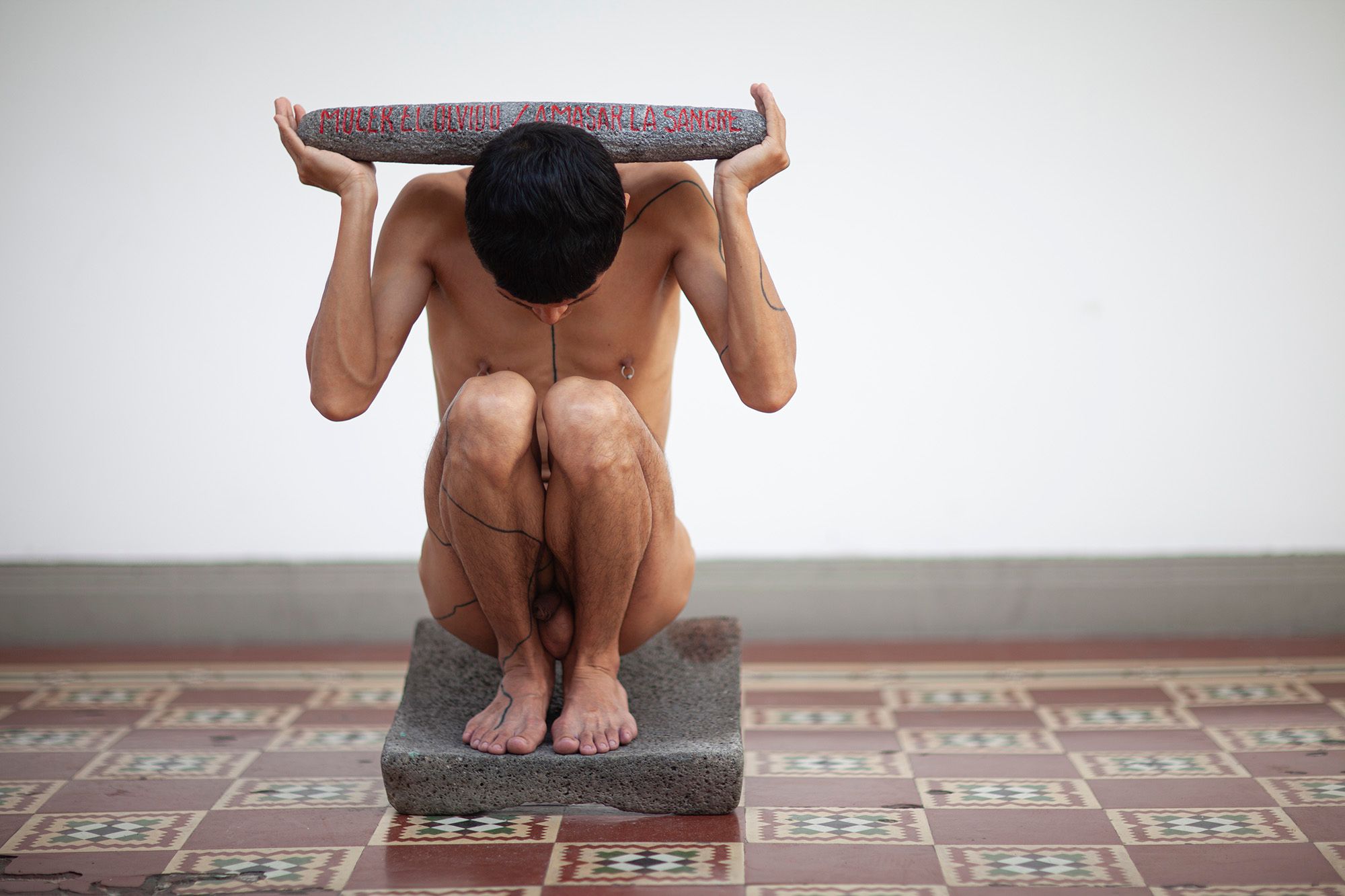
Manuel Tzoc, Moler el olvido / Amasar la sangre, 2021. Photo: Sandra Sebastian. Courtesy of the artist.
25 February 2026
Magazine América Latina
Words Alejandro Ortiz López
Translation Jess Oliveira
6 min read
In the Guatemalan artist’s practice, art moves beyond individual authorship to center communal and ancestral processes that shape Indigenous and cuir experiences.
What kinds of relationships emerge when poetry is made with the body? In Manuel Tzoc’s work, this question unfolds through a performative practice that understands corporeality as a space of encounter extending beyond the artist and those who witness his performances. It is within the processual dimension of his work that an articulation is woven between physical presence, objects imbued with memory, and a historical context marked by colonial violence.
In our conversation in Guatemala City in December 2025, the artist told me that, from the very conception of his proposals, he envisions bodily images in which he integrates delirium, reverie, and lucidity as forms of opposition to the country’s heteropatriarchal and racist narrative. Through these kinds of scenes, he activates a search for historical wounds and reimagines his own body as a poetic tool capable of interrogating, for instance, which identities matter and which have been systematically excluded from the official narrative, as is the case with Indigenous lives in Guatemala.
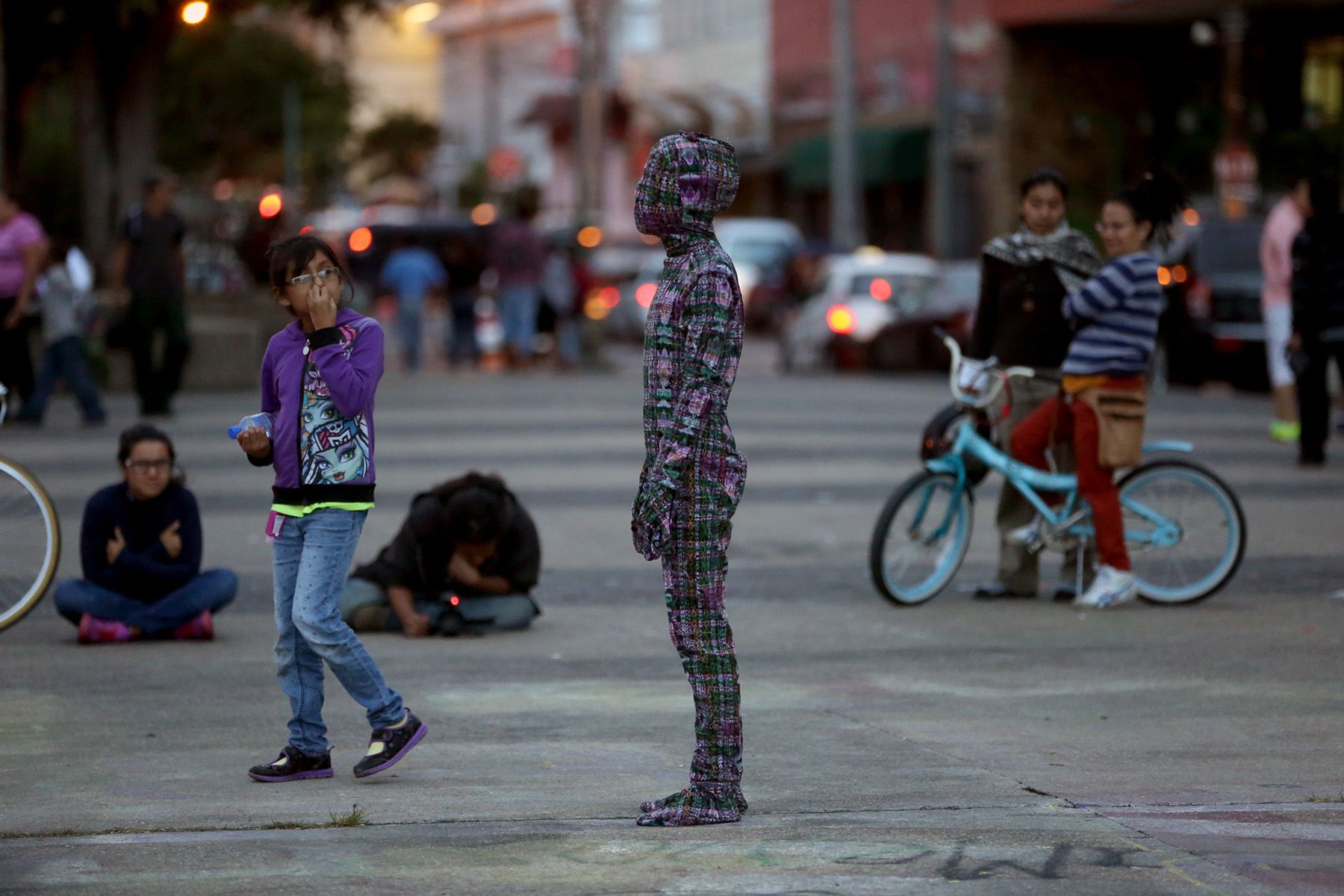
Manuel Tzoc, activation of the performance Piel in Guatemala City. Photo: Esteban Biba. Courtesy of the artist.
The interruption of consciousness constitutes one of the central inquiries of Manuel’s performative work. His pieces in this format revolve aroud the concepts of origin, wound, memory, and racism. Drawing on these themes, which are linked to pain and human power, the artist creates images with his own body in order to render such categories visible and to resignify them. In doing so, he proposes a reconfiguration of historical trauma that encompasses his Indigenous and cuir experience. As Tzoc states: “The poet’s work is in constant search of the wound, but also of emotional restorarion and healing.”
This poetic repair of the wound can already be identified in Tzoc’s early performances, such as Piel and Memoria en blanco (both from 2016). In these works, he is interested in the relationship between affective memory and historical pain, developing actions that engage remembrance while activating the corporeality of his mother and father. In 2016, he presented the first of these performances in front of the Palacio Nacional de la Cultura, in Guatelama City, the site from which state power was exercised and which was implicated in several genocides against the Maya population, particularly the Ixil* people. In Piel, the artist wears a garment that fully covers his body, made from a marbled fabric used by Micaela Bucup, his mother. The fabric against Manuel’s flesh activates a ritual in which his body, totally wrapped in maternal memory, inscribes itself affectively before a building where colonial state power was consolidated. The work thus proposes a restorative image. Despite the historical violence inflicted upon Indigenous communities in Guatemala, Tzoc’s body conjures a visual anachronism as it positions itself before a structure haunted by the specter of genocide perpetrators.
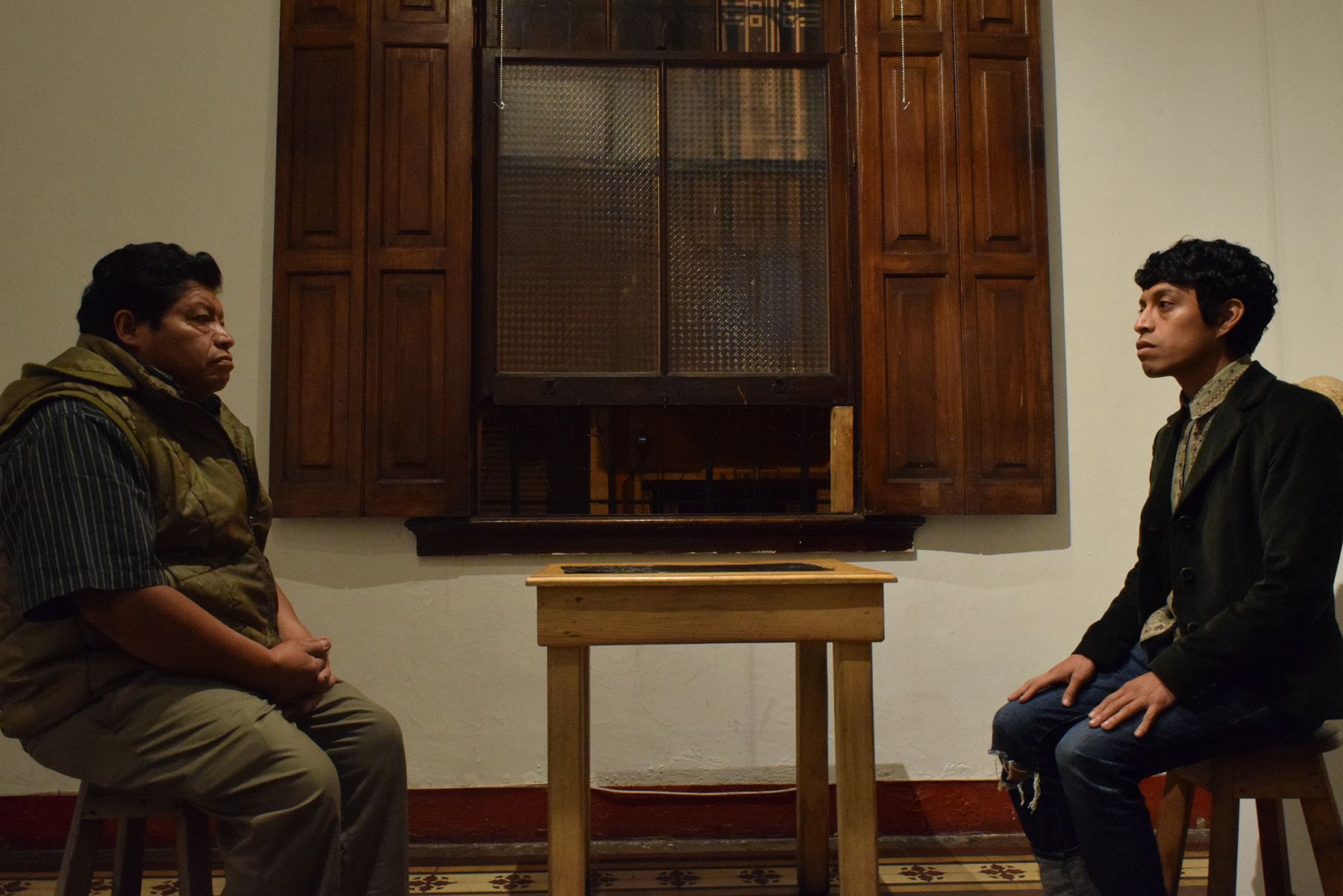
Manuel Tzoc, presentation of Memoria en blanco, 2016. Photo: Fabrizio Quemé. Courtesy of the artist.
In Memoria en blanco, Manuel invites his father, Gerónimo Ricardo Tzoc Puac, to imagine another form of communication by submitting himself to an uncomfortable yet liberating exercise. Performed publicly at the Proyecto Poporopo gallery, the piece places father and son face to face, seated in silence. The ritual unfolds as they sift through their memories in order to encounter one another in the past, moving from tender, everyday scenes to more problematic and violent episodes in their relationship. The artist askes his father to revisit specific moments like the night he arrived home with a bloodied face, the hug he gave Manuel upon learning that his son was gay; the time he returned home intoxicated, among others. Through this gesture, both unsettle and reconfigure the affective communication between their bodies.
Beyond the co-constructon of performance with other corporealities, Tzoc’s practice deepens through reflection on the complexity of bodies within the territorialities of the Americas. La refundación de Abya Yala (2016), presented in Guatemala and Chile in collaboration with artist Rodrigo Arenas-Cartes, stages an encounter grounded in K’iche’ and Mapuche experiences. The performance mobilizes elements from these communities alongside gestures in which both performers traverse, soil, and share their bodies. Through this act, they reconfigure the political, erotic, and sexual cartography of Abya Yala. After tearing apart an old map of the Americas, they take off their Western clothing to reveal Indigenous garments. They then trace, in ink on each other’s skin, a map of Abya Yala, culminating in the friction of their penises combined with mud made from K’iche’ and Mapuche soil, which proposes a carnal bridge.
Other forms of material relationships emerge in Tzoc’s work. Moler el olvido / Amasar la sangre (2021), for instance, is a performance in which the performer stands on a maize-grindind board, while holding a stone roller inscribed with the phrase that gives the action its title. This gesture positions the stone as an ancestral element while reclaiming the artist’s surname, “Tzoc,” whose root derives from the K’iche’ verb tzok'ï'k’, referring to the “act of carving or chipping stone.”
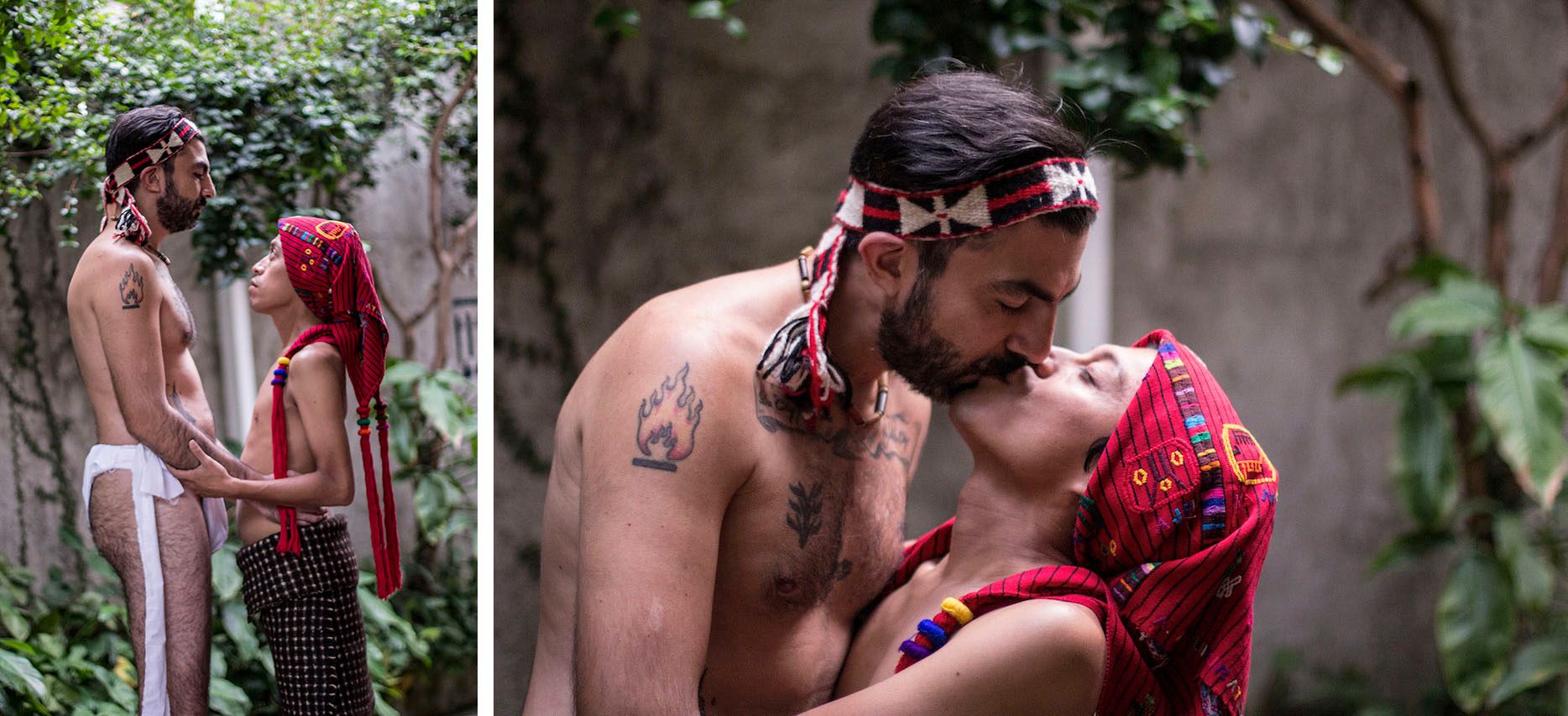
Manuel Tzoc, La refundación de Abya Yala, 2016. Photo: Lilo Euler Coy. Courtesy of the artist.
In dialoue with other forms of knowledge, the artist’s performative practice further expands through collaboration with artisans, such as embroiderers. In Desatando a Gucumatz (2024), Tzoc gathered woven belts (pas) belonging to women in his family. Joined together, these pieces emulate an enormous umbilical cord, with the title of the work embroidered along its length. For Tzoc, the creation process of this piece was symbolic in the reciprocity between the technical knowledge of the weavers and the artist’s subjective craft. This process can be understood in light of what educator Paulo Freire called a “dialogical construction,” in which knowledge is not deposited hierarchically but built in relation. Knowledge emerges through dialogue, not from the power of one over another.
For Manuel Tzoc, whose artistic work began in written poetry, the move toward performance became another way of inhabiting his physical presence. After a decade immersed in this practice in relation to other experiences, lives, and objects, performance has also become a mode of communication in which poetic images function as voices capable of articulating what has not yet been historically assimilated, particularly the Indigenous and cuir experiences embodied in his trajectory. Through his relational proposals, Tzoc dismantles the notion that a work of art belongs to a single individual. Instead, he reveals a living and complex process in which multiple bodies and identities enter into dialogue, alongside communal and ancestral processes that precede the very foundation of his work.
* José Efraín Ríos Montt was a military officer and head of state of Guatemala between 1982 and 1983. In 2013, he was convicted of genocide and crimes against humanity.
About the author
Alejandro Ortiz López
His work encompasses cultural research and the development of curatorial exercises, with an interest in constructing narratives about identity, territory, dissidence, and practices of imagination in Guatemala.
Feature
Archivo Honduras Cuir: The Art of Trans Life and Friendship in Central America
Iahra: Addressing Marine Ecology Through Industrial Materialities
The Convergence of African and Indian Lives in Kelly Sinnapah Mary’s Paintings
Feature
Transforming Memories of State Violence through Poetic Justice
Seed Archives: Celebrating African and Caribbean Design and Culture in London