Iahra: Addressing Marine Ecology Through Industrial Materialities
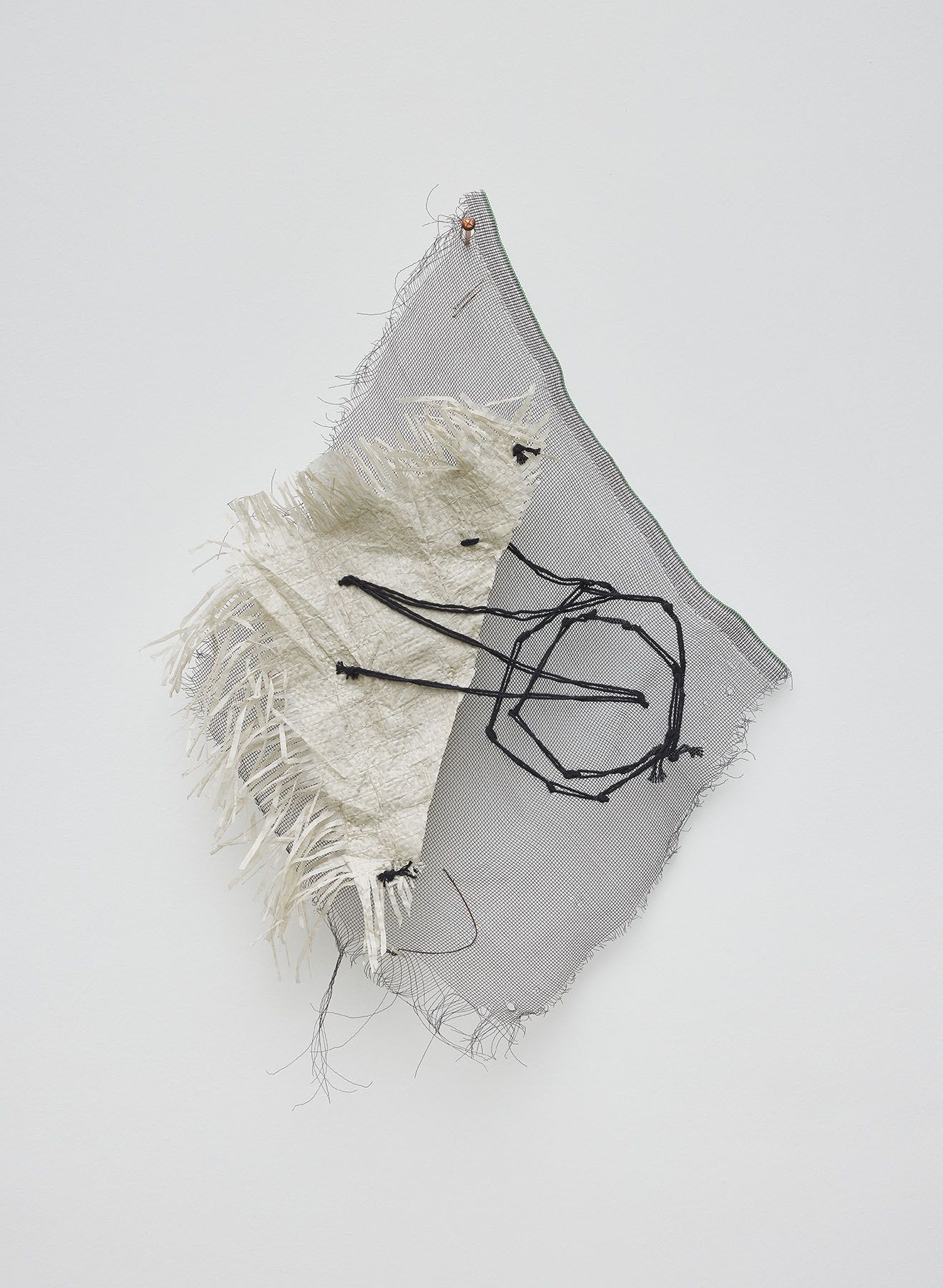
Iahra, Map for Diving, 2022. Raffia, canvas, cotton thread, 57 x 43 cm. Photo: Rafael Salim
In her artistic practice, the Brazilian artist creates works that explore the forms of stingrays and aquatic topologies. Formally, her work engages with Neo-Concretism, foregrounding the experience of space. By using deteriorated industrial materials, Iahra critiques the promises of progress while constructing ecological fictions.
One late afternoon, Iahra welcomed me into her Rio de Janeiro studio, which occupies almost an entire floor of a concrete building that once housed a printing shop. The view draws the eye across the landscape of Rio's North Zone, with its industrial buildings, mountains, and communities. Iahra wears a tie-dye, Spiderman-print T-shirt and a plastic face shield, while the smell of metal welding permeates the room. Among other things, she tells me about her interest in stingrays, the diversity of species inhabiting the Guanabara Bay, and her idea of the winged creature as an ancestor of humans in the sea.
The form of the stingray appears in the series Outras Frequências (2019-), a site-specific piece that begins on the wall, with overlapping sheets of kraft paper, folded along sewn lines, and then expands in scale, breaking with the frontality of the plane and takes on three-dimensional space through suspension. In Três Folhas (2025) three ray-like forms measuring nearly three meters each occupy the space. Since this work, which is part of the same series that was later added to the collection of the Pinacoteca de São Paulo, the artist’s interest in creating environments that could be described here as fictionally-situated aquatic topologies has intensified. The idea of topology implies that space ceases to be a three-dimensional void to be filled and instead becomes a special type of space: a place defined by the relationship between bodies, an environment where situations emerge.
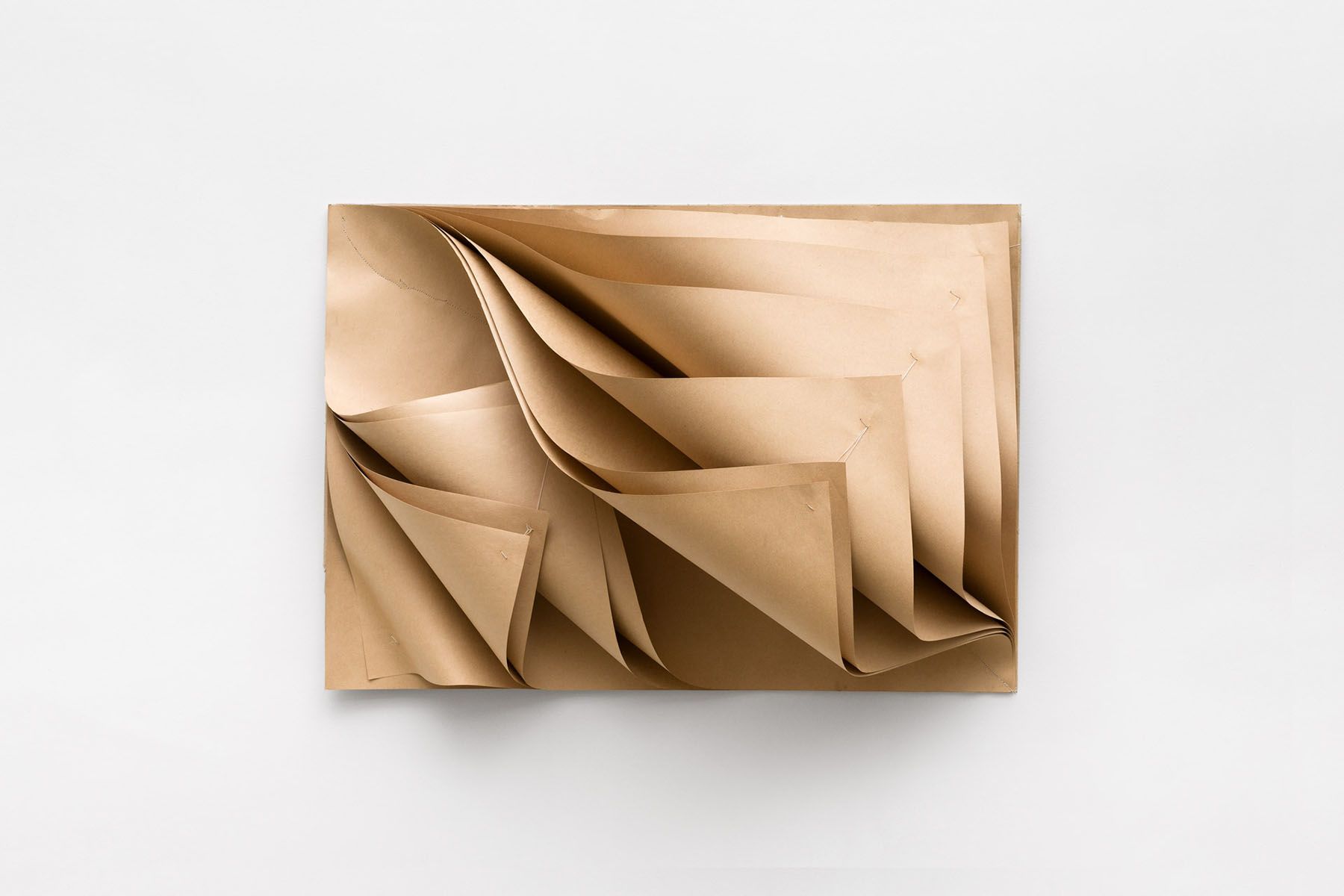
Iahra, Reflection, from the serie Outras Frequências, 2022. Kraft paper, thread sewing technique, 120 x 32 x 100 cm. Courtesy of Pivô Estúdio.
This shift from the flat plane toward multidimensional space finds parallels in debates within the history of twentieth-century Brazilian art. A special type of object emerges from abandoning the surface in favor of space, as Ferreira Gullar notes in the text Teoria do Não-objeto (1959). By breaking with the formalism of Concrete art—the movement that emphasized abstract geometry and whose legacy traces back to Constructivism—artists such as Antônio Dias, Lygia Clark, and Hélio Oiticica reoriented the art object toward experience. In doing so, they proposed a more active relationship between forms, bodies, and space. Iahra’s work engages with these questions without simply stipulating them as continuities. It points to what the author describes as an “eruption of worlds”. Within this framework, her practice unfolds through continuous operations of “folding” and the “metamorphosis” of objects and surfaces, which frequently lead to speculative fictions, or divinations, around non-human worlds and imagined temporalities. Using industrial materials and the forms of marine animals, her work connects the fictional field to contemporary ecological issues.
In Quando a Guanabara sobrepor o aterro (2023), Iahra travels through the center of Rio de Janeiro to Solar dos Abacaxis, where a capsule-shaped glass sculpture suspended by iron rods is activated by being filled with water from the territory surrounding the gallery. The performance-sculpture projects an imminent future, marked by rising sea levels and the likely flooding of these areas. The fictional element, which projects a future timeline, and the factual element, which echoes scientific predictions related to the emergence of the New Climatic Regime, bring the work closer to a work of dystopian science fiction.
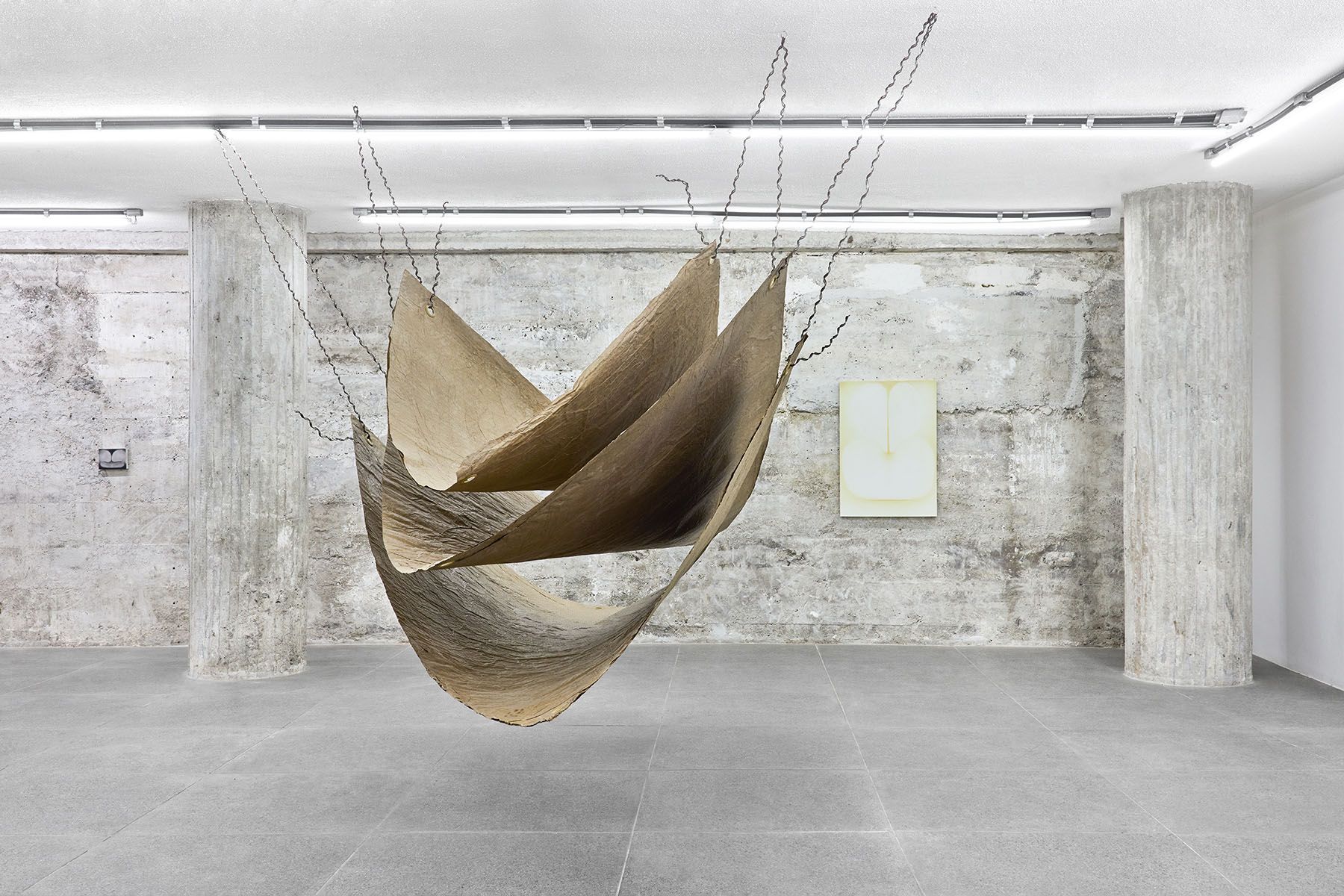
Iahra, Três Folhas (Three Pages), from the serie Outras Frequências, 2023. Kraft paper, metal thread, grommets, resin, variable dimensions. Courtesy of ORA Art 028
In this sense, Iahra's work can also be interpreted as an uncertain cartography toward the ocean floor—as the title of the drawing Mapa para mergulho (2022)suggests—where hegemonic notions of the art object, surface and space dissolve along the trajectory of a diver’s descent. Perhaps that is precisely why dots and lines, which conventionally constitute a surface, appear in her drawings as fragile structures. This also extends to her handling of materials. Twisted iron, broken car parts, torn tarps, and shredded fabrics form objects of unstable construction, symbolically associated with the vestiges of industrial production systems. These are materials, generally gathered, that become expressive by highlighting flaws in the promises of progress made by civilizational projects. When mobilized by the artist, they begin to tell stories about the territories from here.
Iahra is part of the group exhibition Solar Apex, on view at MAC Niterói through June 7, 2026.
About the author
Guilherme Ferreira
Guilherme Ferreira (Rio de Janeiro, 1996) is a researcher with a master’s pursuing his doctorate in Communications and Culture from the University of Rio de Janeiro where he studies Contemporary Art and Ecological Thought. He is a member of the Anthropocene Commons research network and a visiting scholar at the Bauhaus University in Weimar. He also works as a designer, writer, educator, independent curator and member of the Brazilian artist collective Acta.
Chavis Mármol: Thinking Manually in the Age of Artificial Intelligence
Archivo Honduras Cuir: The Art of Trans Life and Friendship in Central America
The Convergence of African and Indian Lives in Kelly Sinnapah Mary’s Paintings
Transforming Memories of State Violence through Poetic Justice
Seed Archives: Celebrating African and Caribbean Design and Culture in London